
What is Nvidia?
NVIDIA is a semiconductor company that designs graphics processing units (GPUs), AI accelerators, networking hardware, and software platforms that power modern artificial intelligence systems. Founded in 1993, the company originally focused on gaming graphics but has evolved into the backbone of the AI industry. Today, Nvidia’s hardware is used by leading AI companies, cloud providers, research institutions, and enterprises worldwide to train and deploy large language models. The company’s success is not based solely on hardware performance. Its software ecosystem, particularly CUDA, has created a powerful platform that developers rely on for AI development. As a result, Nvidia has become one of the most influential technology companies in the world and a critical player in the global AI infrastructure market.
Why Nvidia Is the Most Important Company in the AI Race
The rapid growth of artificial intelligence has made Nvidia one of the most important companies in the technology sector. Training advanced AI models requires enormous computing power, and Nvidia’s GPUs have become the industry standard for handling these workloads. Industry estimates suggest the company controls roughly 80% to 90% of the AI accelerator market, giving it a dominant position in AI infrastructure. Beyond hardware, Nvidia offers a complete ecosystem that includes CUDA software, networking solutions, AI libraries, and optimized frameworks. This integrated approach allows organizations to build AI systems faster and more efficiently. As AI adoption expands across healthcare, finance, manufacturing, and cloud computing, Nvidia remains at the center of the global AI race because it provides the tools that make large-scale AI possible.
The Main Reasons Companies Want Alternatives to Nvidia
Despite Nvidia’s leadership, many organizations are actively searching for alternatives. One major reason is cost. High demand for Nvidia GPUs has pushed prices upward, making AI infrastructure expensive for businesses and cloud providers. Supply constraints have also created challenges, forcing companies to wait months for certain AI chips. Another concern is vendor dependency. Many organizations worry about becoming too reliant on a single supplier for critical computing resources. In addition, competitors are offering specialized hardware designed to improve efficiency for specific AI workloads such as inference. As AI spending continues to rise, businesses are evaluating alternative solutions that can reduce costs, improve availability, and provide greater flexibility while still delivering competitive performance for machine learning applications.
How Big Tech Companies Are Challenging Nvidia
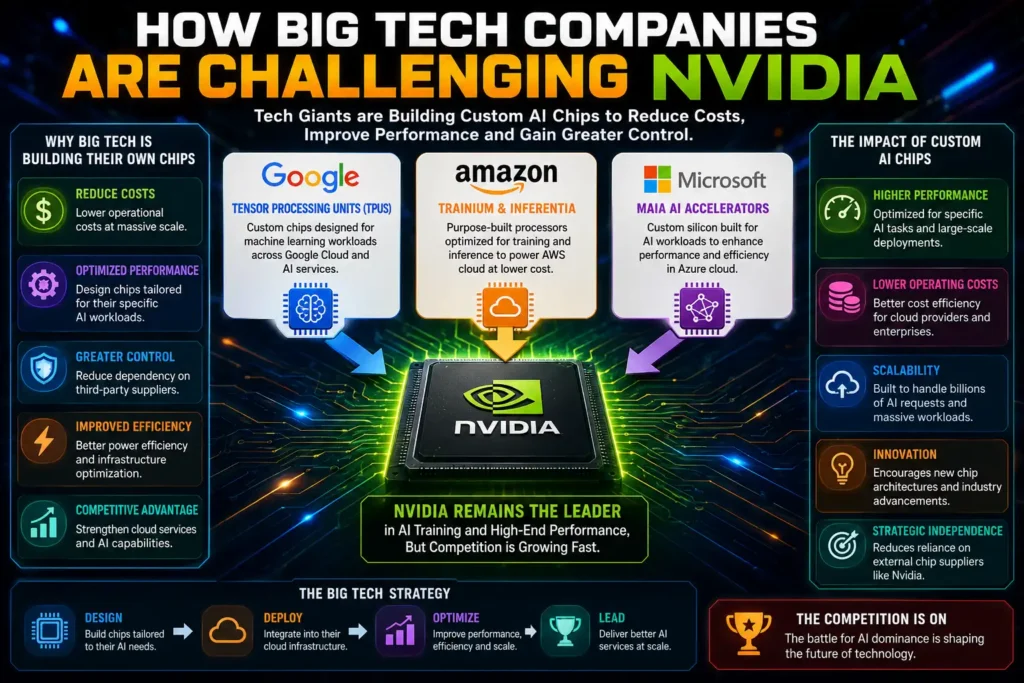
Some of the biggest technology companies in the world are attempting to reduce their dependence on Nvidia by developing custom AI chips. Google has expanded its Tensor Processing Units (TPUs), Amazon has invested heavily in Trainium and Inferentia processors, while Microsoft has introduced its Maia AI accelerators. These companies operate massive cloud platforms and process enormous AI workloads every day. By creating their own silicon, they can optimize performance, lower operational costs, and gain greater control over their infrastructure. Although Nvidia remains the preferred choice for many advanced AI training tasks, custom chips are becoming increasingly important for inference and cloud-based AI services. This trend signals that competition in the AI hardware market is expanding beyond traditional semiconductor companies and into the broader cloud ecosystem.
AMD’s Battle to Become Nvidia’s Biggest Rival
AMD has emerged as Nvidia’s strongest direct competitor in the AI accelerator market. The company’s Instinct MI300 and newer AI-focused GPUs have gained attention for offering competitive performance and attractive pricing. AMD’s strategy focuses on providing organizations with a viable alternative that can reduce infrastructure costs while maintaining strong AI capabilities. The company has also invested heavily in ROCm, its software platform designed to compete with Nvidia’s CUDA ecosystem. Although AMD still trails Nvidia in market share and developer adoption, it has made significant progress in AI inference and data center deployments. Many analysts view AMD as the company most capable of challenging Nvidia’s dominance because it combines advanced hardware engineering with a growing software ecosystem and strong relationships across the technology industry.
Intel’s Efforts to Reclaim a Position in AI Hardware
Intel is also working to strengthen its position in the AI hardware market after falling behind Nvidia and AMD. The company has introduced its Gaudi accelerator family as a lower-cost alternative for AI workloads and continues investing in AI-focused chip development. Under renewed leadership, Intel is emphasizing efficiency, affordability, and tighter integration between hardware and software. However, the company faces significant challenges. NVIDIA’s software ecosystem remains deeply entrenched, while AMD has gained momentum as the primary alternative in the AI accelerator space. Intel must not only deliver competitive hardware performance but also improve developer adoption and software support. While its market share remains relatively small today, Intel’s manufacturing capabilities and long-term investments could help it become a more influential player in the evolving AI infrastructure landscape.
The Rise of Custom AI Chips and ASICs
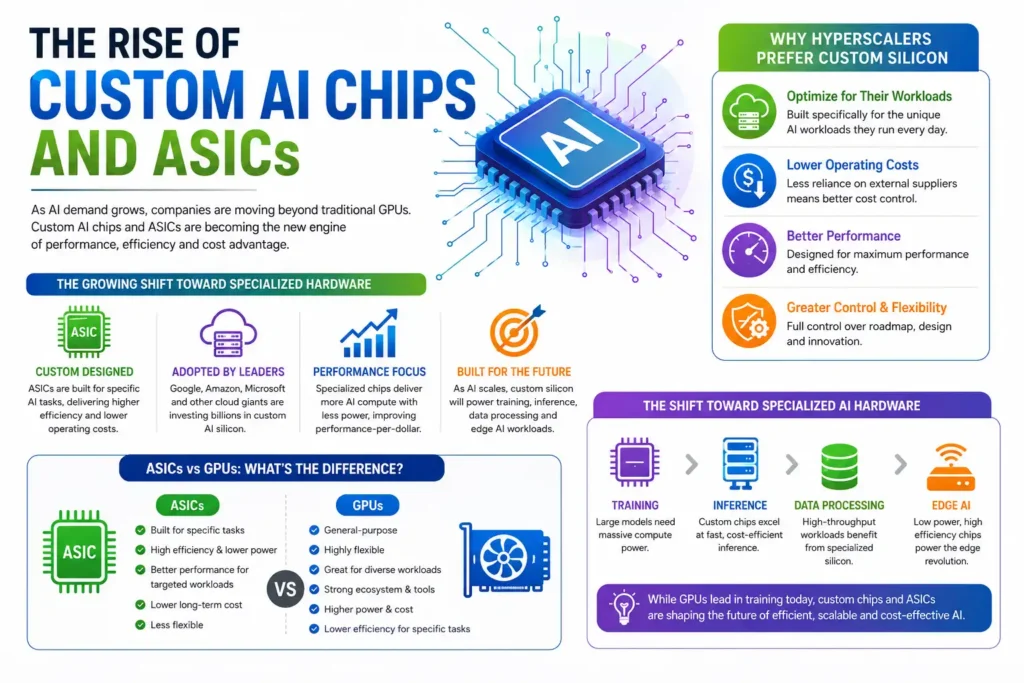
As demand for artificial intelligence continues to grow, companies are increasingly exploring alternatives to traditional GPUs. One of the biggest trends shaping the industry is the rise of custom AI chips and Application-Specific Integrated Circuits (ASICs). Unlike general-purpose processors, these chips are designed for specific AI workloads, allowing them to deliver higher efficiency and lower operating costs. Major cloud providers, including Google, Amazon, and Microsoft, are investing heavily in custom silicon to power their AI services. This shift reflects a broader industry movement toward specialized computing. While Nvidia remains dominant in AI training, custom chips are becoming increasingly attractive for inference, data processing, and large-scale cloud deployments where performance efficiency matters most.
What Makes ASICs Different from GPUs?
ASICs are chips built to perform specific tasks with maximum efficiency, while GPUs are designed to handle a wide range of parallel computing workloads. This specialization allows ASICs to achieve better power efficiency and lower operational costs for targeted AI applications. Because they focus on a narrow set of functions, ASICs often deliver faster performance for certain workloads. However, GPUs remain more flexible, making them suitable for diverse AI training and research environments.
Why Hyperscalers Prefer Custom Silicon
Hyperscalers such as Google, Amazon, and Microsoft operate enormous cloud infrastructures that process billions of AI requests daily. Building custom silicon allows them to optimize hardware specifically for their workloads, reducing dependency on third-party suppliers. Custom chips can lower operating costs, improve energy efficiency, and provide better control over performance optimization. As AI demand grows, these advantages become increasingly valuable for large-scale cloud providers seeking long-term competitive benefits.
💚 You might also like: Pasonet :- Smart & Flexible Digital Networking Platform
Performance-Per-Dollar Advantages
One of the biggest reasons companies invest in custom AI chips is improved performance per dollar. Specialized hardware can deliver more AI computations while consuming less power than general-purpose alternatives. This efficiency becomes especially important at scale, where even small improvements can save millions of dollars annually. For cloud providers and enterprise AI operators, achieving better cost efficiency can significantly improve profitability while supporting larger AI workloads.
The Shift Toward Specialized AI Hardware
The AI industry is gradually moving from general-purpose computing toward specialized hardware designed for specific workloads. Training, inference, recommendation systems, and edge AI applications each have unique performance requirements. As a result, companies are developing processors tailored to these tasks rather than relying solely on traditional GPUs. While Nvidia continues to dominate high-end AI training, specialized hardware is expected to play a growing role in the future of artificial intelligence infrastructure.
Startups Trying to Disrupt Nvidia’s Dominance
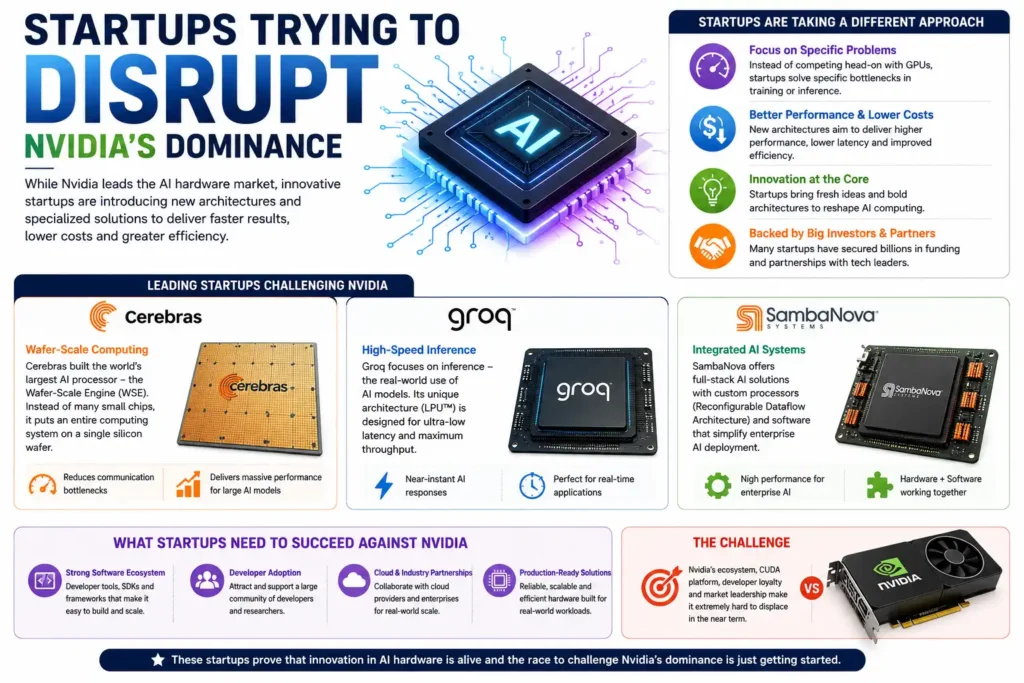
While major technology companies develop their own AI chips, several startups are attempting to challenge Nvidia through innovative hardware architectures. These companies believe there is still room for disruption in a market largely controlled by one player. Rather than competing directly on GPU design, many startups focus on solving specific performance bottlenecks in AI training and inference. Their goal is to deliver faster results, lower costs, and improved efficiency for enterprise customers. Although competing against Nvidia is extremely difficult due to its ecosystem advantages, growing AI demand has created opportunities for new entrants. Some startups have already attracted billions of dollars in investment and partnerships from major technology companies.
Cerebras and Wafer-Scale Computing
Cerebras has gained industry attention through its Wafer-Scale Engine, one of the largest AI processors ever built. Instead of dividing workloads across multiple smaller chips, Cerebras places an entire computing system on a single silicon wafer. This approach reduces communication bottlenecks and improves processing speed for large AI models. The company positions its technology as a solution for organizations requiring massive computing power for advanced AI research and model training.
Groq’s High-Speed Inference Approach
Groq focuses primarily on AI inference, the process of running trained models in real-world applications. The company has developed a unique architecture designed to minimize latency and maximize response speed. This makes Groq particularly attractive for applications that require near-instant AI outputs. By concentrating on inference rather than training, Groq aims to carve out a niche where specialized performance can outperform traditional GPU-based solutions.
SambaNova and Other Emerging Players
SambaNova is another startup seeking to challenge established AI hardware providers through integrated AI systems and specialized processors. The company offers hardware and software solutions designed to simplify enterprise AI deployment. Other emerging players, including Tenstorrent and d-Matrix, are also exploring new architectures focused on efficiency and scalability. These startups demonstrate that innovation in AI hardware remains active despite Nvidia’s dominant market position.
What Startups Need to Succeed Against Nvidia
For startups to compete effectively, they must offer more than just faster hardware. Success requires a complete ecosystem that includes software tools, developer support, cloud partnerships, and production-ready infrastructure. NVIDIA’s greatest strength lies not only in its chips but also in its extensive platform. Startups that can solve specific customer challenges while building strong software ecosystems have the best chance of gaining meaningful market share in the rapidly expanding AI industry.
NVIDIA’s Biggest Competitive Advantages Still Remain
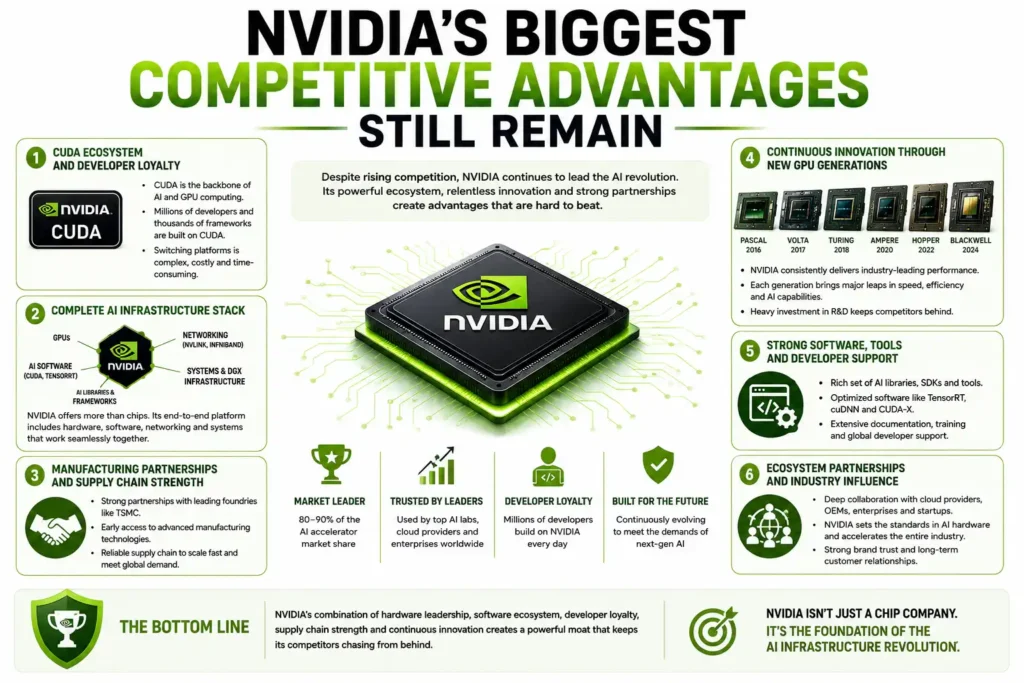
Despite growing competition from tech giants, startups, and custom chip developers, Nvidia continues to maintain significant advantages. The company has spent decades building a comprehensive ecosystem that extends far beyond hardware. Its leadership in AI is supported by software platforms, networking technologies, developer tools, and strategic manufacturing partnerships. These advantages create high barriers to entry for competitors and make switching platforms difficult for customers. Even organizations developing alternative solutions often continue using Nvidia products for critical AI workloads.
CUDA Ecosystem and Developer Loyalty
CUDA remains Nvidia’s most powerful competitive advantage. Over the years, millions of developers have built AI applications, frameworks, and tools using CUDA-based software. This extensive ecosystem creates strong loyalty and makes migration to competing platforms challenging. Even when alternative hardware offers competitive performance, many organizations remain committed to Nvidia because of the time, expertise, and resources already invested in the CUDA environment.
Software, Networking, and AI Infrastructure Stack
NVIDIA has evolved beyond a chip manufacturer into a full AI infrastructure provider. Its portfolio includes AI software libraries, networking technologies, high-speed interconnects, and enterprise deployment platforms. This integrated stack allows organizations to build, train, and deploy AI systems more efficiently. Competitors may match Nvidia’s hardware performance, but replicating its complete infrastructure ecosystem remains a far greater challenge.
Manufacturing Partnerships and Supply Chain Strength
Strong relationships with manufacturing partners play a crucial role in Nvidia’s success. The company works closely with leading semiconductor foundries and supply chain partners to secure advanced production capacity. These partnerships help Nvidia scale rapidly to meet growing AI demand. In a market where chip availability often determines success, supply chain strength provides a significant competitive advantage over many rivals.
Continuous Innovation Through New GPU Generations
NVIDIA consistently invests billions of dollars in research and development to maintain its technology leadership. The company regularly introduces new GPU architectures that deliver significant improvements in performance, efficiency, and AI capabilities. This continuous innovation cycle helps Nvidia stay ahead of competitors and meet the increasing demands of next-generation AI models. As AI workloads become more complex, ongoing hardware advancements will remain a key driver of Nvidia’s market leadership.
Frequently Asked Questions
Why is Nvidia so important for AI?
NVIDIA is important for AI because its GPUs provide the massive parallel processing power needed to train and run advanced artificial intelligence models. The company also offers a complete ecosystem that includes CUDA software, AI libraries, networking solutions, and cloud infrastructure support. This combination has made Nvidia the preferred platform for AI developers, enterprises, research institutions, and cloud providers worldwide.
Who are Nvidia’s biggest competitors?
NVIDIA faces competition from several companies across different segments of the AI hardware market. AMD is currently its strongest direct rival in GPUs, while Intel continues investing in AI accelerators. Major cloud providers such as Google, Amazon, and Microsoft are developing custom AI chips. Startups like Cerebras, Groq, and SambaNova are also introducing innovative technologies designed to challenge Nvidia’s market leadership.
Is AMD a serious threat to Nvidia?
AMD is widely considered the most significant traditional competitor to Nvidia. Its Instinct AI accelerators have gained traction among enterprises and cloud providers looking for alternatives. While AMD still trails Nvidia in software ecosystem maturity and market share, it continues improving performance and expanding its AI capabilities. If AMD successfully grows developer adoption and software support, it could become an even stronger competitor in the years ahead.
Why are Google and Amazon building their own AI chips?
Google and Amazon are building custom AI processors to reduce costs, improve efficiency, and gain greater control over their infrastructure. Operating large cloud platforms requires enormous computing resources, and relying entirely on third-party suppliers can be expensive. By designing their own chips, these companies can optimize hardware specifically for their workloads while reducing dependence on external vendors such as Nvidia.
What is CUDA, and why does it matter?
CUDA is Nvidia’s proprietary software platform that enables developers to use GPUs for artificial intelligence, machine learning, scientific computing, and other high-performance workloads. It matters because thousands of AI applications, frameworks, and tools are built around CUDA. This extensive ecosystem makes it easier for developers to build and scale AI solutions while creating a significant competitive advantage for Nvidia.
Can custom AI chips replace Nvidia GPUs?
Custom AI chips can replace Nvidia GPUs for certain workloads, particularly inference and specialized cloud applications. However, Nvidia GPUs remain the preferred choice for many large-scale AI training projects because of their flexibility, software support, and mature ecosystem. Rather than completely replacing GPUs, custom chips are more likely to complement them by handling specific tasks where specialized hardware delivers better efficiency.
Will Nvidia remain the leader in AI hardware?
NVIDIA is expected to remain a leading force in AI hardware for the foreseeable future due to its strong ecosystem, continuous innovation, and dominant market position. However, competition is increasing from AMD, Intel, cloud providers, and AI startups. While Nvidia’s leadership may face greater challenges in the coming years, its combination of hardware, software, and infrastructure expertise gives it a substantial advantage over most competitors.
💚 You might also like: Google AI Glasses: Real-Time AI Wearable Tech Guide
Conclusion
The race to compete against Nvidia has become one of the most important stories in the technology industry. From AMD and Intel to cloud giants like Google, Amazon, and Microsoft, companies are investing billions of dollars to develop alternatives to Nvidia’s AI hardware. At the same time, innovative startups are introducing new architectures designed to improve efficiency and performance for specific AI workloads.
Despite these challenges, Nvidia continues to hold a commanding position thanks to its powerful GPUs, CUDA ecosystem, networking technologies, and deep industry partnerships. The company’s influence extends far beyond hardware, creating an AI infrastructure platform that competitors still struggle to match. While the market is becoming more competitive, Nvidia remains the benchmark against which every AI hardware company is measured.
As artificial intelligence continues transforming industries worldwide, the competition surrounding Nvidia will only intensify. Whether through custom chips, specialized accelerators, or next-generation processors, rivals will continue searching for ways to challenge its dominance. For now, however, Nvidia remains at the center of the AI revolution and one of the most strategically important companies shaping the future of technology.
🌍 Explore the future of technology with Tech Fueler.