

Introduction
Artificial intelligence is transforming cybersecurity faster than most businesses expected. Cybercriminals now use AI to automate attacks, create convincing scams, and discover vulnerabilities in real time. At the same time, security teams rely on machine learning and predictive analytics to detect threats before damage occurs. This growing conflict has created a modern digital battlefield where AI powers both defense and offense.
According to IBM’s Cost of a Data Breach Report, organizations worldwide continue to face rising cyberattack costs driven by increasingly advanced threats. Understanding how AI reshapes cybersecurity is now essential for businesses, governments, and everyday internet users seeking stronger digital protection.
How Hackers Are Using AI
Hackers are increasingly using artificial intelligence to launch faster, smarter, and more scalable cyberattacks. AI allows attackers to automate phishing campaigns, generate realistic deepfakes, crack passwords, and identify system weaknesses with minimal human effort. Cybercriminal groups also use machine learning to analyze large amounts of stolen data and personalize attacks for higher success rates.
Modern AI tools reduce the technical barriers for cybercrime, enabling even inexperienced attackers to deploy advanced threats. As generative AI technologies continue evolving, cybersecurity experts warn that AI-driven attacks will become more sophisticated, difficult to detect, and financially damaging across global industries.
How AI Is Fighting Back Against Hackers
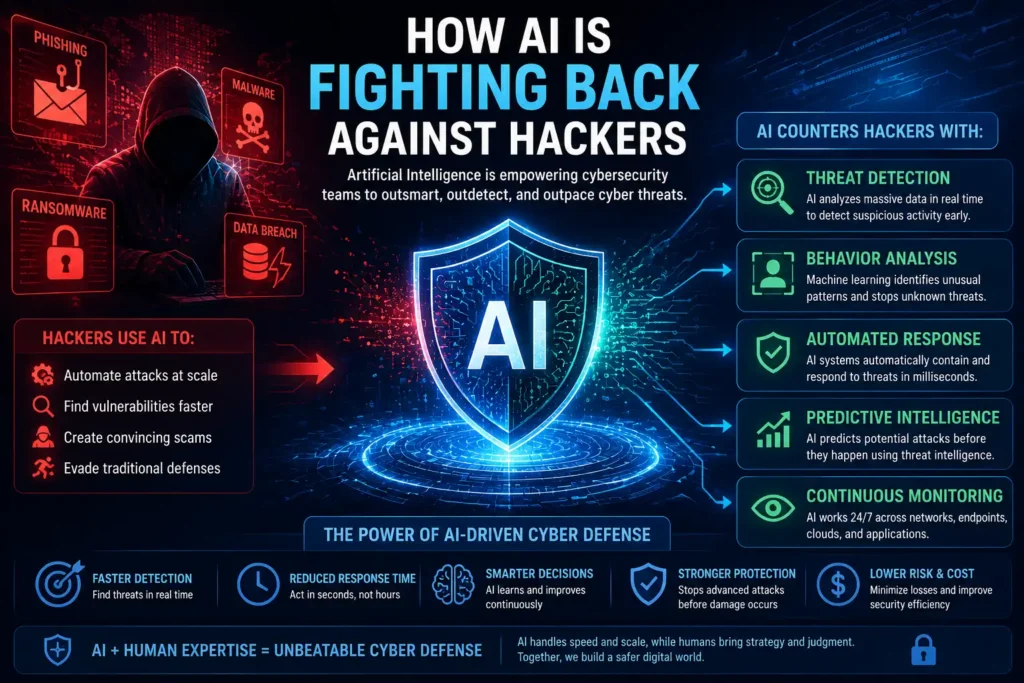
Artificial intelligence is also becoming one of the strongest defenses against modern cyber threats. Security teams use AI-powered systems to detect suspicious behavior, analyze massive amounts of network data, and respond to attacks in real time. Machine learning algorithms can identify unusual login attempts, malware activity, and insider threats faster than traditional security tools.
Many cybersecurity platforms now rely on predictive analytics to prevent attacks before systems are compromised. AI also improves automated incident response by reducing investigation time and minimizing human error. As cyberattacks grow more sophisticated, AI-driven cybersecurity solutions are becoming essential for proactive digital defense strategies worldwide.
AI vs Hackers: The Cybersecurity Arms Race
The conflict between artificial intelligence and cybercriminals has created a rapidly evolving cybersecurity arms race. Hackers continuously adopt advanced AI tools to improve attack speed, accuracy, and scalability, while security providers develop smarter defense systems to counter emerging threats. This ongoing competition affects businesses, governments, and individuals across every digital environment. Experts believe AI will redefine both offensive and defensive cybersecurity strategies over the next decade.
Organizations that fail to modernize their security infrastructure may struggle against increasingly automated attacks. In this high-stakes environment, cybersecurity success depends on how quickly defenders can adapt to constantly changing AI-powered threats and tactics.
Biggest Cybersecurity Threats in the Age of AI
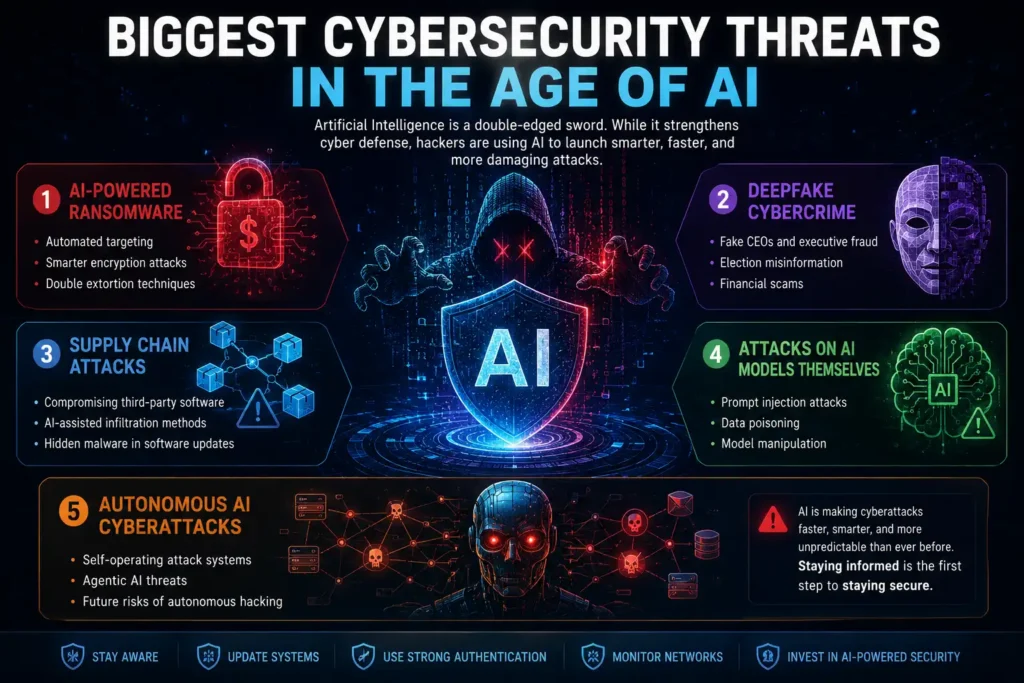
The rise of artificial intelligence has introduced several new cybersecurity threats that are more advanced and difficult to control. AI-powered ransomware, deepfake fraud, supply chain attacks, and autonomous cyberattacks are becoming major concerns for organizations worldwide. Cybercriminals now automate attack processes, exploit vulnerabilities faster, and create highly convincing digital deception campaigns.
AI-Powered Ransomware
AI-powered ransomware attacks are becoming faster, smarter, and more destructive than traditional ransomware operations. Cybercriminals use AI to automate target selection, identify high-value systems, and optimize encryption processes for maximum impact. Some ransomware groups also rely on machine learning to bypass security defenses and adapt attack techniques during deployment.
Deepfake Cybercrime
Deepfake cybercrime is rapidly emerging as one of the most dangerous AI-driven security threats worldwide. Criminals use AI-generated videos and cloned voices to impersonate executives, government officials, and public figures in highly convincing scams. Fake CEO fraud attacks have already caused major financial losses for businesses through fraudulent wire transfers and manipulated communication.
Supply Chain Attacks
Supply chain attacks have become increasingly dangerous as cybercriminals use AI to infiltrate trusted third-party systems and software providers. Attackers target vendors, cloud platforms, and software update mechanisms to distribute hidden malware across multiple organizations simultaneously. AI-assisted infiltration methods help hackers identify weak supply chain connections and automate exploitation processes more efficiently.
Attacks on AI Models Themselves
Cybercriminals are increasingly targeting artificial intelligence systems directly through specialized attacks designed to manipulate AI behavior. Prompt injection attacks can trick AI models into revealing sensitive information or bypassing security restrictions. Data poisoning attacks involve corrupting training datasets so that machine learning systems produce inaccurate or harmful outputs.
Autonomous AI Cyberattacks
Autonomous AI cyberattacks represent a major future risk in the cybersecurity landscape. These attacks involve self-operating systems capable of launching, adapting, and optimizing cyberattacks with minimal human involvement. Agentic AI threats could eventually scan networks, exploit vulnerabilities, evade detection, and spread malware automatically across connected systems.
💚 You might also like: Samigo App: Simple & Fast App for Daily Tasks
Challenges of Using AI in Cybersecurity
Although artificial intelligence improves threat detection and automation, it also introduces several cybersecurity challenges for organizations. AI systems require massive amounts of data, which can create privacy and security concerns if sensitive information is exposed. Machine learning models may also produce false positives or inaccurate threat assessments that overwhelm security teams.
Another major issue is the growing shortage of cybersecurity professionals capable of managing advanced AI systems effectively. Attackers can additionally manipulate AI through data poisoning and adversarial attacks designed to bypass security controls. As AI adoption increases, businesses must balance innovation with transparency, accountability, and strong cybersecurity governance frameworks.
Industries Most Affected by AI Cyber Threats
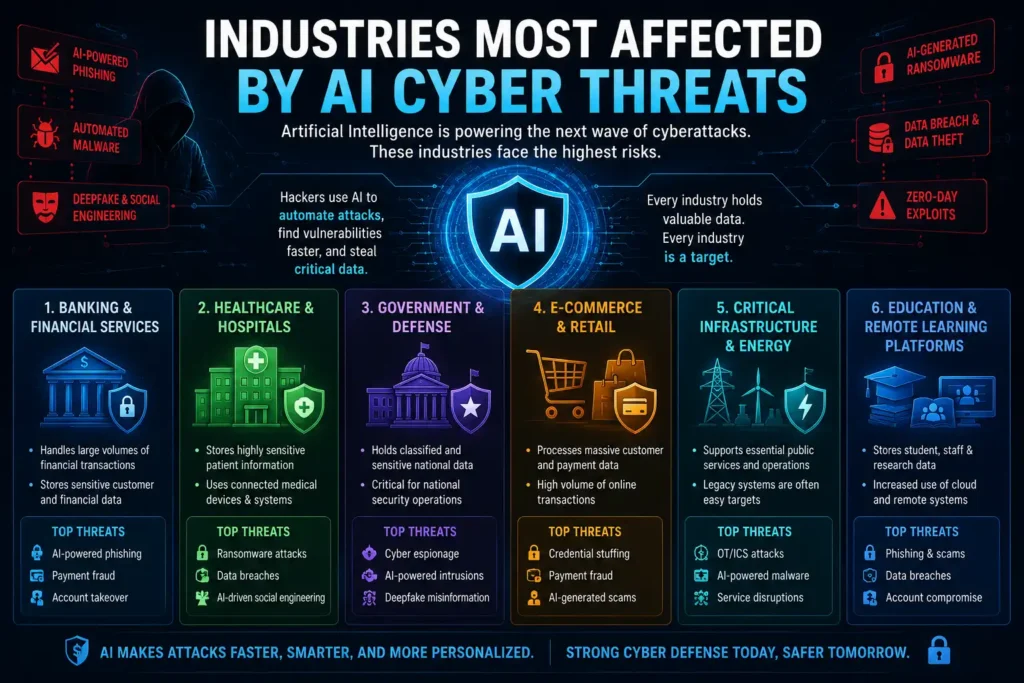
AI-driven cyber threats are impacting nearly every industry, but some sectors face significantly higher risks due to the value of their data and digital infrastructure. Financial institutions, healthcare providers, government agencies, and energy companies are frequent targets because they store sensitive information and manage critical operations.
Cybercriminals increasingly use AI to automate attacks against industries with large customer bases and interconnected systems. The expansion of cloud computing, remote work, and digital services has also increased attack surfaces across multiple sectors.
Banking and Financial Services
These industries remain one of the best targets for AI-powered cyberattacks. Cybercriminals use artificial intelligence to automate fraud detection evasion, launch phishing campaigns, and conduct credential theft operations against customers and financial institutions. AI-driven attacks can rapidly analyze transaction patterns and exploit weaknesses in digital banking systems.
Healthcare and Hospitals
Healthcare organizations and hospitals face growing cybersecurity risks as AI-powered attacks target sensitive patient information and connected medical systems. Cybercriminals frequently attack healthcare networks because medical records hold valuable personal and financial data. AI-driven ransomware campaigns can disrupt hospital operations, delay treatments, and compromise patient safety within critical care environments.
Government and Defense
Government agencies and defense organizations are major targets for AI-powered cyber espionage and national security attacks. Cybercriminal groups and state-sponsored actors use artificial intelligence to automate reconnaissance, gather intelligence, and exploit vulnerabilities in critical systems.
E-Commerce and Retail
The e-commerce and retail industry faces increasing pressure from AI-driven cyber threats targeting customer accounts, payment systems, and online platforms. Cybercriminals use AI to automate credential stuffing attacks, bypass fraud detection systems, and generate realistic phishing scams aimed at shoppers.
Critical Infrastructure and Energy
Critical infrastructure and energy sectors are highly vulnerable to AI-powered cyberattacks because they manage essential national services and industrial systems. Attackers increasingly target power grids, oil facilities, transportation networks, and water systems using automated reconnaissance and advanced malware techniques.
Education and Remote Learning Platforms
Educational institutions and remote learning platforms have become attractive targets for AI-driven cyberattacks due to their large user bases and limited cybersecurity resources. Schools and universities store valuable student records, financial data, and research information that cybercriminals can exploit.
💚 You might also like: How SaaS Businesses Make Money in 2026
Best Practices to Stay Secure in the AI Age
Staying secure in the age of artificial intelligence requires a proactive and continuously evolving cybersecurity strategy. Organizations should implement multi-factor authentication, regularly update software, and monitor systems for unusual activity using AI-powered detection tools. Employee cybersecurity awareness training is equally important because human error remains a leading cause of security breaches.
Businesses must also secure cloud environments, encrypt sensitive data, and develop strong incident response plans to minimize damage during attacks. Cybersecurity experts recommend adopting a zero-trust security model to limit unauthorized access across networks. Combining advanced technology with strong security policies creates better protection against modern AI-driven cyber threats.
AI Cybersecurity Tools and Technologies
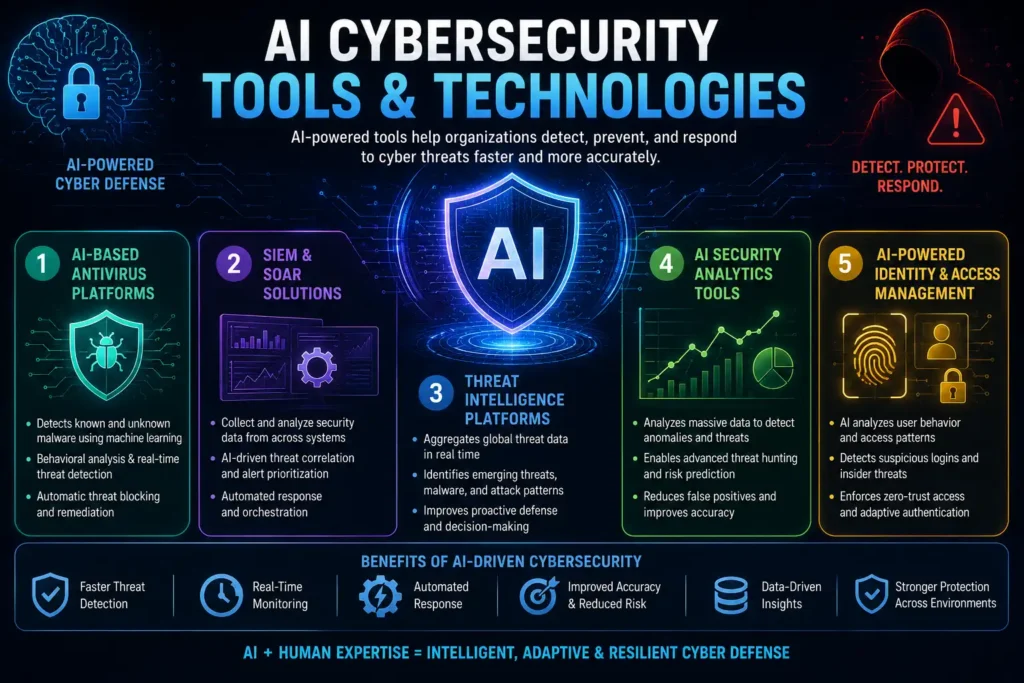
AI cybersecurity tools and technologies are helping organizations detect, prevent, and respond to cyber threats more efficiently than traditional security systems. Modern cybersecurity platforms use machine learning to analyze network traffic, identify suspicious behavior, and automate threat response in real time. Businesses increasingly rely on AI-driven antivirus software, security analytics tools, and threat intelligence platforms to strengthen digital defense strategies.
AI-Based Antivirus Platforms
AI-based antivirus platforms use machine learning and behavioral analysis to detect cyber threats beyond traditional signature-based methods. Unlike conventional antivirus software, AI-powered systems can identify suspicious activity patterns, zero-day malware, and previously unknown attack techniques in real time. These platforms continuously learn from new threat data to improve detection accuracy and reduce response times.
SIEM and SOAR Solutions
SIEM and SOAR solutions play a critical role in modern AI-driven cybersecurity operations. Security Information and Event Management platforms collect and analyze large volumes of security data from across organizational networks. Security Orchestration, Automation, and Response systems use AI to automate incident response workflows and reduce investigation times.
Threat Intelligence Platforms
Threat intelligence platforms use artificial intelligence to gather, analyze, and prioritize cybersecurity threat data from multiple global sources. These systems monitor malware activity, hacker groups, phishing campaigns, and emerging vulnerabilities in real time. AI-powered analytics help security teams identify high-risk threats faster and improve decision-making during incident response processes.
AI Security Analytics Tools
AI security analytics tools help organizations detect hidden cyber threats by analyzing massive amounts of security data in real time. These platforms use machine learning algorithms to identify unusual behavior patterns, insider threats, and suspicious network activity that traditional systems may overlook.
AI-Powered Identity and Access Management
AI-powered identity and access management systems help organizations secure user authentication and control access to sensitive resources more effectively. These platforms use machine learning to analyze login behavior, device activity, and user risk levels in real time.
Frequently Asked Questions (FAQs)
How is AI changing cybersecurity?
Artificial intelligence is transforming cybersecurity by improving both cyberattacks and defense systems. Security teams use AI to detect threats faster, automate incident response, and analyze large amounts of security data in real time.
Can hackers use ChatGPT or generative AI?
Hackers can use generative AI tools like ChatGPT to support certain cybercrime activities, including phishing email creation, scam messaging, and social engineering campaigns. However, reputable AI platforms implement safety restrictions to prevent malicious usage.
What are AI-powered cyberattacks?
AI-powered cyberattacks are cyber threats that use artificial intelligence or machine learning to automate and improve attack methods. These attacks include AI-generated phishing emails, deepfake scams, intelligent malware, automated vulnerability discovery, and adaptive ransomware campaigns.
Is AI good or bad for cybersecurity?
Artificial intelligence can be both beneficial and dangerous for cybersecurity, depending on how it is used. Cybersecurity professionals use AI to improve threat detection, automate monitoring, and strengthen incident response capabilities.
Can AI stop hackers completely?
AI cannot stop hackers completely because cybercriminals continuously adapt their attack methods and develop new techniques to bypass security systems. While AI significantly improves threat detection, automated response, and cybersecurity analytics, no security solution can guarantee complete protection against all attacks.
What industries are most vulnerable to AI cyber threats?
Industries most vulnerable to AI cyber threats include banking, healthcare, government, e-commerce, education, and critical infrastructure sectors. These industries manage sensitive data, financial transactions, and essential digital operations that make them attractive targets for cybercriminals..
What is the biggest AI cybersecurity risk today?
One of the biggest AI cybersecurity risks today is the rapid growth of AI-powered phishing and social engineering attacks. Cybercriminals use generative AI to create realistic scam emails, fake websites, cloned voices, and personalized fraudulent messages that are difficult for users to identify.
How businesses protect from AI-driven attacks?
Businesses can protect themselves from AI-driven attacks by adopting a layered cybersecurity strategy that combines technology, employee awareness, and proactive risk management. Organizations should implement multi-factor authentication, endpoint protection, AI-powered monitoring systems, and regular software updates to reduce vulnerabilities.
Conclusion
Artificial intelligence is reshaping the cybersecurity landscape in ways that affect businesses, governments, and individuals worldwide. While AI strengthens digital defense through faster threat detection and automated security systems, it also enables cybercriminals to launch smarter and more scalable attacks. From phishing scams and deepfake fraud to ransomware and autonomous cyberattacks, the risks associated with AI-driven threats continue growing rapidly. Organizations must stay informed, invest in advanced cybersecurity technologies, and train employees to recognize evolving attack methods. In the modern digital era, building a strong cybersecurity strategy is no longer optional but essential for long-term protection against AI-powered cyber threats.
✨ More clarity. More insights. Less noise. Follow Tech Fueler.