
Introduction to SaaS Business Model
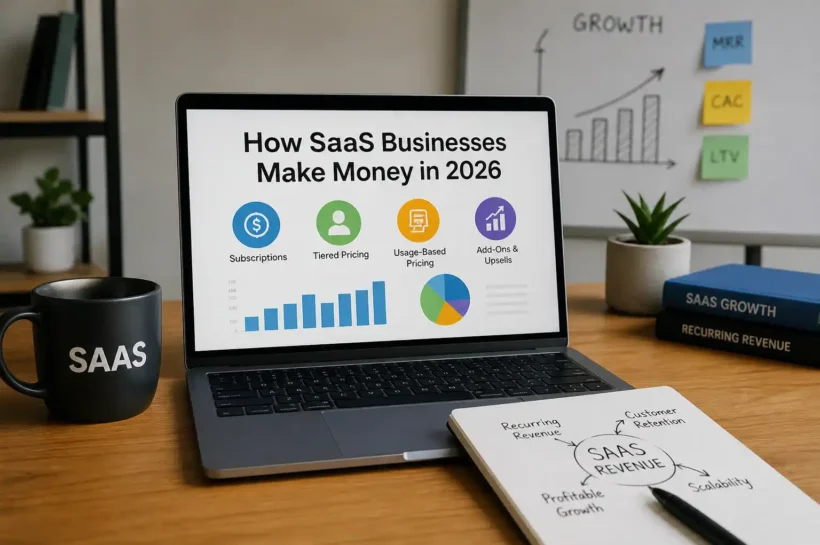
Software as a Service (SaaS) is a cloud-based delivery model where users access software through the internet instead of installing it locally. Unlike traditional software that requires one-time purchases and manual updates, SaaS operates on a subscription basis with continuous improvements. This model reduces upfront costs and increases accessibility. According to industry reports, the global SaaS market is projected to surpass $300 billion by 2026, showing its massive growth. Businesses prefer SaaS because it creates predictable recurring revenue, lower distribution costs, and scalable infrastructure, making it one of the most profitable and sustainable digital business models today.
How SaaS Businesses Make Money :- Core Revenue Models
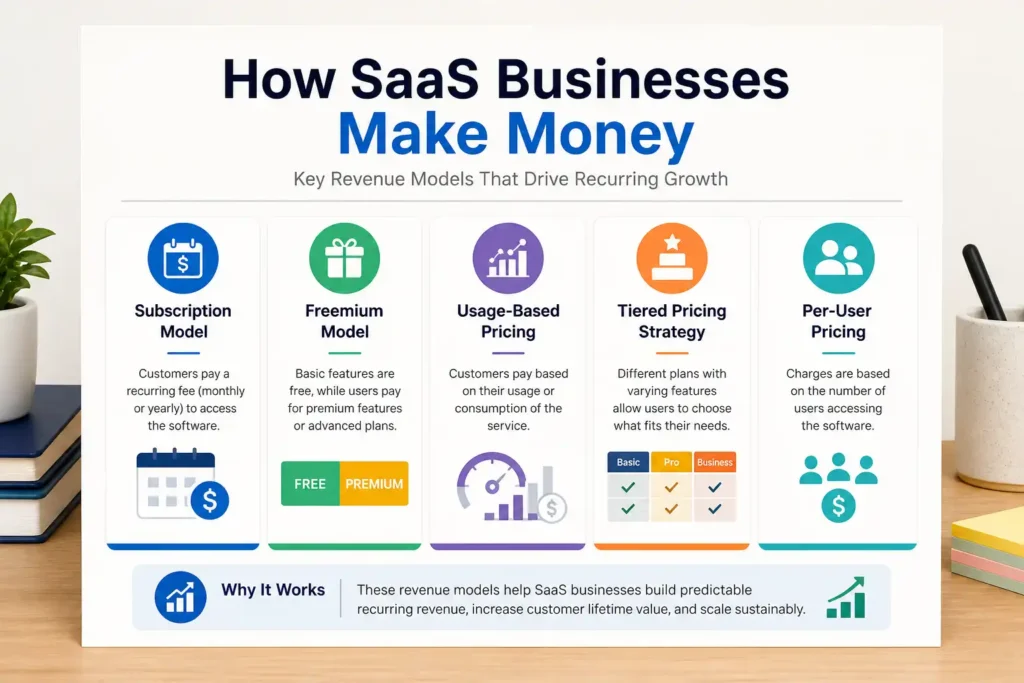
SaaS companies generate revenue through multiple pricing strategies designed to maximize recurring income and customer lifetime value. Instead of relying on one-time sales, they focus on long-term relationships and scalable monetization. Research from SaaS Capital shows that over 70% of SaaS revenue comes from subscription models. However, successful companies often combine several approaches like freemium, usage-based, and tiered pricing to capture different customer segments. This flexibility allows SaaS businesses to adapt pricing based on user behavior, company size, and product value, ultimately increasing profitability while maintaining steady growth and predictable cash flow.
Subscription-Based Pricing Model
The subscription model is the backbone of most SaaS businesses, where customers pay monthly or annually for access. Annual plans often offer discounts to improve cash flow and retention. This model generates predictable revenue through metrics like MRR and ARR. According to OpenView Partners, top SaaS companies earn over 80% of revenue through subscriptions, making it the most reliable and scalable pricing strategy.
Freemium Model
The freemium model offers a basic version of the product for free while charging for advanced features. It helps attract a large user base quickly. Conversion rates typically range between 2% to 5%, according to SaaS benchmarks. While it lowers acquisition costs, it requires strong feature gating and value differentiation to convert free users into paying customers effectively.
Usage-Based (Pay-As-You-Go) Model
In this model, customers pay based on how much they use the service, such as API calls or storage. It aligns pricing directly with value delivered, making it attractive for scaling businesses. According to Paddle, usage-based pricing is growing rapidly, especially in cloud and developer tools, because it offers flexibility and encourages higher usage over time.
Tiered Pricing Strategy
Tiered pricing divides services into multiple plans like Basic, Pro, and Enterprise. Each tier offers different features and limits, allowing businesses to target various customer segments. This strategy encourages upgrades as user needs grow. Research shows that companies using tiered pricing often see higher average revenue per user (ARPU) due to effective upselling opportunities.
Per-User Pricing Model
In this model, it charges customers according on the total users accessing the software. It is widely used in B2B SaaS products like collaboration tools. This model scales naturally as organizations grow. However, it can limit adoption if pricing becomes too expensive, so companies often balance it with feature-based or usage-based elements.
Additional Revenue Streams in SaaS Businesses
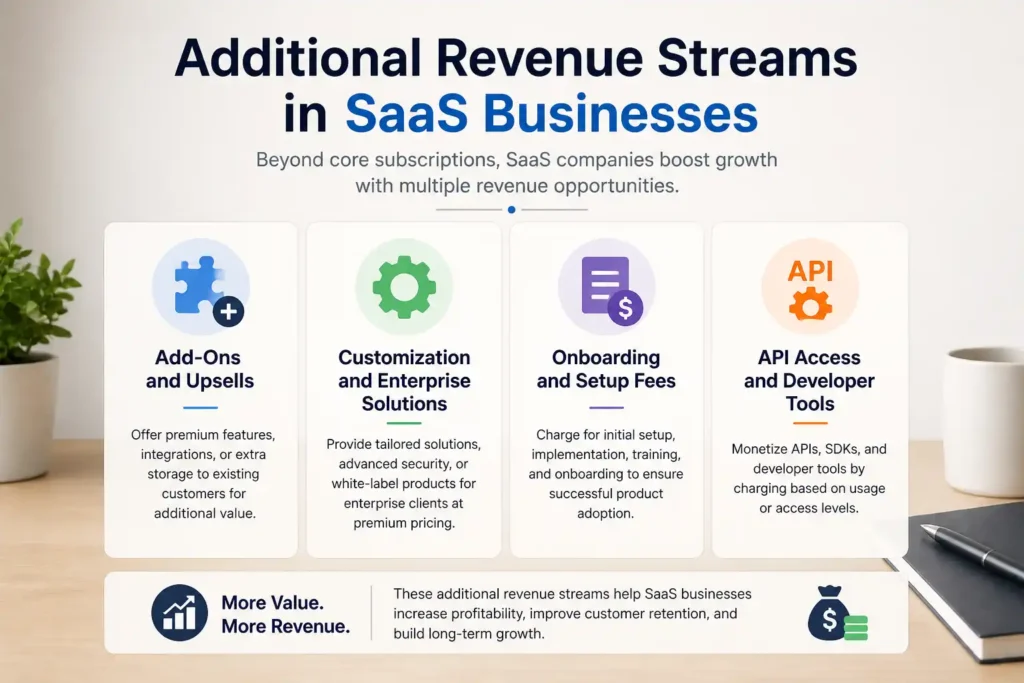
Beyond core pricing models, SaaS companies unlock additional revenue streams to increase profitability and diversify income. These streams often come from existing customers, making them highly efficient and cost-effective. According to ProfitWell, expansion revenue can contribute up to 30% of total SaaS income. By offering add-ons, customization, and premium services, companies enhance customer value while boosting revenue. These strategies not only improve monetization but also strengthen customer relationships, as users are more likely to invest in solutions tailored to their specific needs and business goals.
Add-Ons and Upsells
Add-ons and upsells allow customers to purchase extra features, storage, or integrations beyond their base plan. This strategy increases revenue without acquiring new users. Studies show that upselling to existing customers is significantly more cost-effective than acquiring new ones, making it a key growth driver for SaaS businesses.
Customization and Enterprise Solutions
Large businesses often require tailored solutions, and SaaS companies charge premium prices for customization. This may include advanced security, integrations, or white-label products. Enterprise deals typically generate higher contract values and long-term commitments, making them a crucial revenue source for scaling SaaS companies.
Onboarding and Setup Fees
Some SaaS companies charge onboarding or setup fees for initial implementation and training. This is common in complex B2B software. These fees help cover operational costs and ensure customers successfully adopt the product, which ultimately improves retention and long-term revenue potential.
API Access and Developer Tools
Many SaaS platforms monetize API access by charging developers based on usage. This approach builds an ecosystem around the product and encourages integrations. Companies like Stripe and Twilio have successfully scaled using this model, generating significant revenue from developer-driven usage.
💚 You might also like: Classroom 15x: Transforming Modern Education in 2026
Key SaaS Metrics That Drive Revenue
Understanding key SaaS metrics is essential for optimizing revenue and long-term growth. These metrics help businesses measure performance, identify opportunities, and make data-driven decisions. According to McKinsey, SaaS companies that actively track and optimize metrics grow faster and achieve higher profitability. Metrics like MRR, CAC, and churn rate directly impact revenue and sustainability. By focusing on these indicators, businesses can improve customer retention, reduce costs, and maximize lifetime value. Ultimately, strong metric management is what separates successful SaaS companies from those that struggle to scale effectively.
Monthly Recurring Revenue (MRR)
MRR represents the predictable monthly income generated from subscriptions. It is one of the most important SaaS metrics for tracking growth. Businesses use MRR to forecast revenue, measure performance, and evaluate the impact of pricing changes, making it a critical indicator of financial stability.
Annual Recurring Revenue (ARR)
ARR is the yearly equivalent of recurring revenue and is commonly used for long-term planning. It provides a broader view of business performance and is often used by investors to evaluate SaaS companies. Higher ARR indicates strong customer retention and sustainable growth potential.
Customer Lifetime Value (CLTV)
CLTV measures the total revenue a business expects from a customer over their lifetime. A higher CLTV means better profitability. Successful SaaS companies focus on increasing CLTV by improving retention, upselling, and delivering consistent value to customers over time.
Customer Acquisition Cost (CAC)
CAC measures the total cost of acquiring a new customer, including all marketing and sales expenses involved. A lower CAC improves profitability. SaaS companies aim to maintain a healthy CLTV-to-CAC ratio, typically around 3:1, to ensure sustainable and efficient growth.
Churn Rate
Churn rate measures the percentage of customers who stop using the service over a given period. High churn can severely impact revenue. Reducing churn through better customer experience and support is essential for maintaining consistent growth in SaaS businesses.
Expansion Revenue
Expansion revenue comes from old customers with new upgrades, add-ons, or increased usage. It is one of the most profitable revenue sources because it requires no acquisition cost. Companies with strong expansion strategies often achieve faster and more sustainable growth.
Pricing Strategies SaaS Companies Use to Maximize Profit
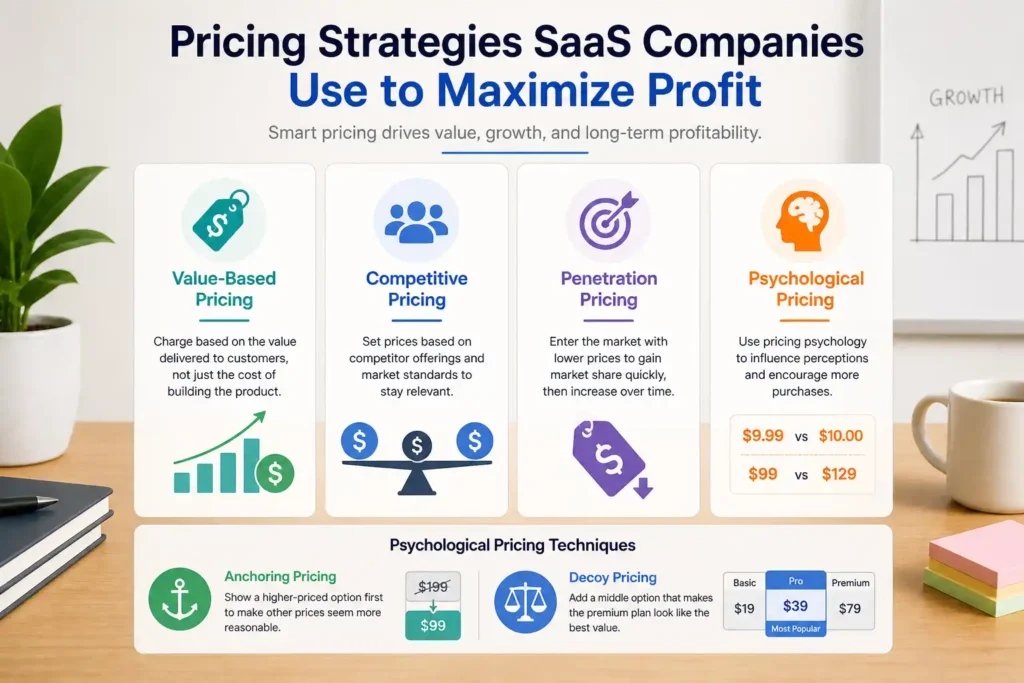
SaaS pricing is not just about covering costs, it’s a strategic lever to maximize revenue and customer lifetime value. Leading SaaS companies continuously test and refine pricing based on user behavior, perceived value, and market demand. According to a study by Price Intelligently, a 1% improvement in pricing can increase profits by up to 11%, making it more impactful than acquisition or retention. By combining value-based, competitive, and psychological pricing strategies, SaaS businesses can optimize conversions, improve margins, and position their product effectively in crowded markets while maintaining long-term customer satisfaction.
Value-Based Pricing
Value-based pricing focuses on charging customers based on the perceived value of the product rather than production cost. This approach requires a deep understanding of customer pain points and outcomes. SaaS companies that adopt value-based pricing often achieve higher margins because customers are willing to pay more for solutions that directly impact their business performance and ROI.
Competitive Pricing
Competitive pricing involves setting prices based on what similar SaaS products are charging in the market. This strategy helps businesses stay relevant and attract price-sensitive customers. However, relying only on competitors can limit growth, so successful SaaS companies combine this approach with differentiation to justify premium pricing and avoid price wars.
Penetration Pricing
This strategy is common among startups entering competitive markets. Once a strong customer base is built, prices are gradually increased. While effective for growth, it requires careful planning to ensure long-term profitability without undervaluing the product.
Psychological Pricing
Psychological pricing uses human behavior and perception to influence buying decisions. Instead of purely logical pricing, it focuses on how users interpret value. Research shows that pricing psychology can significantly improve conversion rates. SaaS companies often use techniques like anchoring and decoy pricing to guide users toward higher-value plans.
💚 You might also like: 10 Best Tools For Teachers in 2026 (Digital & AI Tools)
How Successful SaaS Companies Scale Revenue
Scaling revenue in SaaS is not just about acquiring more customers, it’s about increasing value from existing ones while maintaining efficiency. According to Bain & Company, increasing customer retention by just 5% can boost profits by 25% to 95%. Successful SaaS companies focus on retention, expansion of revenue, and scalable growth models. They combine product-led growth with sales-driven strategies to target both small businesses and enterprise clients. By aligning product value with customer needs and continuously optimizing growth strategies, SaaS companies can achieve sustainable and predictable revenue expansion over time.
Customer Retention Strategies
Customer retention is critical for SaaS success because recurring revenue depends on long-term relationships. Companies reduce churn by improving onboarding, offering excellent support, and continuously delivering value. Enhancing customer experience through personalization and proactive engagement helps build loyalty, ensuring users stay longer and contribute more to overall revenue growth.
Upselling and Cross-Selling
Upselling encourages customers to upgrade to higher-tier plans, while cross-selling promotes additional features or services. These strategies increase average revenue per user without extra acquisition costs. Data shows that existing customers are more likely to purchase again, making upselling and cross-selling highly effective for maximizing SaaS profitability.
Product-Led Growth (PLG)
Product-led growth relies on the product itself to drive user acquisition and expansion. Free trials, freemium models, and seamless onboarding play a key role. Companies like Slack and Zoom have scaled rapidly using PLG, as users experience value firsthand before committing, leading to higher conversion rates and organic growth.
Sales-Led Growth for Enterprise SaaS
Enterprise SaaS companies often use sales-led growth, where dedicated sales teams close high-value deals. This approach involves personalized demos, negotiations, and long sales cycles. Although costly, it results in large contracts and long-term commitments, making it essential for scaling revenue in enterprise-focused SaaS businesses.
💚 You might also like: How to Optimize Website Speed in 2026 (Step-by-Step Guide)
The Main Challenges in SaaS Monetization
Despite its advantages, SaaS monetization comes with several challenges that can impact profitability and growth. From rising acquisition costs to pricing inefficiencies, businesses must constantly adapt to remain competitive. According to ProfitWell, many SaaS companies lose up to 30% of revenue due to poor pricing strategies. Additionally, churn and infrastructure costs can reduce margins if not managed properly. Understanding these challenges allows businesses to proactively address them through better pricing models, improved customer experience, and efficient cost management, ensuring long-term sustainability and scalable growth.
High Customer Acquisition Costs
Customer acquisition costs (CAC) can be high due to marketing, advertising, and sales expenses. As competition increases, acquiring new users becomes more expensive. SaaS companies must optimize marketing channels and improve conversion rates to ensure CAC remains sustainable and does not negatively impact overall profitability.
Pricing Optimization Issues
Many SaaS companies struggle with setting the right price for their product. Underpricing can reduce revenue, while overpricing can limit adoption. Continuous testing, customer feedback, and data analysis are essential for finding the optimal pricing strategy that balances growth and profitability effectively.
Customer Churn
Customer churn directly affects recurring revenue and growth. High churn means losing customers faster than acquiring them, which can be damaging. SaaS businesses must focus on retention strategies like better onboarding, continuous engagement, and product improvements to keep customers satisfied and reduce churn rates.
Scaling Infrastructure Costs
As SaaS companies grow, infrastructure costs such as cloud hosting and data storage increase. Without proper optimization, these costs can reduce profit margins. Efficient resource management and scalable architecture are essential to maintain profitability while supporting business growth and user demand.
Examples of Famous Saas Brands’ Revenue Models in 2026
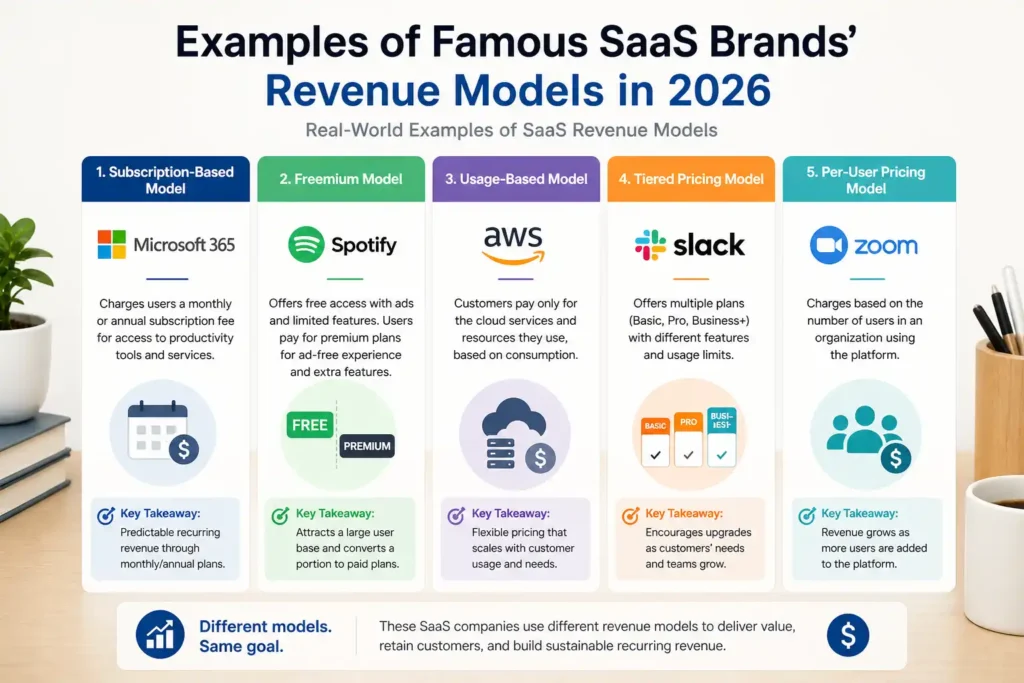
Real-world examples help illustrate how SaaS companies successfully implement different monetization strategies. Leading companies often combine multiple revenue models to maximize growth and profitability. According to industry data, hybrid pricing strategies are becoming more common among top SaaS businesses. By analyzing successful case studies, businesses can understand how pricing models work in practice and apply similar strategies to their own products. These examples highlight the importance of aligning pricing with customer value, usage patterns, and market demand to achieve sustainable and scalable revenue growth.
Subscription-Based SaaS Example
Companies like Microsoft 365 use a subscription-based model, charging users monthly or annually for access to tools. This approach ensures predictable revenue and long-term customer relationships. The success of this model lies in continuous updates, strong value delivery, and flexible pricing options for different user segments.
Freemium SaaS Example
Spotify is a well-known example of the freemium model, offering free access with ads and premium plans without interruptions. This strategy attracts millions of users and converts a percentage into paying customers. The key to success is offering enough value in the free version while encouraging upgrades.
Usage-Based SaaS Example
AWS (Amazon Web Services) follows a usage-based pricing model, where customers pay for the resources they consume. This model is highly scalable and flexible, making it attractive for businesses of all sizes. It aligns cost with usage, ensuring customers only pay for what they actually use.
FAQs
How do SaaS companies generate recurring revenue?
SaaS companies generate recurring revenue primarily through subscription-based pricing models. Customers pay monthly or annually for access to software. This predictable income allows businesses to forecast growth, invest in improvements, and maintain stable cash flow over time while building long-term customer relationships.
What is the most profitable SaaS pricing model?
The most profitable SaaS pricing model depends on the product and market, but subscription-based and value-based pricing are often the most effective. Combining these with upselling and expansion revenue strategies helps maximize customer lifetime value and overall profitability.
Is freemium a good strategy for SaaS startups?
Freemium can be effective for SaaS startups looking to grow quickly and attract users. However, it requires a strong conversion strategy to turn free users into paying customers. Without proper execution, it can lead to high costs without sufficient revenue generation.
How long does it take for SaaS businesses to become profitable?
Most SaaS businesses take 1 to 3 years to become profitable, depending on their growth strategy and investment level. High upfront costs in product development and customer acquisition can delay profitability, but strong retention and recurring revenue eventually lead to sustainable profits.
💚 You might also like: Best Social Media Marketing Tips for Growth in 2026
Conclusion
SaaS businesses make money through a combination of smart pricing strategies, recurring revenue models, and customer-focused growth tactics. From subscription plans to usage-based pricing, each model plays a role in maximizing profitability. The key to success lies in understanding customer value, optimizing pricing, and continuously improving the product. With the right approach, SaaS companies can achieve predictable revenue and long-term growth. As the market continues to evolve, businesses that adapt to new trends and focus on customer experience will be better positioned to build sustainable and highly profitable SaaS ventures
✨ Turn insights into power. Follow Tech Fueler.