
What Is Email Marketing?
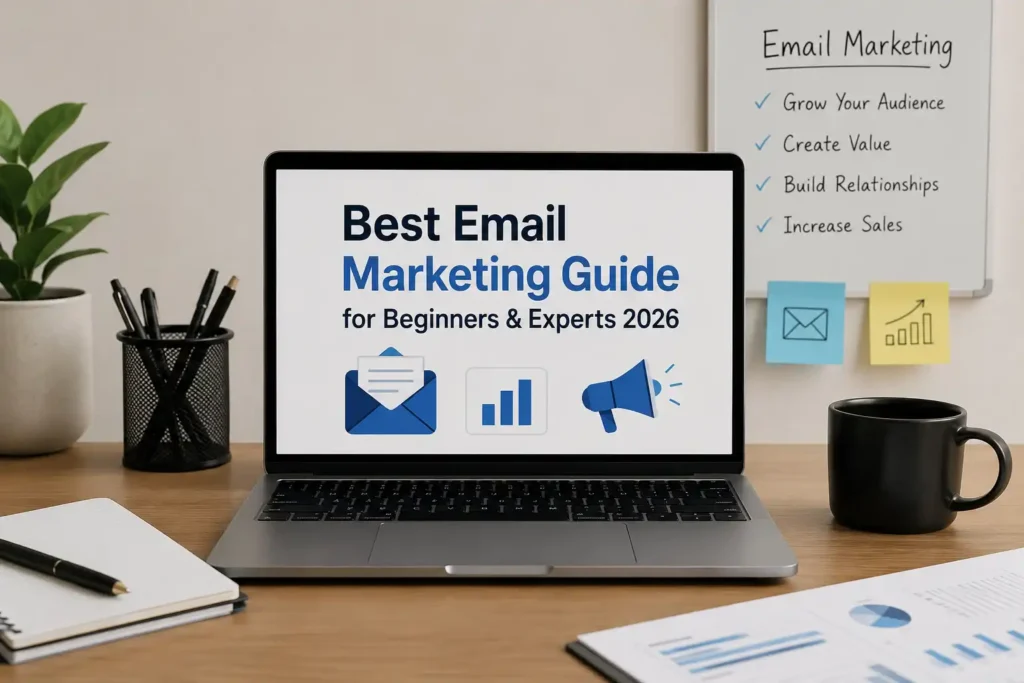
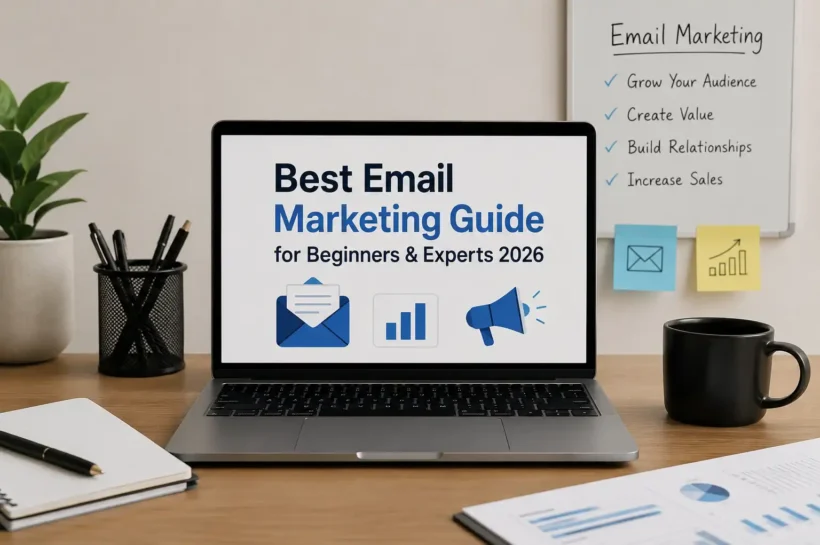
Email marketing is a digital marketing method that helps businesses connect with people through targeted email messages. Companies use it to promote products, share updates, build relationships, and increase conversions. Unlike social media platforms, email gives brands direct access to their audience’s inbox. That control makes email marketing highly valuable for long-term growth. Modern email marketing also includes automation, personalization, segmentation, and behavioral targeting. Whether you run a small business, blog, ecommerce store, or SaaS company, email marketing helps you engage customers, nurture leads, and improve sales while maintaining a professional brand presence online.
Benefits of Email Marketing for Beginners
Email marketing offers multiple advantages for beginners who want to grow an audience or business online. It is affordable, scalable, and easy to start with modern email marketing tools. Unlike paid advertising, email marketing allows long-term communication with subscribers without ongoing advertising costs. It also delivers higher engagement because messages reach users directly in their inbox. Beginners can use email marketing to increase traffic, generate leads, promote products, and build trust over time. With automation and personalization features becoming more accessible, even small businesses and solo creators can compete effectively using smart email marketing strategies.
How Email Marketing Helps Different Businesses
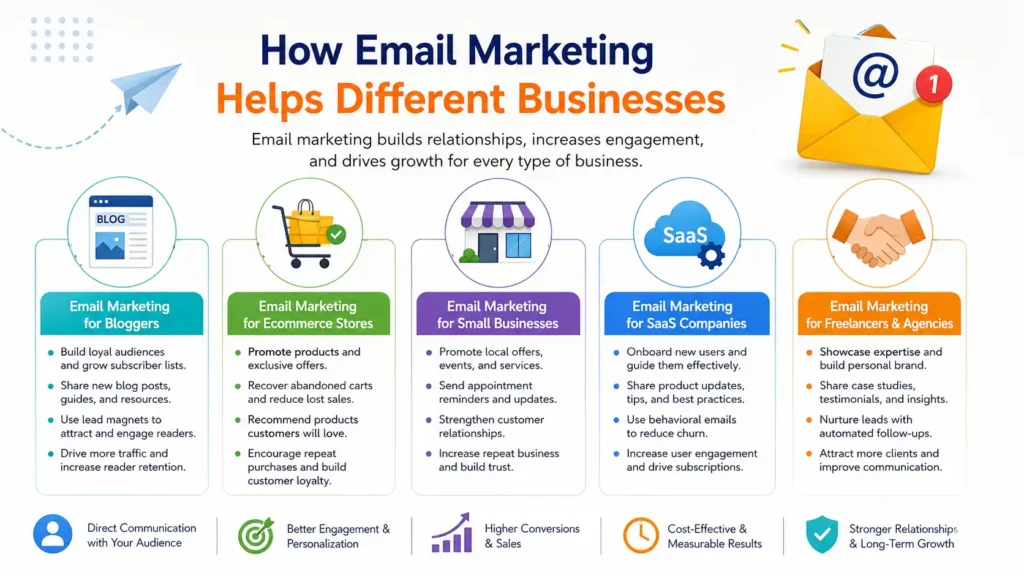
Email Marketing for Bloggers
Bloggers use email marketing to build loyal audiences and increase website traffic. Newsletters help readers stay updated with new articles, guides, and resources. Bloggers also use lead magnets like ebooks and checklists to grow subscriber lists. Consistent email communication encourages repeat visits and improves reader engagement.
Email Marketing for Ecommerce Stores
Ecommerce businesses use email marketing to promote products, recover abandoned carts, and encourage repeat purchases. Personalized product recommendations improve customer experience and increase sales opportunities. Seasonal campaigns and discount offers also perform well through email communication.
Email Marketing for Small Businesses
Small businesses use email marketing to compete with larger brands while staying within limited budgets. Local businesses send promotions, event updates, appointment reminders, and newsletters directly to customers. Email campaigns strengthen customer relationships and improve repeat business.
Email Marketing for SaaS Companies
SaaS companies rely heavily on email marketing for onboarding, user education, and customer retention. Automated email sequences guide users through product features and encourage platform adoption. SaaS brands also use behavioral emails to reduce churn and increase subscriptions.
Email Marketing for Freelancers and Agencies
Freelancers and agencies use email marketing to showcase expertise and attract potential clients. Email newsletters help share case studies, portfolio updates, and industry insights with subscribers. Automated follow-up emails improve lead nurturing and communication efficiency.
💚 You might also like: AxelaNote: Smart Note-Taking Tool For Productivity
Important Email Marketing Terms Beginners Should Know
Email List
An email list is a collection of subscribers who voluntarily shared their email addresses with a business or creator. These subscribers usually join through signup forms, lead magnets, or landing pages.
Subscribers
Subscribers are people who signed up to receive emails from a business, website, or creator. They may join an email list to access exclusive content, discounts, newsletters, or updates. Subscribers are important because they already showed interest in the brand.
Open Rate
Open rate measures the percentage of subscribers who opened an email campaign. It helps marketers understand how effective subject lines and sender names are at attracting attention.
Click-Through Rate (CTR)
Click-through rate measures how many subscribers clicked links inside an email compared to total recipients. CTR shows how engaging and persuasive email content is for readers. A higher CTR often means subscribers found the message valuable or relevant.
Conversion Rate
Conversion rate measures the percentage of subscribers who completed a desired action after opening an email. These actions may include purchasing products, downloading resources, or filling forms.
Bounce Rate
Bounce rate refers to emails that could not be delivered to subscriber inboxes. Hard bounces happen because of invalid email addresses, while soft bounces occur due to temporary delivery problems.
Spam Complaint
A spam complaint occurs when subscribers mark marketing emails as spam or junk. Too many spam complaints can hurt sender reputation and reduce future email deliverability.
Segmentation
Segmentation is the process of dividing subscribers into smaller groups based on interests, behavior, demographics, or purchase history. This strategy helps businesses send more personalized and relevant emails to different audience segments.
Automation
Email automation allows businesses to send emails automatically based on triggers, schedules, or user actions. Automated emails include welcome sequences, abandoned cart reminders, and follow-up campaigns.
CTA (Call-to-Action)
A call-to-action, commonly called CTA, encourages subscribers to take specific actions after reading an email. Examples include “Buy Now,” “Download Free Guide,” or “Learn More.” Effective CTAs are clear, visible, and action-focused.
How to Start Email Marketing Step-by-Step
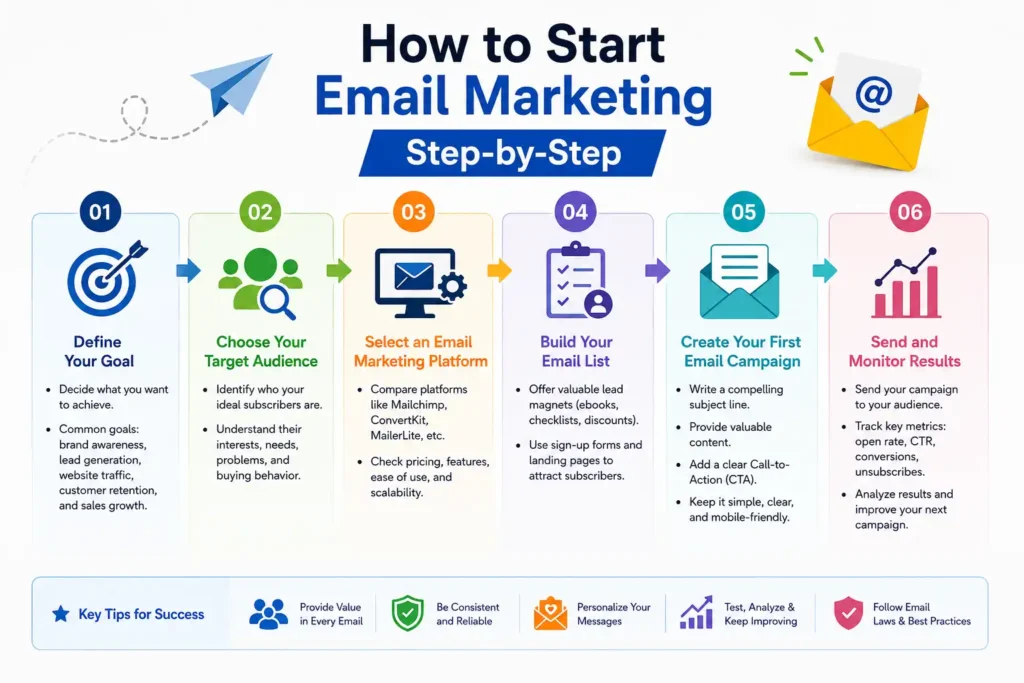
Starting email marketing may seem overwhelming for beginners, but the process becomes simple when broken into clear steps. Successful email marketing begins with setting goals and understanding the target audience. After selecting the right email marketing platform, businesses can start building subscriber lists and creating campaigns. Consistency, personalization, and valuable content play major roles in long-term success. Modern tools also make automation and analytics easier for beginners.
Step 1 :- Define Your Goal
Before starting email marketing, businesses should define clear goals for their campaigns. Common goals include brand awareness, lead generation, website traffic, customer retention, and sales growth. Clear objectives help shape email content, targeting, and strategy. Without goals, campaigns often lack direction and measurable outcomes.
Step 2 :- Choose Your Target Audience
Understanding the target audience is essential for successful email marketing. Businesses should identify subscriber interests, demographics, problems, and buying behavior before creating campaigns. Audience research helps marketers produce more relevant and personalized content.
Step 3 :- Select an Email Marketing Platform
Choosing the right email marketing platform helps beginners manage campaigns more efficiently. Platforms like Mailchimp, ConvertKit, and MailerLite provide templates, automation, analytics, and subscriber management tools. Businesses should compare pricing, usability, features, and scalability before selecting software.
Step 4 :- Build Your Email List
Building an email list requires offering value that encourages users to subscribe. Businesses often use lead magnets such as ebooks, discounts, templates, or free courses to attract subscribers. Signup forms and landing pages also play important roles in list building.
Step 5 :- Create Your First Email Campaign
Creating the first email campaign involves writing engaging subject lines, valuable content, and strong CTAs. Businesses should keep emails clear, concise, and visually organized for better readability. Mobile optimization is also essential because many users check emails on smartphones.
Step 6 :- Send and Monitor Results
After sending campaigns, businesses should track metrics like open rates, click-through rates, conversions, and unsubscribes. Analytics help marketers understand subscriber behavior and identify areas for improvement. Monitoring performance allows businesses to optimize subject lines, content, timing, and segmentation strategies.
Best Email Marketing Tools for Beginners
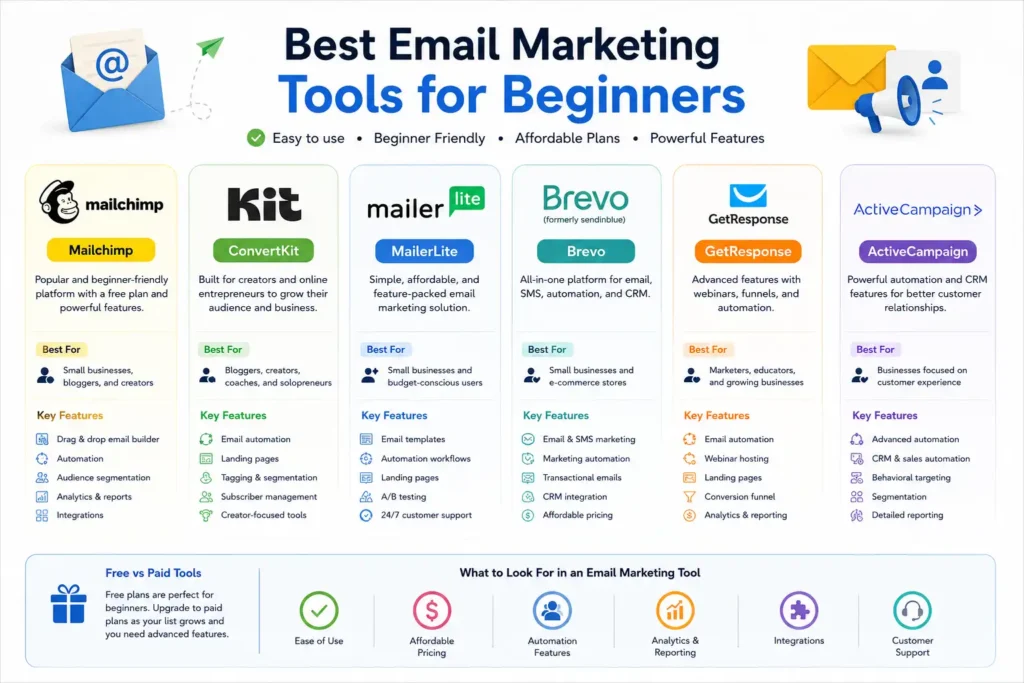
Choosing the right email marketing software can significantly improve campaign management and results for beginners. Modern email marketing platforms provide tools for automation, templates, analytics, segmentation, and subscriber management. Some platforms focus on simplicity, while others offer advanced automation and CRM features. Beginners should choose software based on ease of use, pricing, scalability, and business goals. Free plans are useful for learning basic email marketing skills before upgrading to premium features.
Mailchimp
Mailchimp is one of the most popular email marketing platforms for beginners because of its user-friendly interface and free plan options. It offers templates, automation, analytics, and audience segmentation features. Businesses can create professional campaigns without technical expertise. Mailchimp also integrates with ecommerce platforms and websites, making subscriber management easier. Its beginner-friendly dashboard helps users monitor campaign performance effectively.
ConvertKit
ConvertKit is designed primarily for creators, bloggers, and online entrepreneurs. It focuses on simplicity, automation, and audience management. Users can create automated email sequences and landing pages easily. ConvertKit also provides tagging and segmentation features for personalized communication. Many content creators prefer ConvertKit because it supports newsletter growth, digital product promotion, and subscriber engagement without overwhelming beginners with complicated features.
MailerLite
MailerLite is known for its clean interface, affordability, and beginner-friendly features. It provides email templates, automation workflows, landing pages, and subscriber management tools. Small businesses and creators often choose MailerLite because of its simple design and cost-effective pricing. The platform also includes useful analytics and A/B testing features. Beginners can quickly launch professional campaigns using MailerLite’s intuitive system.
Brevo
Brevo, formerly known as Sendinblue, combines email marketing, SMS marketing, and automation in one platform. It is popular among small businesses because of its affordable pricing and flexible features. Brevo allows users to create personalized campaigns, automated workflows, and transactional emails. Its CRM integration also improves customer communication management. Beginners benefit from its straightforward interface and scalable marketing capabilities.
GetResponse
GetResponse offers advanced email marketing features along with webinar hosting, landing pages, and marketing automation tools. It supports businesses that want more than standard email campaigns. Beginners can use drag-and-drop templates and automation builders to simplify campaign creation. GetResponse also includes analytics and conversion funnel features. Its all-in-one marketing approach makes it useful for growing online businesses and marketers.
ActiveCampaign
ActiveCampaign is a powerful email marketing platform focused on automation and customer experience. It provides advanced segmentation, CRM integration, and behavioral targeting features. Businesses use ActiveCampaign to create personalized customer journeys and automated workflows. Although it includes more advanced tools, beginners can still learn the platform gradually. Strong automation capabilities make ActiveCampaign popular among businesses focused on customer retention and conversions.
Free vs Paid Email Marketing Tools
Free email marketing tools are ideal for beginners who want to learn without large investments. Paid plans unlock advanced automation, segmentation, analytics, and higher subscriber capacities. Businesses should compare features carefully before upgrading. Choosing between free and paid tools depends on audience size, campaign complexity, and long-term business goals.
💚 You might also like: Best 12 Passive Income Ideas That Work in 2026
How to Build an Email List From Scratch
Building an email list from scratch is one of the most important steps in email marketing. A quality email list gives businesses direct access to interested audiences without depending entirely on search engines or social media algorithms. Successful brands focus on attracting subscribers through valuable content, lead magnets, and optimized signup experiences.
According to HubSpot research, segmented and permission-based email lists generate significantly higher engagement and conversion rates. Beginners should focus on building trust instead of collecting random contacts. A smaller but highly engaged email list usually performs better than a large inactive audience with poor interaction and low conversion potential.
Understanding Email Funnels and Customer Journey
Email funnels help businesses guide subscribers through different stages of the customer journey using strategic communication. Instead of sending random emails, marketers create sequences designed to educate, nurture, and convert subscribers gradually. A strong email funnel improves customer experience because subscribers receive relevant information based on their interests and behavior.
Businesses use funnels to increase engagement, build trust, and drive conversions more effectively. According to Salesforce research, personalized customer journeys significantly improve customer satisfaction and revenue growth. Understanding email funnels helps beginners create smarter campaigns that support long-term relationship building instead of focusing only on immediate sales opportunities.
💚 You might also like: How SaaS Businesses Make Money in 2026
How to Write Emails That People Actually Open
Writing emails that people open requires understanding audience psychology, curiosity, and communication clarity. Subscribers receive dozens of emails daily, so brands must create messages that immediately attract attention. Subject lines play a critical role because they influence first impressions and open rates. However, valuable email content is equally important for maintaining trust and engagement.
According to Campaign Monitor studies, personalized subject lines can significantly increase email open rates. Businesses should focus on conversational writing, clear messaging, and relevant content that solves subscriber problems. Effective email copy encourages readers to engage naturally instead of feeling pressured by aggressive sales tactics.
Email Design Best Practices for Beginners
Email design plays an important role in user experience, readability, and campaign performance. Well-designed emails make content easier to consume while encouraging subscribers to engage with CTAs and offers. Modern audiences frequently check emails on smartphones, making mobile optimization essential for successful campaigns. Businesses should focus on clean layouts, readable fonts, balanced visuals, and accessibility improvements. According to Litmus research, mobile devices account for a large percentage of email opens globally. Effective email design improves engagement without overwhelming subscribers with excessive graphics or complicated layouts. Beginners should prioritize simplicity, readability, and user-friendly structure when creating marketing emails.
Types of Email Campaigns Every Beginner Should Know
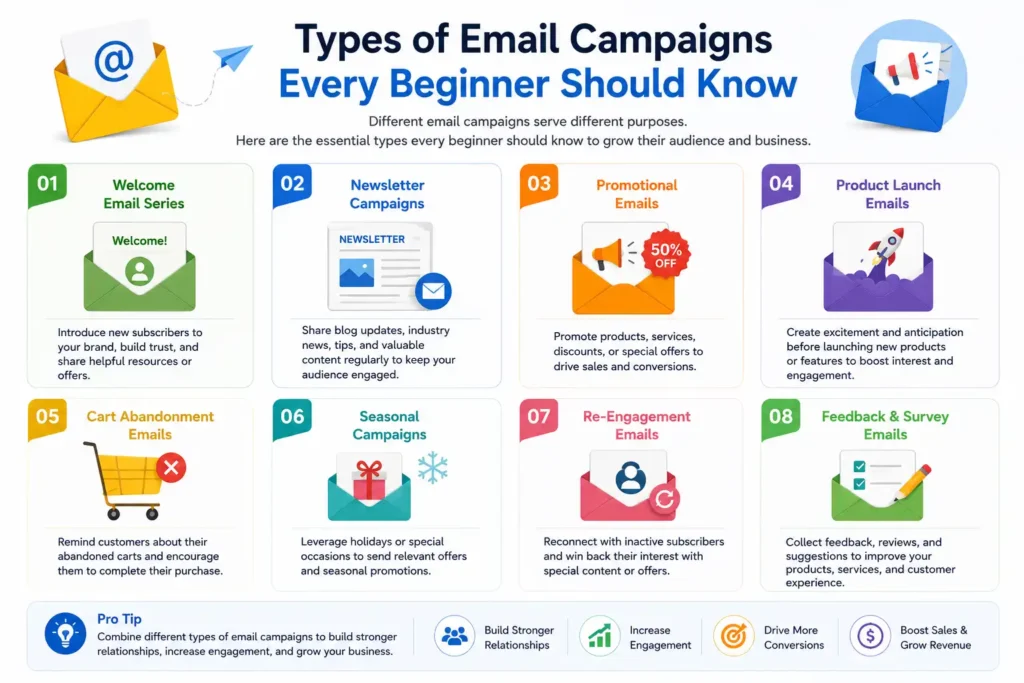
Welcome Email Series
Welcome emails helps in to introduce new subscribers to a brand instantly after signup. These emails usually include greetings, brand information, helpful resources, or exclusive offers.
Newsletter Campaigns
Newsletter campaigns help businesses share updates, blog posts, industry news, and educational content regularly with subscribers. Consistent newsletters strengthen audience relationships and keep brands visible in subscriber inboxes.
Promotional Emails
Promotional emails focus on increasing sales, product awareness, or conversions through special offers and marketing campaigns. Businesses use promotional emails to announce discounts, limited-time deals, or exclusive products
Product Launch Emails
Product launch emails create excitement around new products, services, or features before official releases. Businesses use teaser campaigns, countdowns, and early-access offers to build anticipation among subscribers.
Cart Abandonment Emails
Cart abandonment emails target users who added products to carts but left without completing purchases. These automated emails remind customers about unfinished orders and often include incentives like discounts or free shipping.
Seasonal Campaigns
Seasonal email campaigns align with holidays, events, or shopping trends throughout the year. Businesses use seasonal campaigns to promote relevant products, special discounts, or limited-time offers during occasions like Black Friday, Christmas, or summer sales.
Re-Engagement Emails
Re-engagement emails target inactive subscribers who stopped opening or interacting with campaigns. Businesses use these emails to rebuild interest through personalized messages, exclusive offers, or feedback requests.
Feedback and Survey Emails
Feedback and survey emails help businesses understand customer opinions, experiences, and satisfaction levels. These emails collect valuable insights that improve products, services, and customer support.
Email Marketing Automation in 2026
Email marketing automation allows businesses to send personalized emails automatically based on user behavior, triggers, or schedules. Automation saves time while maintaining consistent communication with subscribers throughout different stages of the customer journey. Modern email marketing platforms provide automation tools that help beginners create welcome sequences, abandoned cart emails, follow-ups, and behavioral campaigns easily. According to Salesforce studies, automated email campaigns often achieve higher engagement rates compared to standard bulk emails because they deliver relevant content at the right time. Understanding automation helps businesses improve efficiency, nurture leads more effectively, and scale communication without manually managing every email interaction individually.
💚 You might also like: Classroom 15x: Transforming Modern Education in 2026
Email Marketing Metrics You Should Track
Tracking email marketing metrics helps businesses understand campaign performance and identify opportunities for improvement. Without analytics, marketers cannot determine whether subscribers are engaging with content or ignoring campaigns completely. Important metrics like open rates, click-through rates, conversions, and unsubscribe rates reveal how audiences respond to email communication. According to HubSpot research, data-driven marketers consistently achieve better campaign results than businesses relying on guesswork alone. Monitoring performance metrics also helps improve subject lines, personalization, segmentation, and content quality over time. Beginners should focus on understanding essential email marketing KPIs because strong analytics support smarter decisions and long-term growth strategies.
A/B Testing in Email Marketing
A/B testing is one of the most effective ways to improve email marketing performance through data-driven experimentation. Instead of guessing what subscribers prefer, businesses test different email elements to identify which versions produce better results. Modern email marketing platforms make A/B testing accessible even for beginners by automating experiments and reporting outcomes clearly.
According to Campaign Monitor studies, small changes in subject lines, CTA buttons, or send times can significantly impact engagement and conversions. Businesses that consistently test campaigns often achieve stronger long-term performance because they continuously optimize communication strategies according to actual subscriber behavior and preferences.
💚 You might also like: 10 Best Tools For Teachers in 2026 (Digital & AI Tools)
Common Email Marketing Mistakes Beginners Make
Many beginners struggle with email marketing because they focus on quick results instead of long-term relationship building. Common mistakes often reduce engagement, damage sender reputation, and limit campaign effectiveness. Poor list management, excessive promotions, and weak optimization strategies frequently lead to low open rates and high unsubscribe rates.
Here are some Mistakes :-
- Buying Email Lists
- Sending Too Many Emails
- Ignoring Mobile Users
- Writing Misleading Subject Lines
- Using Too Many CTAs
- Not Cleaning the Email List
- Ignoring Analytics
- Not Testing Emails Before Sending
According to marketing studies, businesses that prioritize audience experience and personalization achieve better email marketing performance consistently. Avoiding common mistakes helps beginners build stronger subscriber trust and improve campaign results gradually. Learning from these errors also allows businesses to create more professional, engaging, and sustainable email marketing strategies that support long-term growth.
Email Marketing Laws and Compliance
Email marketing laws and compliance regulations help protect consumer privacy while ensuring businesses follow ethical communication practices. Companies that ignore email marketing regulations risk financial penalties, legal problems, and damage to brand reputation. Laws like CAN-SPAM and GDPR require businesses to obtain permission, provide unsubscribe options, and handle subscriber data responsibly.
According to privacy experts, transparency and trust are becoming increasingly important for customer retention and brand loyalty. Beginners should understand basic compliance requirements before launching campaigns. Following ethical and legal email marketing practices improves subscriber trust while supporting sustainable long-term communication and business growth across global markets.
Frequently Asked Questions (FAQs)
Is email marketing good for beginners?
Yes, email marketing is highly beginner-friendly because modern platforms simplify campaign creation, automation, and analytics.
How much does email marketing cost?
Email marketing costs vary depending on subscriber size, platform features, and campaign complexity. Many platforms offer free plans for small audiences, while paid plans may range from affordable monthly subscriptions to enterprise pricing.
Can I start email marketing for free?
Yes, many email marketing platforms provide free plans that include basic templates, subscriber management, and automation features. Beginners can build email lists and launch campaigns without major upfront costs.
How often should I send emails?
Email frequency depends on audience expectations, industry type, and content quality. Many businesses send weekly or biweekly emails to maintain engagement without overwhelming subscribers.
What is a good email open rate?
A good email open rate varies by industry, audience quality, and campaign type. In many industries, open rates between 20% and 30% are considered healthy.
Which email marketing tool is easy to use?
Mailchimp, MailerLite, and ConvertKit are commonly considered beginner-friendly email marketing tools because of their simple interfaces and helpful tutorials.
How long should marketing emails be?
Marketing emails should remain concise and focused while providing enough value for subscribers. Shorter emails often perform better because modern audiences prefer quick and easy-to-read communication.
Is email marketing still profitable in 2026?
Yes, email marketing remains highly profitable in 2026 because it provides direct communication, strong personalization, and measurable ROI.
Final Thoughts
Email marketing continues to be one of the most effective and reliable digital marketing strategies for businesses of all sizes. It helps brands build direct relationships with subscribers, increase engagement, and generate long-term revenue through personalized communication. Beginners do not need advanced technical skills to succeed because modern email marketing platforms simplify campaign creation, automation, and analytics significantly. The key to success is consistency, experimentation, and providing genuine value to subscribers regularly. Businesses that focus on audience trust instead of aggressive promotion usually achieve stronger long-term results. Starting with simple campaigns and improving gradually is often the best approach for sustainable email marketing growth.
✨ More clarity. More insights. Less noise. Follow Tech Fueler.