
What Is Freelancing and Its Types?
Freelancing is a work model where individuals offer services to clients without becoming permanent employees. Over the last few years, freelancing has grown rapidly because businesses now prefer flexible talent over full-time hiring. According to Upwork, millions of professionals worldwide earn through freelancing in areas like writing, graphic design, programming, SEO, and marketing. Common freelancing types include creative freelancing, technical freelancing, consulting, and virtual assistance. Many people start freelancing because it offers flexibility, lower startup costs, and location independence compared to traditional jobs.
How Freelancing Works
Freelancing works through direct client relationships where professionals provide specialized services for short-term or long-term projects. Unlike regular employment, freelancers manage their own schedules, pricing, communication, and workload. Most freelancers operate remotely using online platforms, social media, or personal websites to attract clients. This work model gives individuals more control over their careers, but it also requires consistency, discipline, and self-management skills to maintain a stable income and long-term growth in competitive industries.
Finding Clients
Finding clients is one of the most important parts of freelancing success. Freelancers usually get clients through platforms like Fiverr, Upwork, LinkedIn, referrals, or personal branding. Building trust, showing strong portfolios, and networking consistently help freelancers attract better-paying projects and long-term contracts in competitive markets.
Project-Based Work
Most freelancers work on project-based contracts where clients pay for a specific task or deliverable. This model allows flexibility because freelancers can handle multiple clients at the same time. Common project-based services include website development, content writing, logo design, video editing, and digital marketing campaigns for businesses worldwide.
Hourly vs Fixed Pricing
Freelancers generally use hourly or fixed pricing models depending on the project scope. Hourly pricing works better for ongoing tasks or uncertain workloads, while fixed pricing suits clearly defined projects. According to industry surveys, experienced freelancers often prefer value-based pricing because it increases profit potential and rewards expertise instead of time spent.
Remote Work Structure
Freelancing mainly operates through remote work structures where communication happens online using tools like Zoom, Slack, Trello, and Google Meet. This setup allows freelancers to work with international clients from anywhere. Remote freelancing also reduces office expenses and gives professionals greater flexibility in managing daily schedules and productivity.
What Is a Business and Its Types?
A business is an organization created to provide products or services in exchange for profit. Unlike freelancing, businesses are designed to operate beyond one individual’s personal effort. Businesses can range from small local stores to large global companies with employees, systems, and multiple income streams. Common business types include service businesses, product-based businesses, eCommerce stores, SaaS companies, agencies, and subscription models. According to the U.S. Small Business Administration, small businesses play a major role in economic growth and job creation worldwide. Many entrepreneurs choose business models because they offer scalability and long-term asset-building opportunities.
How a Business Operates
A business operates through systems, processes, teams, and structured operations that help generate consistent revenue. Unlike freelancers who mainly rely on personal work hours, businesses focus on building scalable models that can grow over time. Business owners manage sales, marketing, operations, finances, and customer relationships while creating systems that reduce dependency on one person. Successful businesses usually prioritize automation, branding, customer retention, and operational efficiency to increase long-term profitability and market stability.
Hiring Employees or Contractors
Businesses often hire employees or independent contractors to handle operations, customer service, marketing, and production tasks. Delegation allows companies to scale faster without relying entirely on the owner’s time. Many startups begin with freelancers or remote contractors before building full in-house teams as revenue and operational demands increase.
Building Processes
Processes help businesses operate smoothly and consistently. Standard operating procedures, workflows, and automation systems reduce errors while improving productivity. Strong business processes also make team training easier and allow companies to maintain quality as they scale operations, handle more customers, and expand into competitive markets.
Managing Operations and Growth
Business owners focus heavily on managing operations, cash flow, customer experience, and long-term growth strategies. This includes marketing campaigns, financial planning, hiring decisions, and process optimization. Sustainable growth usually comes from strong leadership, clear systems, and the ability to adapt quickly to changing customer demands and industry trends.
Difference Between Freelancing and Business
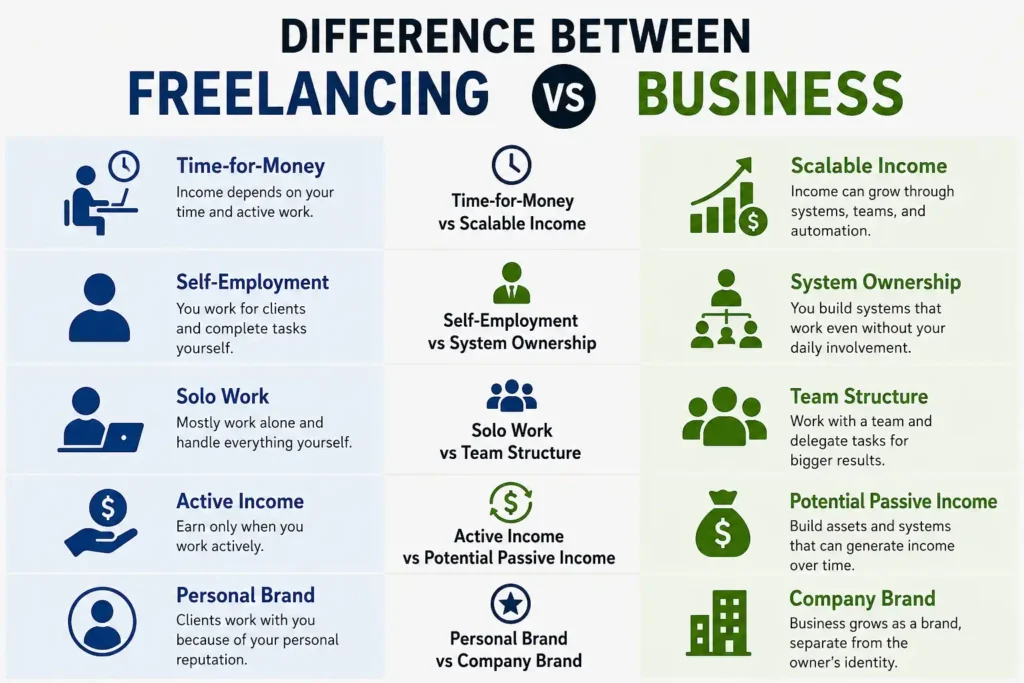
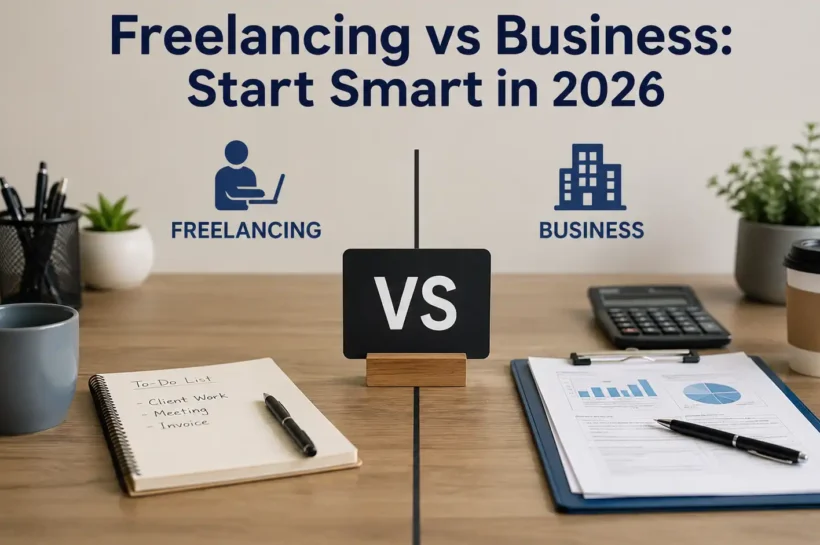
The main difference between freelancing and business lies in scalability, structure, and income generation. Freelancers mainly sell personal skills and time, while businesses create systems that can operate with teams, automation, and processes. Freelancing offers flexibility and faster startup opportunities, whereas businesses focus on long-term expansion and asset creation. Both models can become profitable, but they require different mindsets, responsibilities, and growth strategies. Choosing between freelancing and business depends on personal goals, financial risk tolerance, and desired lifestyle.
Time-for-Money vs Scalable Income
Freelancing usually follows a time-for-money model where earnings depend on active work hours. Businesses focus more on scalable income by building systems, products, or teams that generate revenue continuously. This scalability gives businesses greater long-term growth potential compared to solo freelancing models tied directly to personal availability.
Self-Employment vs System Ownership
Freelancers are self-employed professionals responsible for completing client work themselves. Business owners focus on creating systems that operate independently from their daily involvement. Owning scalable systems allows entrepreneurs to reduce workload dependency while increasing operational efficiency, profitability, and business valuation over time.
Solo Work vs Team Structure
Freelancers often work independently and manage projects alone, while businesses typically involve teams, departments, and collaboration structures. Team-based operations allow businesses to handle larger workloads, serve more customers, and expand faster. However, managing teams also increases operational complexity and leadership responsibilities for business owners.
Active Income vs Potential Passive Income
Freelancers mainly earn active income because payments stop when work stops. Businesses can create potential passive income through digital products, subscriptions, software, licensing, or automated services. Although passive income still requires management, businesses usually have stronger opportunities for long-term recurring revenue generation.
Personal Brand vs Company Brand
Freelancers usually grow through personal branding, where clients trust their individual expertise and reputation. Businesses build company brands that operate separately from the founder’s identity. A strong company brand creates long-term market value, improves scalability, and helps businesses attract customers, partnerships, and investment opportunities more effectively.
💚 You might also like: Best Email Marketing Guide for Beginners & Experts 2026
Skills Needed for Freelancing vs Business
Freelancing and business ownership both require valuable skills, but the priorities differ on each path. Freelancers mainly depend on personal expertise, communication, and client handling abilities to generate income consistently. Business owners, on the other hand, focus more on leadership, systems, sales, and long-term growth management. According to research from LinkedIn, communication, adaptability, and problem-solving remain among the most in-demand professional skills globally. Whether someone chooses freelancing or business, learning high-income and management skills greatly improves long-term success, financial stability, and career growth opportunities in competitive digital industries.
Skills Required for Freelancers
Successful freelancers need a combination of technical and soft skills to attract clients and maintain long-term relationships. Communication helps build trust with clients, while client management improves project handling and professionalism. Technical expertise increases service quality and market demand. Personal branding helps freelancers stand out online, and strong time management improves productivity and deadline consistency.
Skills Required for Business Owners
Business owners require broader management and growth-focused skills. Leadership helps guide teams and make strategic decisions, while sales and marketing drive customer acquisition. Team management improves productivity and workflow efficiency. Financial planning supports business stability, and systems building helps companies scale operations without depending entirely on the owner’s daily involvement.
💚 You might also like: AxelaNote: Smart Note-Taking Tool For Productivity
Real-Life Examples of Freelancing and Business Models
Real-world examples help explain how freelancing and business models work differently in practical situations. Many freelancers begin independently by selling services online, while entrepreneurs build systems and teams around scalable ideas. The rise of digital platforms has made both models more accessible globally. According to Statista, the global freelance market and online business economy continue growing rapidly due to remote work and digital transformation. Studying successful examples gives beginners valuable insights into income potential, scalability, branding, and long-term sustainability in both career paths.
Example of a Successful Freelancer
A freelance graphic designer working through platforms like Upwork or direct referrals can build a six-figure career independently. Many successful freelancers increase income by specializing in premium services, improving personal branding, and creating long-term client relationships instead of relying only on low-paying one-time projects.
Example of a Service Agency
Digital marketing agencies are strong examples of scalable service businesses. Agencies usually start with one freelancer who later builds a team of writers, designers, SEO experts, and account managers. This structure allows agencies to serve multiple clients simultaneously while generating higher revenue without depending entirely on one individual’s workload.
Example of an Online Business
An online business example includes eCommerce stores, SaaS products, or educational platforms selling digital courses. These businesses often use automation, paid advertising, and content marketing to scale globally. Many online businesses generate recurring revenue through subscriptions, memberships, or repeat customer purchases over time.
Lessons From Each Model
Freelancing teaches independence, communication, and skill mastery, while business ownership teaches leadership, systems, and scalability. Freelancers learn how to sell expertise directly, whereas businesses focus on building long-term operational structures. Both paths offer valuable lessons, and many entrepreneurs actually begin their journey through freelancing before creating scalable companies.
Biggest Challenges People Face in Both Paths
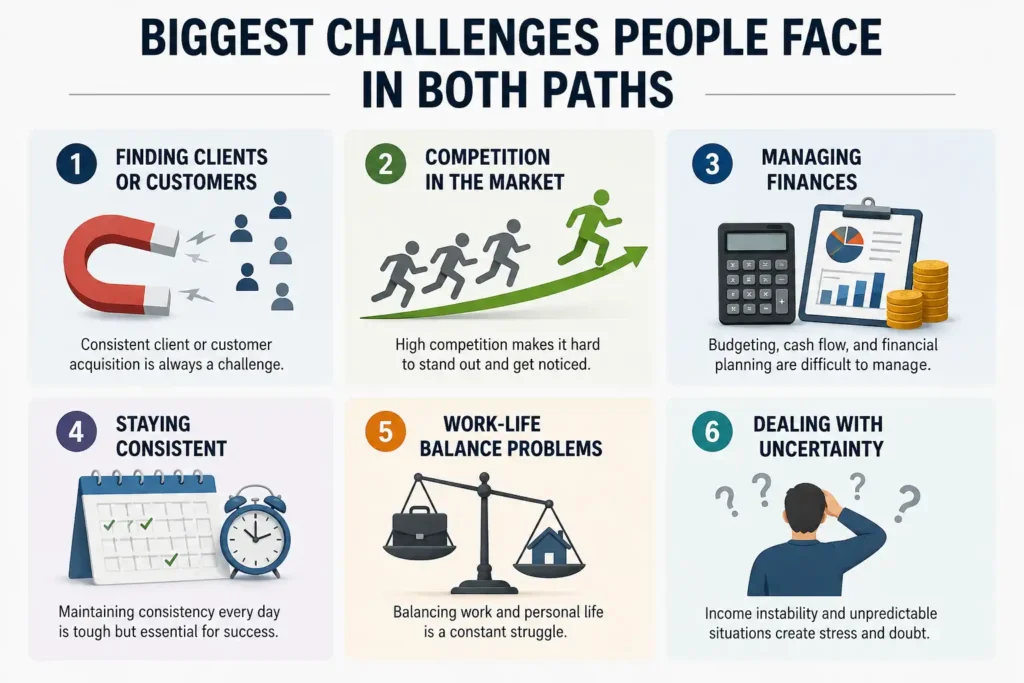
Finding Clients or Customers
Both freelancers and businesses struggle with attracting paying clients consistently. Strong marketing, networking, referrals, and personal branding are essential for customer acquisition. Without consistent lead generation, income becomes unstable, making growth difficult for freelancers and businesses operating in highly competitive online industries.
Competition in the Market
Competition continues to increase because more professionals and companies are entering online industries every year. Standing out requires specialization, branding, quality service, and a better customer experience. Businesses and freelancers that fail to differentiate themselves often struggle with pricing pressure and inconsistent client demand.
Managing Finances
Financial management is a major challenge for freelancers and entrepreneurs alike. Budgeting, saving, tax planning, and managing cash flow require discipline and planning. Poor financial decisions often create stress, limit growth opportunities, and increase the risk of business failure or unstable freelance income.
Staying Consistent
Consistency is one of the hardest challenges in freelancing and business ownership. Success usually comes from long-term effort instead of short-term motivation. Consistently improving skills, marketing services, and delivering quality work helps professionals build sustainable income and stronger reputations over time.
Work-Life Balance Problems
Freelancers and entrepreneurs often struggle with separating work from personal life, especially in remote work environments. Irregular schedules, client demands, and business responsibilities can lead to burnout. Building routines, setting boundaries, and managing workload properly help maintain healthier long-term productivity and mental focus.
Dealing With Uncertainty
Income uncertainty is common in both freelancing and business ownership. Market changes, economic conditions, and client loss can affect revenue unexpectedly. Successful professionals reduce uncertainty by diversifying income streams, improving savings, and continuously adapting to changing industry trends and customer behavior.
Best Industries for Freelancing and Business in 2026
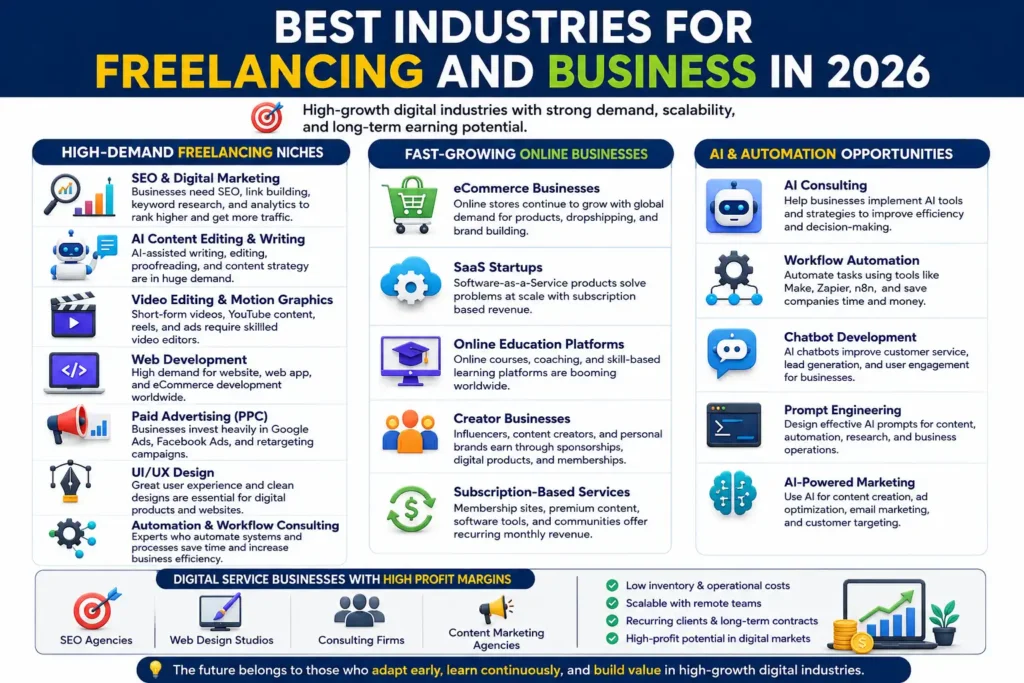
The digital economy continues to create new opportunities for freelancers and entrepreneurs across multiple industries. Businesses increasingly rely on remote services, automation, AI tools, and online operations, making digital skills more valuable than ever. Choosing high-growth industries improves earning potential, scalability, and long-term stability. Professionals who adapt early to emerging technologies and online business trends will likely gain major competitive advantages in future markets.
High-Demand Freelancing Niches
High-demand freelancing niches in 2026 include SEO, AI content editing, video editing, web development, paid advertising, UI/UX design, and automation consulting. Businesses continue outsourcing specialized digital tasks globally, creating strong opportunities for skilled freelancers with technical expertise and strong online portfolios.
Fast-Growing Online Businesses
Fast-growing online businesses include SaaS startups, eCommerce brands, online education platforms, creator businesses, and subscription-based services. These models scale effectively because they serve global audiences through digital systems. Many entrepreneurs prefer online businesses because of lower operational costs and higher scalability potential.
AI and Automation Opportunities
AI and automation are creating major opportunities for freelancers and businesses alike. AI consulting, workflow automation, chatbot development, prompt engineering, and AI-powered marketing services are becoming highly profitable industries. Companies increasingly invest in automation tools to improve efficiency and reduce long-term operational costs.
Digital Service Businesses With High Profit Margins
Digital service businesses like SEO agencies, web design studios, consulting firms, and content marketing agencies often have high profit margins because they require lower inventory and operational expenses. These businesses scale effectively through remote teams, automation systems, and recurring client contracts in growing online markets.
Expert Tips for Success in Freelancing or Business
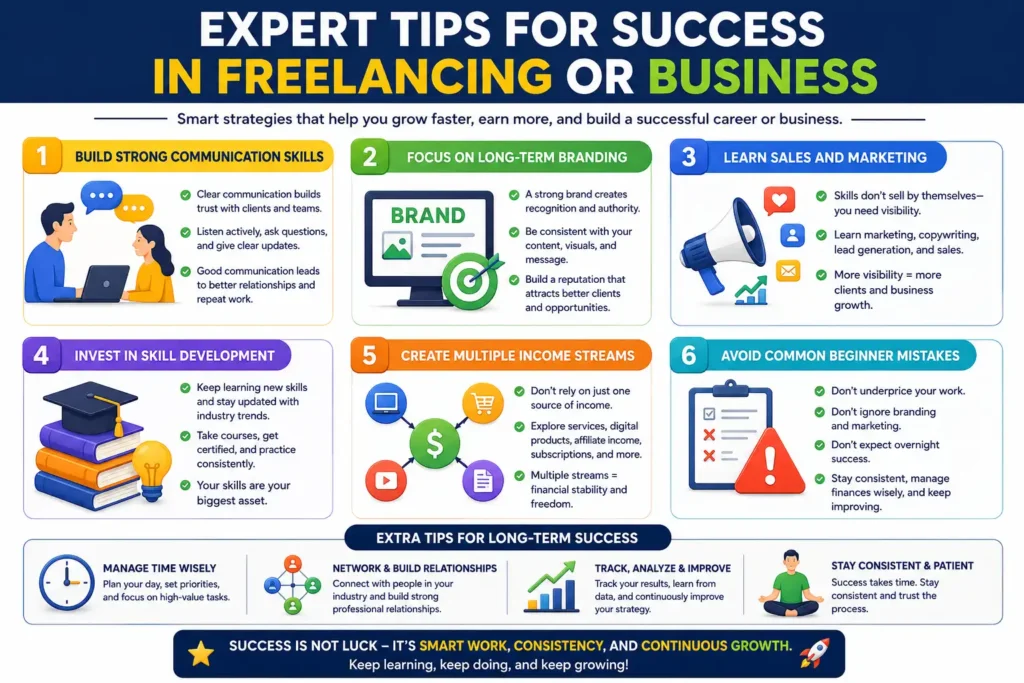
Success in freelancing or business rarely happens overnight. Both paths require patience, adaptability, continuous learning, and strong problem-solving abilities. Many successful entrepreneurs and freelancers spend years improving their systems, communication, and marketing strategies before reaching financial stability. According to research from Harvard Business Review, long-term business growth often depends more on consistency and decision-making than talent alone. Whether someone chooses freelancing or entrepreneurship, building valuable skills and maintaining discipline are critical for sustainable growth. The most successful professionals focus on long-term positioning instead of chasing quick income or temporary trends.
Build Strong Communication Skills
Communication is one of the most valuable skills in freelancing and business. Clear communication improves client trust, team collaboration, negotiations, and customer relationships. Professionals who communicate confidently usually close more deals, solve problems faster, and maintain stronger long-term partnerships in competitive industries and remote work environments.
Focus on Long-Term Branding
Long-term branding helps freelancers and businesses build authority, trust, and recognition in their industries. A strong brand increases customer loyalty and improves marketing results over time. Consistent content, professional presentation, and positive customer experiences help create a reputation that attracts better opportunities and higher-paying clients.
Learn Sales and Marketing
Sales and marketing are essential for generating revenue in any business model. Even highly skilled professionals struggle without effective customer acquisition strategies. Learning content marketing, social media promotion, copywriting, lead generation, and sales psychology helps freelancers and entrepreneurs attract consistent clients and grow their income sustainably.
Invest in Skill Development
Industries change rapidly, especially in digital markets driven by technology and AI innovation. Professionals who continuously improve their skills remain competitive and adaptable. Investing in courses, certifications, practical experience, and industry knowledge increases expertise while creating better career and business growth opportunities over time.
Create Multiple Income Streams
Relying on a single income source increases financial risk in freelancing and business. Successful professionals often diversify income through consulting, digital products, affiliate marketing, subscriptions, online courses, or service expansion. Multiple income streams improve financial stability and reduce dependency on one client or revenue channel.
Avoid Common Beginner Mistakes
Many beginners fail because they underprice services, ignore branding, avoid marketing, or expect instant success. Others struggle with poor financial management and inconsistent effort. Learning from experienced professionals, setting realistic expectations, and focusing on long-term growth help avoid costly mistakes in competitive industries.
💚 You might also like: Best 12 Passive Income Ideas That Work in 2026
Frequently Asked Questions
Freelancing and business ownership often raise important questions for beginners deciding between flexibility, scalability, income stability, and long-term career goals. Both models offer unique advantages and challenges depending on personal preferences, financial situation, and professional skills. As digital work continues growing worldwide, more people are exploring freelancing and entrepreneurship as alternatives to traditional employment. Understanding common questions helps individuals make informed decisions while setting realistic expectations about workload, profitability, freedom, and long-term sustainability in modern online industries.
Is freelancing better than business?
Freelancing is better for people who want flexibility, lower startup costs, and direct control over their workload. Business ownership is usually better for those interested in scalability, team building, and long-term asset creation. The better option depends on personal goals, risk tolerance, and lifestyle preferences.
Can a freelancer become a business owner?
Yes, many successful business owners start as freelancers first. Freelancing helps individuals build skills, client relationships, industry knowledge, and financial resources. Over time, freelancers often scale into agencies, consulting firms, or product-based businesses by hiring teams and building operational systems.
Which is most profitable in the long term?
Businesses generally have higher long-term profit potential because they can scale through systems, automation, and teams. Freelancing income often depends on personal time and workload capacity. However, highly specialized freelancers can still earn substantial income through premium pricing and recurring client relationships.
Is freelancing considered a business?
Yes, freelancing is technically a business because freelancers provide services in exchange for income. Freelancers manage clients, pricing, contracts, marketing, and finances independently. Many governments and financial institutions legally classify freelancing as self-employment or a small business activity.
Which option is safer for beginners?
Freelancing is often considered safer for beginners because it requires lower investment and smaller financial risks. People can start freelancing with existing skills and gradually build experience. Businesses may involve greater operational complexity, startup costs, and financial responsibilities during the early stages.
Can I do freelancing and business together?
Yes, many professionals combine freelancing and business ownership simultaneously. Freelancers often use client income to fund new business ideas or agencies. This hybrid approach helps create financial stability while gradually building scalable systems, products, or long-term business operations.
Which one gives more freedom?
Freelancing offers more short-term flexibility because individuals control their schedules and workloads directly. Businesses may eventually provide greater long-term freedom once systems and teams are established. However, business ownership usually requires more responsibility and time commitment during the growth phase.
How much money do I need to start?
Freelancing can start with minimal investment because many services only require a computer, internet connection, and marketable skills. Online businesses may also begin with low costs depending on the business model. Traditional businesses generally require higher startup capital, equipment, or operational expenses.
Freelancing vs Business: Which Is More Secure?
Neither freelancing nor business ownership guarantees complete security because both depend on market demand and consistent income generation. Freelancers face client dependency risks, while businesses manage operational and financial risks. Building strong skills, savings, and multiple income streams improves security in both models.
Can You Start With Freelancing and Later Build a Business
Yes, this is one of the most common growth paths today. Many entrepreneurs begin by freelancing to gain experience, build networks, and generate capital. After understanding market demand, they expand into agencies, digital products, SaaS platforms, or other scalable online business models successfully.
Conclusion
Freelancing and business ownership both offer valuable opportunities in today’s digital economy, but they follow very different growth paths. Freelancing focuses more on personal skills, flexibility, and direct client work, while businesses prioritize scalability, systems, and long-term expansion. Neither option is universally better because success depends on individual goals, mindset, risk tolerance, and lifestyle preferences. Many professionals actually combine both models by starting as freelancers before building larger businesses over time. The key to long-term success is continuous learning, consistency, strong communication, and the ability to adapt to changing market trends and digital opportunities.
✨ This is just the start. Follow Tech Fueler for more gems.