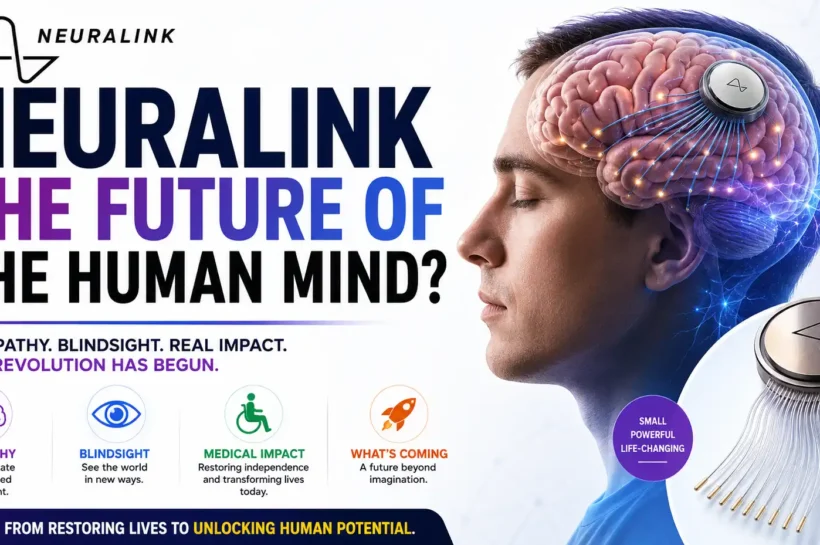

What Is Neuralink?
Neuralink was founded in 2016 by Elon Musk alongside a team of neuroscientists and engineers, including Max Hodak, who later departed the company. The founding idea was deceptively simple but enormous in scope: the human brain communicates at a painfully slow rate with the digital world. We type, we swipe, we talk, but these are all low-bandwidth bottlenecks compared to how fast the brain actually processes information.
The company’s official two-part mission is to restore autonomy to people with unmet medical needs, and then eventually to expand human potential for healthy individuals. The first part is what’s happening right now in clinical trials. The second part is the long-term vision that raises both excitement and serious ethical debate.
Headquartered in Fremont, California, and now with operations in Austin, Texas, Neuralink has raised over $650 million in funding as of 2025, including a significant funding round announced in June 2025. The investor confidence signals that this isn’t a startup experiment anymore, it’s a company that people with serious money believe will fundamentally alter medicine.
How Does Neuralink Work?
Here’s where most coverage gets either too technical or too vague. Let’s hit the middle ground detailed enough to actually understand, but written for someone who isn’t a neurosurgeon.
The brain communicates through electrical signals. Neurons fire, sending tiny voltage spikes along their connections. These spikes encode information about the intent to move your hand, the mental image of a chess piece, or the word you’re about to say. The challenge with traditional medical devices has always been reading those signals clearly, reliably, and wirelessly, without causing damage or requiring a tangle of external wires.
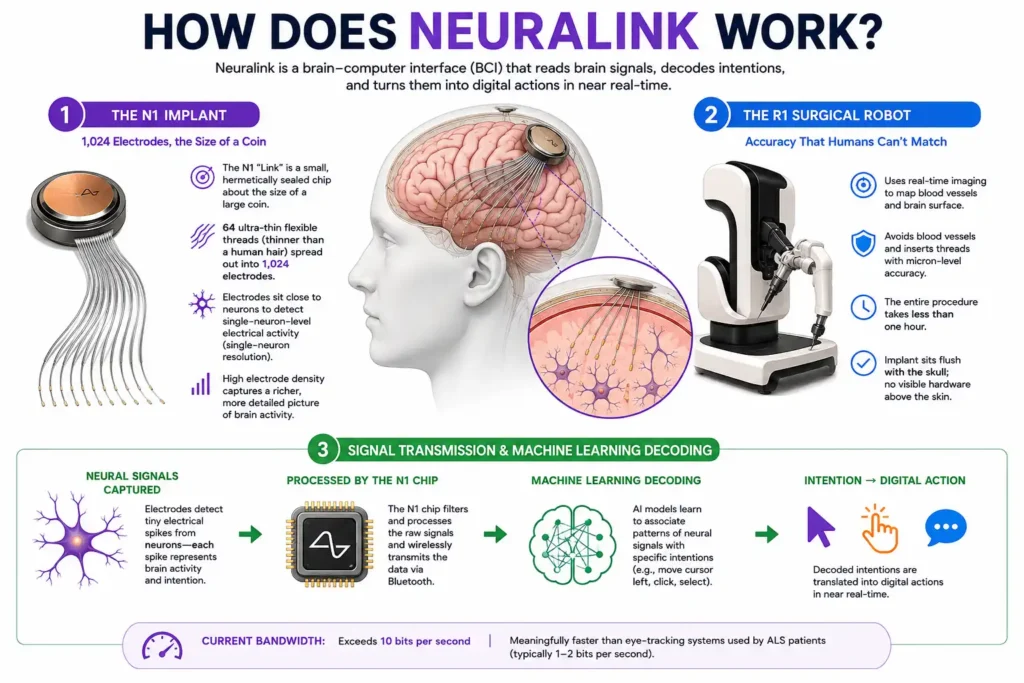
Neuralink’s approach is built around three core components: the N1 implant, the R1 surgical robot, and a machine learning decoding system. Together, these three elements form a system that can translate thought into digital action in near real-time.
The N1 Implant 1,024 Electrodes, the Size of a Coin
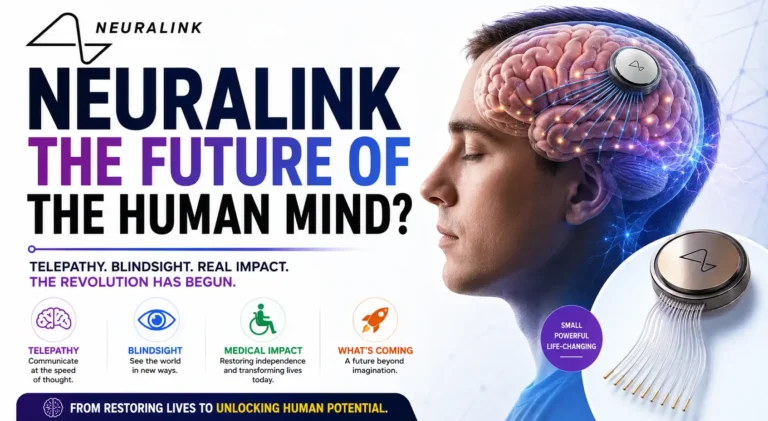
The N1 device, also called “the Link,” is a small, hermetically sealed chip roughly the size of a large coin. It’s implanted directly into the cerebral cortex, the outer layer of the brain responsible for motor control, thought, and perception. Attached to the chip are 64 flexible threads, each thinner than a human hair, spreading out into 1,024 individual electrodes. These electrodes sit close enough to individual neurons to detect single-neuron-level electrical activity, a capability researchers call “single-neuron resolution.”
This is a significant technical leap. Older BCI devices used far fewer electrodes. The extra density means Neuralink can capture a richer, more detailed picture of what the brain is doing moment to moment.
The R1 Surgical Robot Accuracy That Humans Can’t Match
Implanting threads thinner than a human hair into a living brain, while avoiding blood vessels, requires precision that no human surgeon can reliably deliver. That’s why Neuralink built the R1 robot. The machine uses real-time imaging to map blood vessels, then inserts threads into the cortex with micron-level accuracy. The entire procedure takes less than one hour, and the implant sits flush with the skull; there’s no visible hardware above the skin.
Signal Transmission and Machine Learning Decoding
Once the electrodes are capturing neural signals, the N1 chip processes and transmits that data wirelessly via Bluetooth to a smartphone app. Here’s where machine learning steps in. The raw neural signals are patterns of electrical spikes, meaningless without context. Neuralink’s software learns to associate specific patterns with specific intentions (moving a cursor left, clicking a button, thinking of a particular letter). Over time, the decoding improves. The system gets calibrated to each patient’s unique neural patterns.
According to Neuralink’s own technical updates, the current bandwidth exceeds 10 bits per second, meaningfully faster than eye-tracking systems currently used by ALS patients, which typically max out around 1–2 bits per second.
💚 You might also like: Schedow: Smart AI Scheduling for Better Productivity in 2026
Neuralink’s Human Trials: Real Patients, Real Results
Clinical trial data is where the rubber meets the road. Let’s look at what’s actually happened with real patients, because this is where Neuralink either proves or disproves its claims.
FDA Approval: A Rocky Road to Green Light
The FDA initially rejected Neuralink’s application for human trials in 2022, citing concerns about thread migration within brain tissue, battery safety, lithium exposure risk, and gaps in preclinical data. Neuralink spent roughly a year addressing these issues, refining thread flexibility so they retract with natural brain movement, hermetically sealing the battery, and perfecting the R1 robot’s vessel-avoiding insertion. FDA approval came in May 2023. The PRIME Study (Precise Robotically Implanted Brain-Computer Interface) was subsequently cleared.
Noland Arbaugh, the First Human Patient
Noland Arbaugh, paralyzed from the shoulders down after a diving accident, received the first Neuralink implant in January 2024. Within days, he was controlling a computer cursor with his thoughts. He played chess online for hours. He later demonstrated learning Spanish and doing math through neural control. His case attracted massive global attention because it wasn’t a controlled lab demonstration. It was a person living his life, meaningfully improved, because of a chip in his brain.
There was a complication worth noting: approximately 85% of the electrode threads retracted from the cortex in the weeks following surgery. This reduced signal quality. Neuralink addressed it through software updates that improved signal decoding from the remaining threads without requiring additional surgery. No infections occurred. No device failure. The fix was algorithmic, not surgical.
The CONVOY Study Controlling Robotic Arms
A second study, CONVOY, extended the application to external assistive devices. Participant Alex Conley also cross-enrolled from the PRIME Study, demonstrating control of an Assistive Robotic Arm (ARA) using the same neural implant. He played rock-paper-scissors with a robotic hand and, at one point, controlled a Tesla Optimus robot arm shown publicly at Neuralink’s Summer 2025 progress update.
ALS Patient Brad Communicating Outdoors Again
Brad, a nonverbal ALS patient, used Neuralink’s system to communicate something impossible outdoors with his previous eye-tracking setup, which required stable lighting and a fixed screen. His case represents one of the most powerful real-world demonstrations of what this technology can do for quality of life, beyond laboratory conditions.
Global Expansion of Trials
By late 2025, Neuralink had expanded clinical operations across four countries. The UAE-PRIME Study was launched at Cleveland Clinic Abu Dhabi in partnership with the Department of Health Abu Dhabi. In the United Kingdom, Neuralink partnered with University College London Hospitals and Newcastle Hospitals for the GB-PRIME Study, announced in July 2025. Canada saw its first procedures with cervical spinal cord injury patients. As of October 2025, more than 13 patients had received the implant, with Neuralink’s stated goal of reaching 20–30 globally by year’s end.
Neuralink’s Products: Telepathy, Blindsight & What’s Coming
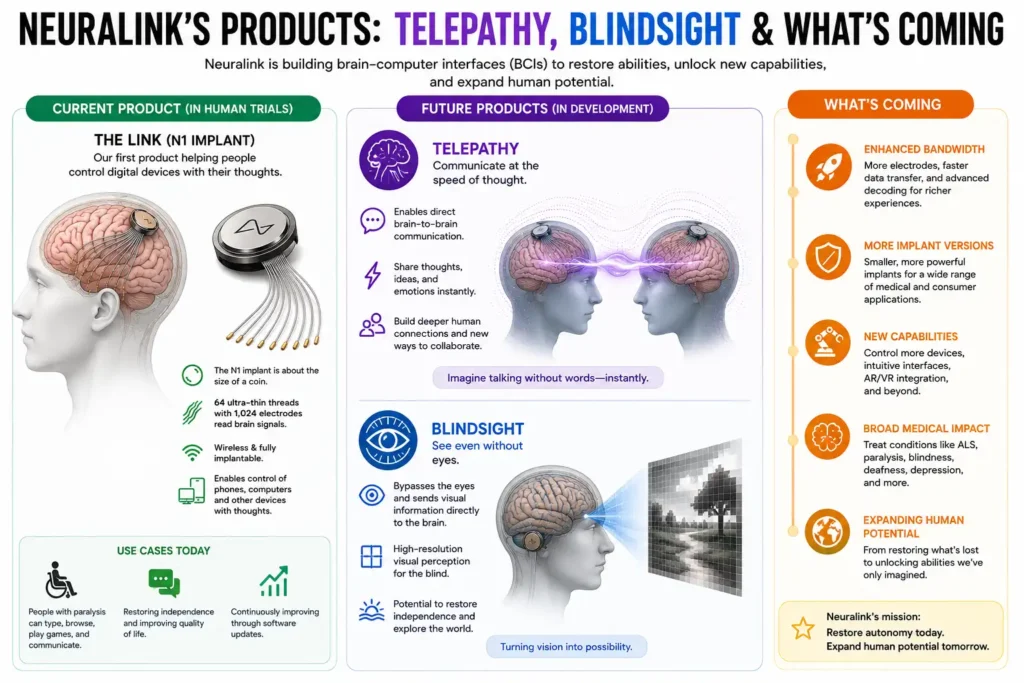
Most people think Neuralink is one product. It’s actually a platform company building multiple distinct neural interfaces. Understanding the product roadmap is key to understanding where the technology is going.
Telepathy, the First Product, Already in Patients
Telepathy is Neuralink’s flagship device, the one in Noland, Brad, and Alex. Its primary purpose is motor restoration: allowing patients to control computers, smartphones, and robotic devices through thought. It reads signals from the motor cortex and translates them into cursor movement, clicks, and commands. The current iteration achieves communication speeds meaningfully faster than existing assistive technologies, particularly for paralysis and ALS patients.
Blindsight Restoring Vision by Bypassing the Eyes
Blindsight is Neuralink’s second major product line, and it works in the opposite direction of Telepathy. Instead of reading from the brain, it writes to it. The device uses camera-equipped glasses to capture visual input, processes it via smartphone, and wirelessly transmits data to an implant in the visual cortex, stimulating neurons to produce the perception of sight. This bypasses the eyes and optic nerves entirely, which means it could theoretically restore vision even to people born blind.
Animal trials in non-human primates showed promising results. Elon Musk announced at the Qatar Economic Forum that the first human implantation could occur in early 2026, potentially in the UAE. The initial visual experience will be low-resolution. Musk described it as similar to “Atari graphics,” but the expectation is that resolution improves with hardware generations and neural adaptation.
VOICE Trial Decoding Speech From Thought
The third active product development stream targets speech restoration. The VOICE trial received FDA Breakthrough Device Designation in mid-2025 and was slated to begin enrolling participants in late 2025. The goal: implant a device that reads neural signals associated with the intent to speak and converts them directly into text or synthesized voice, potentially restoring communication to patients who cannot move or produce sound at all.
What’s Beyond the Current Roadmap
Neuralink has hinted at exoskeleton control through neural signals, bidirectional stimulation (writing back to the motor cortex to improve physical therapy outcomes), and eventually memory-related applications. These are long-horizon goals without confirmed timelines, but the infrastructure being built through current trials is the foundation.
Medical Applications: Who Can Neuralink Help Right Now?
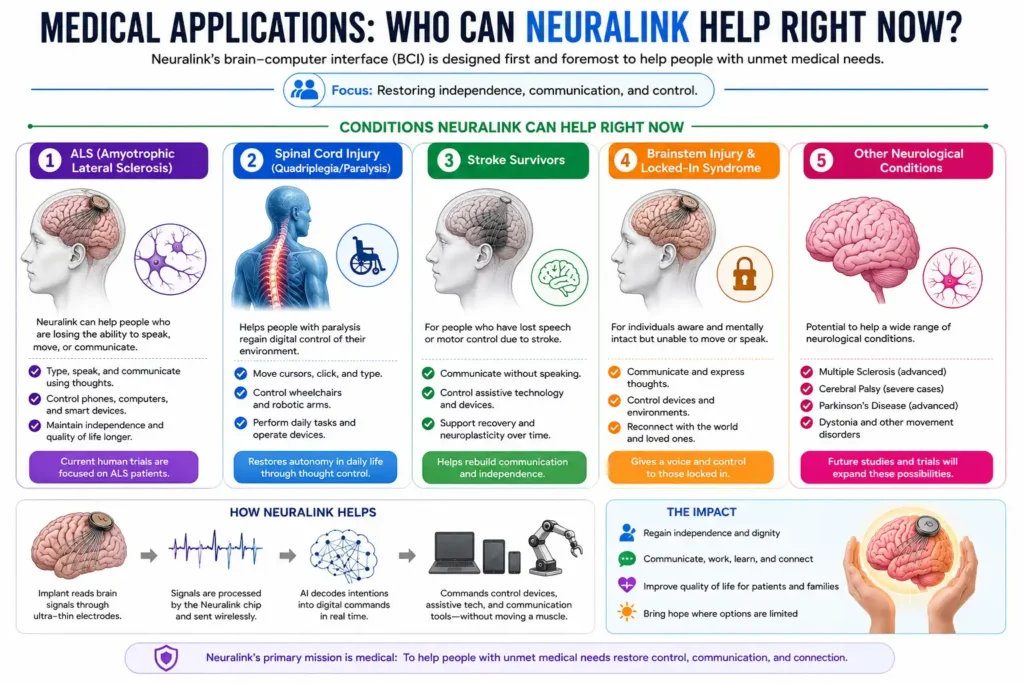
The most grounded, immediate, and unambiguous value of Neuralink is medical. Here’s a realistic look at who the technology can actually benefit today, and who it might help in the coming years.
Spinal Cord Injury and Quadriplegia
Patients with cervical spinal cord injuries who have lost motor function in their arms and legs are currently the primary target population for the PRIME Study. The implant allows them to bypass the damaged spinal cord entirely and send motor intentions directly from the brain to a computer or robotic device. This restores a degree of independent communication, computer access, and device control that was previously out of reach.
ALS Patients
Amyotrophic lateral sclerosis progressively destroys the neurons controlling voluntary muscle movement. In late-stage ALS, patients can lose the ability to speak, type, and even use eye-tracking systems as muscle control deteriorates. Neuralink’s cortical implant, which reads from the brain itself rather than from muscles or eyes, represents potentially the last viable communication channel as the disease progresses. Brad’s case, referenced earlier, is the clearest real-world illustration of this.
Blindness Blindsight’s Target Population
The Blindsight device specifically targets individuals with complete or near-complete vision loss, whether from injury, disease, or congenital causes, who retain an intact visual cortex. The eligibility criteria for initial trials are expected to mirror PRIME Study patterns: adults aged 22–75, with confirmed non-functional eyes or optic nerves but a healthy visual cortex, confirmed via neuroimaging.
Future Neurological Applications Being Studied
Researchers and Neuralink’s own team have discussed potential future applications in stroke rehabilitation, Parkinson’s disease (through targeted stimulation rather than recording), and treatment-resistant depression. These are not current products or active trial phases; they are areas of scientific interest based on adjacent BCI research and the infrastructure Neuralink is building.
How to Apply for a Neuralink Clinical Trial
Neuralink accepts patient applications directly through its website at neuralink.com. Current eligibility focuses on adults with ALS or quadriplegia due to cervical spinal cord injury. The company’s website states applications are open internationally, and trial sites are now active in the US, UK, Canada, and UAE.
Neuralink Vs Others Companies
| Feature | Neuralink | Synchron | BrainGate |
| Electrode Count | 1,024 | 16 | 100 |
| Surgery Type | Open-skull (R1 robot) | Endovascular (no skull opening) | Open-skull |
| Signal Quality | High | Moderate | High |
| Human Patients | 13+ (2025) | Multiple (US/Australia) | Research only |
| FDA Status | 3 Breakthrough Designations | Pivotal trial approval (2023) | Research IND |
| Commercial Roadmap | Active | Active | No |
Neuralink’s competitive advantage is electrode density, wireless capability, and the speed of clinical translation. Its key competitive disadvantage is surgical invasiveness compared to Synchron.
Frequently Asked Questions About Neuralink
Is Neuralink safe?
Based on data available through 2025 from 13+ implanted patients, no infections, device failures, or serious adverse events have been reported. The thread retraction issue in the first patient was resolved through software without additional surgery. Long-term safety data beyond 18 months is still limited.
Can Neuralink read your thoughts?
No. Current devices read the electrical patterns associated with the intent to perform specific physical movements or form specific word patterns that the system is explicitly calibrated to detect. They cannot access memories, emotions, random thoughts, or any mental activity outside the calibrated parameters.
Who currently qualifies for a Neuralink implant?
As of 2026, clinical trial eligibility is focused on adults aged 22–75 with quadriplegia due to cervical spinal cord injury or ALS. Applications are accepted at neuralink.com. Healthy individual access does not exist yet.
How much does Neuralink cost?
Neuralink has not published pricing for commercial use. Current trial participants receive the procedure and device through the clinical trial, funded by Neuralink’s research budget.
What happens if Neuralink as a company fails?
This is a legitimate concern. If the company were to shut down, patients would face the question of whether their implants continue functioning, can be updated, or need to be surgically removed. This is an open regulatory and ethical gap that no regulator has fully addressed yet for any neural implant company.
💚 You might also like: Oncepik: Smart & Simple Tool for Team Productivity
Conclusion
Neuralink is no longer just a futuristic idea or a headline-grabbing concept. It has evolved into a real-world medical technology that is already helping people with severe disabilities regain independence and communication. While the current focus remains on assisting individuals with conditions such as paralysis and ALS, the broader vision extends far beyond today’s capabilities.
At the same time, Neuralink’s journey is still in its early stages. Questions about long-term safety, accessibility, regulation, privacy, and ethics will need careful answers as the technology advances. The successes seen in early clinical trials are encouraging, but widespread adoption will depend on years of additional research, testing, and public trust.
📊 Stay informed. Stay empowered. Follow Tech Fueler.