
Introduction
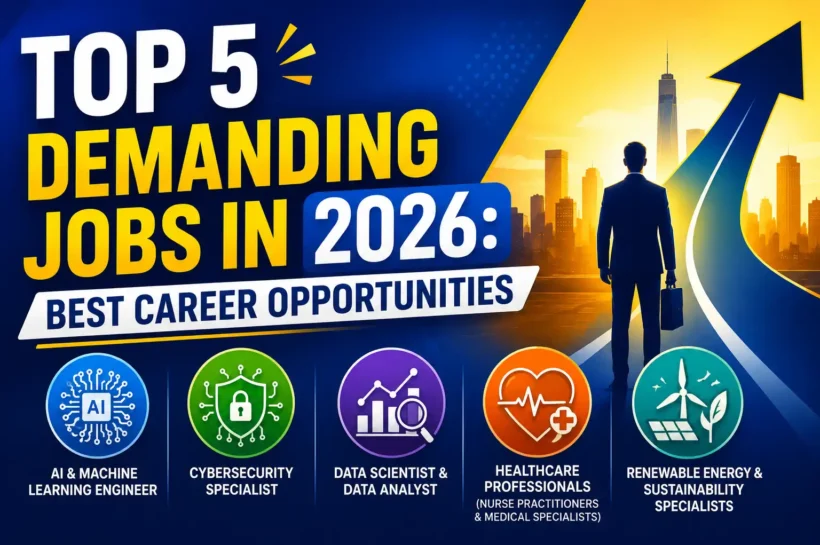
The job market in 2026 looks nothing like it did five years ago. AI is reshaping entire industries, healthcare systems are under pressure, and the energy transition is creating roles that barely existed a decade ago. If you are planning your career right now, one thing is clear: the wrong choice can cost you years. The right one can set you up for decades of stability and growth. This guide breaks down the five most demanding jobs in 2026, backed by real data, so you can make a smarter move.
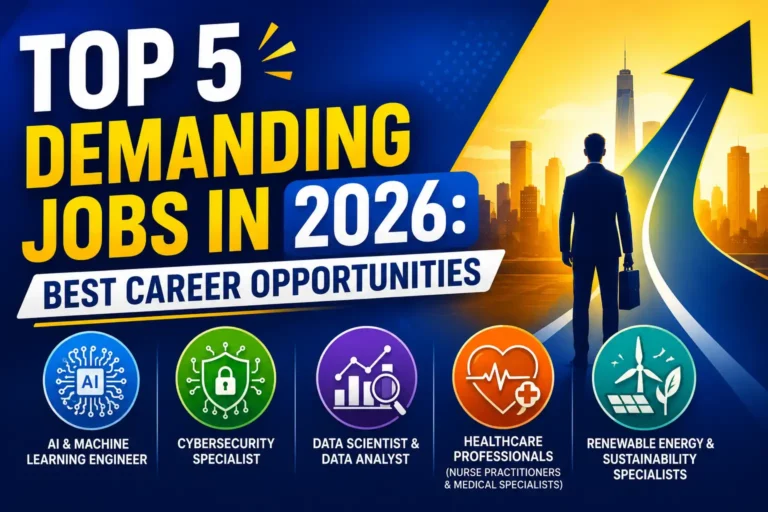
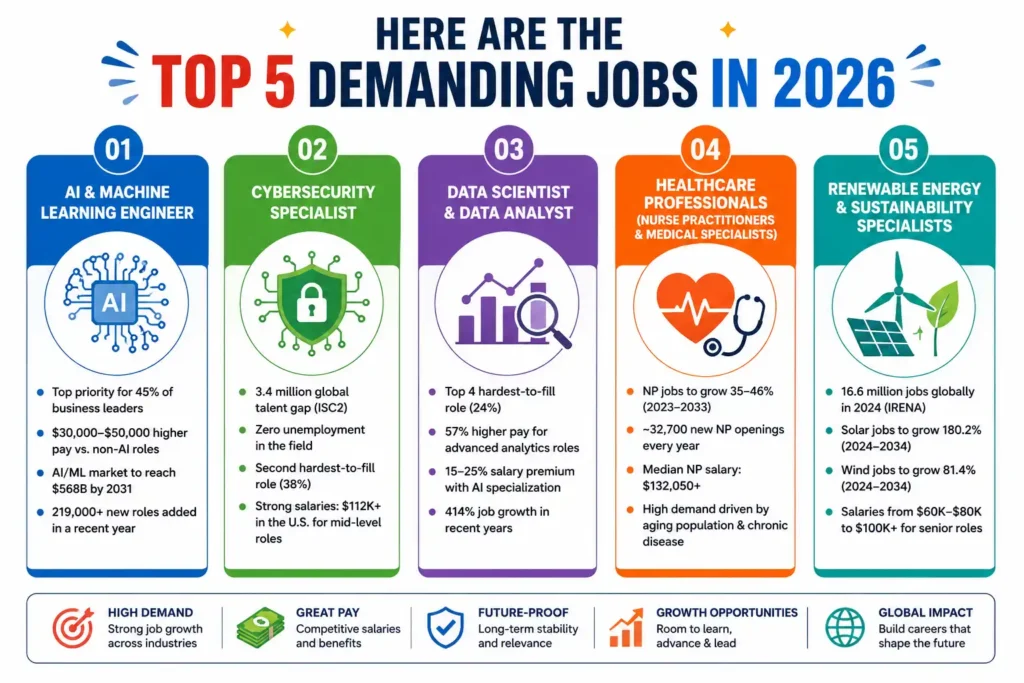
Here are the Top 5 Demanding Jobs in 2026
AI & Machine Learning Engineer
Artificial intelligence is not just a buzzword anymore; it is the backbone of modern business. According to the Robert Half Technology 2026 IT Salary Report, AI and machine learning top the priority list for 45% of business leaders this year. And the talent gap is real. The Infragistics 2026 IT Talent Survey reports that AI engineers are the hardest-to-fill roles, cited by 39% of respondents, while 91% of organizations say hiring staff with AI skills is a top priority.
The numbers speak for themselves. According to market data, AI/ML roles command salaries $30,000–$50,000 higher than comparable non-AI positions. The machine learning market is projected to reach $568 billion by 2031 (Statista), and the industry added 219,000 new roles in a single recent year. Global investment in AI and cloud technologies has already crossed $1.5 trillion, and companies are still hungry for engineers who can turn that investment into working products.
Cybersecurity Specialist
Every business that runs on digital infrastructure has a target on its back. Cyberattacks are more sophisticated, more frequent, and more damaging than ever, and the workforce simply has not kept up. ISC2 reports a global cybersecurity talent gap of 3.4 million professionals, and the field currently sits at effectively zero unemployment. The Infragistics 2026 IT Talent Survey places cybersecurity engineers as the second hardest-to-fill role, cited by 38% of respondents.
Cybersecurity pays well across the board. Entry-level SOC analysts earn competitive starting salaries, while security engineers and architects push well above $112,000 annually in the U.S. Senior roles and CISOs can command significantly more. The UK sector is projected to grow over 35% by 2031, and globally, demand shows no signs of slowing.
💡 Explore More Insights: Schedow: Smart AI Scheduling for Better Productivity in 2026
Are Data Scientist and Data Analyst Different?
Data is the oil of the digital economy, but raw data means nothing without someone who can refine it. Data scientists and analysts sit at the center of every major business decision today, from marketing spend to product development to risk management. According to the Infragistics 2026 IT Talent Survey, data analytics professionals rank among the top four hardest-to-fill roles, cited by 24% of respondents.
Advanced analytics roles command 57% higher pay than basic analyst positions (scale.jobs, 2026). Data scientists with AI specialization earn a 15–25% salary premium over peers without it (AnitaB). The broader data science field has seen 414% job growth in recent years, one of the sharpest spikes of any professional category. For companies operating at scale, hiring a strong data team is no longer optional; it is a survival strategy.
Healthcare Professionals (Nurse Practitioners & Medical Specialists)
While tech roles dominate headlines, healthcare is quietly one of the strongest job markets of 2026. The aging population, physician shortages, and the rise of chronic disease are creating sustained, long-term demand that AI simply cannot replace. Unlike most white-collar professions, nursing and advanced practice roles are immune to automation; they require human empathy, physical presence, and real-time clinical judgment.
Nurse Practitioners (NPs) represent one of the most striking growth stories in modern labor economics. According to the U.S. Bureau of Labor Statistics, NP employment is projected to grow 35–46% between 2023 and 2033, more than ten times the national average of 4% for all occupations. The BLS projects approximately 32,700 new NP openings every year over the decade. The median annual salary for NPs sits at $132,050 (BLS, May 2024), with psychiatric and specialty NPs earning north of $140,000.
💡 Explore More Insights: Why Everyone Is Competing Against Nvidia in AI
Renewable Energy and Sustainability Specialists
The clean energy transition is not just an environmental story; it is a jobs story. According to IRENA and the ILO’s Renewable Energy and Jobs Annual Review 2026, the global renewable energy sector employed 16.6 million people in 2024, up from 16.2 million the prior year. And the BLS just published fresh projections showing solar electric power generation employment is set to grow 180.2% between 2024 and 2034, while wind power generation employment is projected to grow 81.4% in the same period. These are the two fastest-growing industries in the entire U.S. economy.
The energy construction sector alone added nearly 90,000 jobs in a single year. Globally, IRENA projects renewable energy employment could more than double by 2030, reaching over 30 million positions as countries accelerate net-zero targets. Salaries vary widely by role, from skilled trades paying $60,000–$80,000 to senior engineers and sustainability directors earning well above $100,000.
Skills You Need to Land High-Demand Jobs in 2026
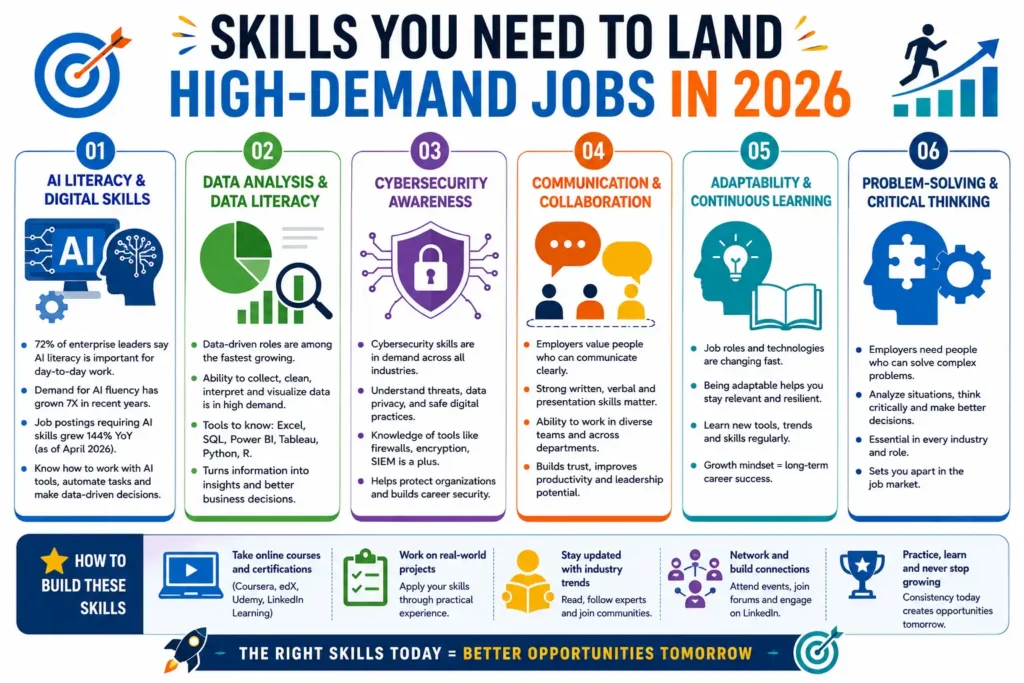
Landing a high-demand job in 2026 is not just about picking the right field. It is about showing up with the right skills before your competition does.
AI Literacy and Digital Skills
AI literacy is no longer a specialty; it is quickly becoming the new baseline. According to the 2026 State of Data & AI Literacy Report by DataCamp, 72% of enterprise leaders now say AI literacy is important for day-to-day work. Meanwhile, demand for AI fluency has grown 7x in recent years, and job postings requiring AI skills grew 144% year over year as of April 2026 (Bipartisan Policy Center / Lightcast). You do not need to build AI systems to be competitive, but you absolutely need to know how to work alongside them. That means using tools like ChatGPT, understanding prompt engineering basics, and knowing when to trust or question AI outputs.
Data Analysis and Problem-Solving
Data literacy is the second pillar. The DataCamp 2026 report found that 88% of enterprise leaders consider basic data literacy important for day-to-day work. Whether you are in marketing, operations, healthcare, or finance, your ability to read data, spot patterns, and translate numbers into decisions is a skill that directly affects your salary. Advanced analytics roles already command 57% higher pay than basic analyst positions. You do not need a math degree; you need a working knowledge of tools like Excel, SQL, and data visualization platforms.
Cybersecurity Awareness
Even if you are not pursuing a dedicated cybersecurity role, basic security awareness is now a professional expectation. The World Economic Forum lists networks and cybersecurity as the second-fastest-growing skill cluster globally, right after AI and big data. As organizations digitize operations and move to cloud infrastructure, every employee from HR to engineering becomes a potential entry point for threats. In technical roles, deeper knowledge of frameworks like NIST, SIEM systems, and cloud security commands a serious salary premium.
💡 Explore More Insights: Google AI Glasses: Real-Time AI Wearable Tech Guide
Communication and Leadership Skills
Here is something a lot of career guides skip: 89% of hiring failures are due to gaps in soft skills (scale.jobs, 2026). Technical ability gets you the interview. Communication and leadership get you promoted. In 2026, as teams become more cross-functional and AI tools handle routine tasks, human judgment, storytelling with data, and the ability to align people behind a goal have become genuinely differentiating. Whether you are presenting findings to a non-technical stakeholder or leading a remote team across time zones, the professionals who can translate complex ideas into clear action are the ones who advance.
Adaptability and Continuous Learning
The half-life of technical skills has dropped to just 2.5 years (scale.jobs, 2026). What you learn today may need updating by 2028. The Bright Horizons 2026 Education Index found that 42% of employees expect their role to change significantly due to AI within the next year, yet only 17% use AI tools frequently today. The gap between knowing change is coming and actually preparing for it is where careers get left behind. Adaptability is not a soft platitude it is the most practical career investment you can make. Employers who see a habit of continuous learning on your resume view it as a signal that you will not need constant hand-holding as the landscape shifts.
Best Way To Prepare for Demanding Jobs in 2026
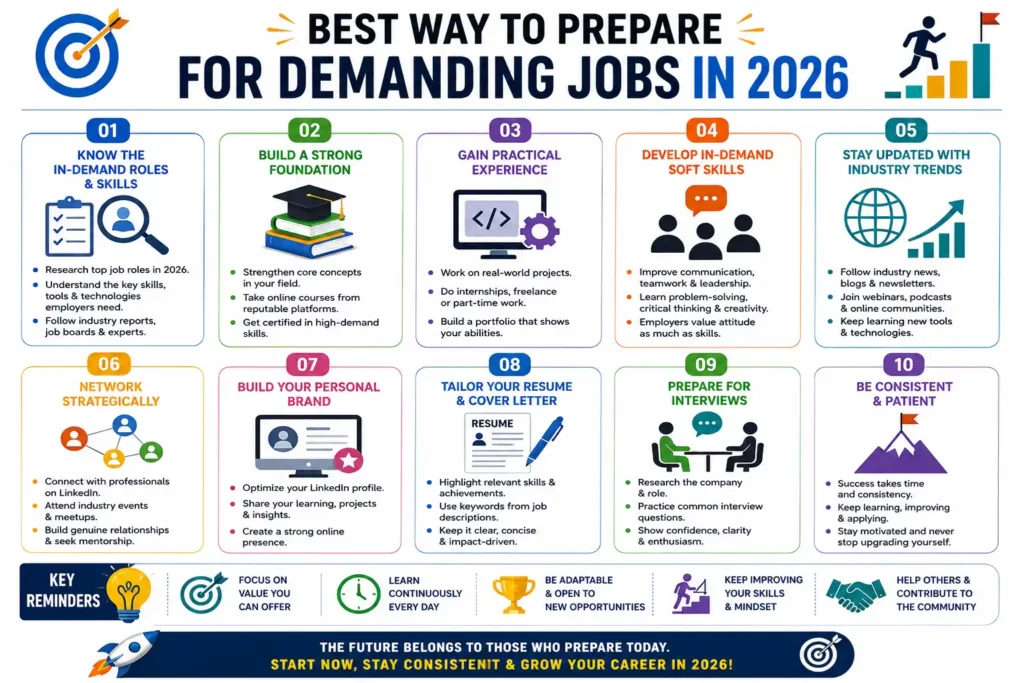
Choosing the Right Degree or Certification
Not every high-demand job requires a traditional four-year degree, and in 2026, employers know it. According to Investopedia, cloud engineer, cybersecurity analyst, and data analyst roles all rank on Indeed’s 2026 Best Jobs list, and all are accessible through certifications. Industry credentials like AWS Cloud Practitioner, CompTIA Security+, and Google Career Certificates open real doors. The smartest approach is to match your credentials to the role’s actual hiring requirement, not to what sounds most impressive.
Online Learning Platforms and Courses
The platforms you use matter. Coursera’s Google Professional Certificates covering Data Analytics, Cybersecurity, Project Management, and AI are among the most employer-recognized credentials available, running around $49/month and are completable in 6 months. Major companies, including Walmart, Best Buy, and Intel, now accept Google Career Certificates in place of bachelor’s degrees for entry-level roles. For deeper technical tracks, Udacity Nanodegrees in AI/ML and full-stack development are highly respected. Free options like Khan Academy, MIT OpenCourseWare, and fast.ai make it possible to learn foundational ML and data skills at zero cost.
Building a Portfolio and Practical Experience
A certificate proves that you studied. A portfolio proves you can deliver. For tech roles, build GitHub repositories with real project data analysis notebooks, ML model implementations, or security lab writeups. For sustainability or healthcare roles, document any relevant volunteer experience, research projects, or case studies. Hiring managers in 2026 consistently say that practical demonstrations of skill outweigh credentials alone. Kaggle competitions for data scientists, Hack The Box challenges for cybersecurity aspirants, and open-source contributions for AI engineers all serve as credible, verifiable proof of competence.
💡 Explore More Insights: Pasonet :- Smart & Flexible Digital Networking Platform
Networking and Professional Development
Most jobs are never posted publicly. Research consistently shows that 70–80% of positions are filled through networks before a job listing ever goes live. LinkedIn remains the most powerful tool for this in 2026, but do not stop there. Attend industry conferences, join professional communities like ISACA (for cybersecurity), IEEE (for AI and engineering), or ASHP (for healthcare), and engage actively in online forums and Discord servers specific to your field. One genuine professional relationship is worth more than 50 cold applications.
Job Search Strategies
Scattergun applications rarely work. Instead, target companies directly, customize every resume to the specific job description using the same keywords that appear in the posting (this directly affects ATS screening scores), and lead your applications with quantifiable outcomes rather than duties. Use platforms like LinkedIn, Indeed, and Wellfound (for tech startups) alongside niche boards like Dice (tech), Health eCareers (healthcare), and Renewable Energy World (clean energy). Setting up job alerts and reaching out to recruiters directly at target companies can cut your search time significantly.
FAQs
What is the most demanding job in 2026?
Based on talent gap data and hiring trends, AI/ML engineers are the single hardest role to fill in 2026. The Infragistics IT Talent Survey reports that 39% of technology leaders cite AI engineers as their top unfilled position, with 91% of organizations naming AI hiring as a strategic priority. Cybersecurity engineers follow closely at 38%.
Which jobs are safest from AI automation?
Roles that require physical presence, human empathy, and real-time judgment are the most AI-resistant. Nurse Practitioners, hands-on skilled trades, and cybersecurity professionals top the list. The University of Cincinnati notes that AI cannot replicate hands-on care and human empathy, making nursing consistently high-demand even as automation disrupts white-collar work. Renewable energy technicians who install and service physical equipment in the field also face near-zero automation risk.
What are the highest-paying careers in 2026?
At the top end, AI/ML engineers and senior cybersecurity architects can exceed $180,000 in the U.S. Data scientists with AI specialization earn a 15–25% salary premium over non-AI peers. Nurse Practitioners have a median salary of $132,050 (BLS), with psychiatric specialists earning above $140,000.
Which demanding jobs do not require a four-year degree?
Several of the most in-demand roles are accessible without a traditional degree. Cybersecurity analysts can enter the field with the Google Cybersecurity Professional Certificate and CompTIA Security+. Solar PV installers and wind turbine technicians typically require a two-year associate’s degree or vocational training. Data analysts can break in through Google’s Data Analytics Certificate on Coursera. Even some AI engineer roles at startups prioritize portfolio work and demonstrated Python skills over formal credentials.
How can beginners prepare for future careers?
Start with one platform, one skill, one project. Pick a high-demand track, data, cybersecurity, or AI, and spend 10 focused hours a week for 6 months. Use Google Career Certificates on Coursera for structured learning, build one real project that solves an actual problem, and start building your LinkedIn presence while you are still learning. The biggest mistake beginners make is waiting until they feel “ready.” The market rewards people who show progress, not perfection.
What skills will employers value most after 2026?
The World Economic Forum is clear: AI and big data, networks and cybersecurity, and technological literacy are the fastest-growing skill clusters through 2030. Beyond technical skills, capabilities that AI cannot replicate, such as critical thinking, emotional intelligence, creative problem-solving, and strategic judgment, will become the primary differentiators. Gartner predicts that 50% of organizations will require “AI-free” skills assessments by 2026, specifically to evaluate whether employees can still think independently. Invest in both.
💡 Explore More Insights: 5 Best E-commerce Platforms for Online Stores 2026
Conclusion
The careers covered in this guide, AI and machine learning engineering, cybersecurity, data science, healthcare, and renewable energy, are not just trendy job titles. They are roles backed by real data, structural labor shortages, and forces that will drive demand for years to come. The job market in 2026 rewards people who are specific, skilled, and proactive. Picking the right field is step one. Building verifiable skills, getting practical experience, and putting yourself in front of the right people is what actually closes the gap between aspiration and employment. The opportunity is there, the question is whether you are ready to move on it.
✨ Keep exploring, keep learning, keep growing with Tech Fueler.