
What Is Claude AI?
Claude AI is the best artificial intelligence assistant created to help users with writing, coding, research, analysis, and everyday productivity tasks. Claude AI was developed by Anthropic, a company founded in 2021 by former OpenAI researchers and executives, including Dario Amodei and Daniela Amodei. The company focuses on creating helpful, honest, and harmless AI systems.
Anthropic quickly became one of the strongest competitors in the AI industry after receiving billions in investments from major tech companies, including Amazon and Google. Claude gained attention because of its natural writing style, strong reasoning abilities, and large context window that allows it to process long documents efficiently.
Many businesses, developers, and content creators now use Claude AI for professional workflows. Its human-like communication and focus on AI safety make it one of the leading AI chatbots available today.
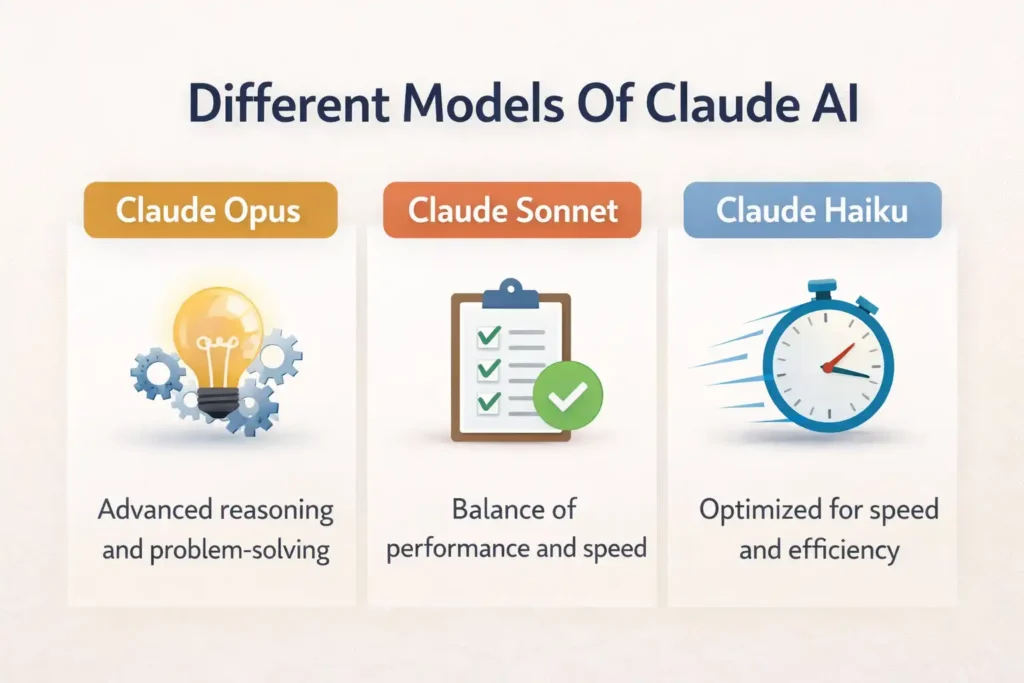
Different Models Of Claude AI
Claude Opus
Claude Opus is the highly advanced version of the Claude family. It delivers high-level reasoning, complex problem-solving, and exceptional writing quality. Businesses and researchers often use Opus for difficult analytical tasks, strategic planning, advanced coding, and detailed content generation where precision and deep understanding are essential.
Claude Sonnet
Claude Sonnet is designed to balance performance and speed, making it suitable for everyday professional tasks. It performs well in writing, coding, brainstorming, and workflow automation. Many companies prefer Sonnet because it offers strong AI capabilities while remaining more cost-efficient than larger enterprise-focused models.
Claude Haiku
Claude Haiku is optimized for speed and lightweight AI tasks. It responds quickly and works well for chatbots, simple automation, customer support, and short-form content generation. Haiku is ideal for businesses that need efficient AI performance with lower operational costs and faster response times.
Differences Between the Models
The primary differences between Claude models involve intelligence level, response speed, context processing, and pricing. Opus focuses on advanced reasoning, Sonnet balances quality with efficiency, and Haiku prioritizes speed. This tiered structure allows users to choose a model that matches their workload complexity and business budget.
Key Features of Claude AI
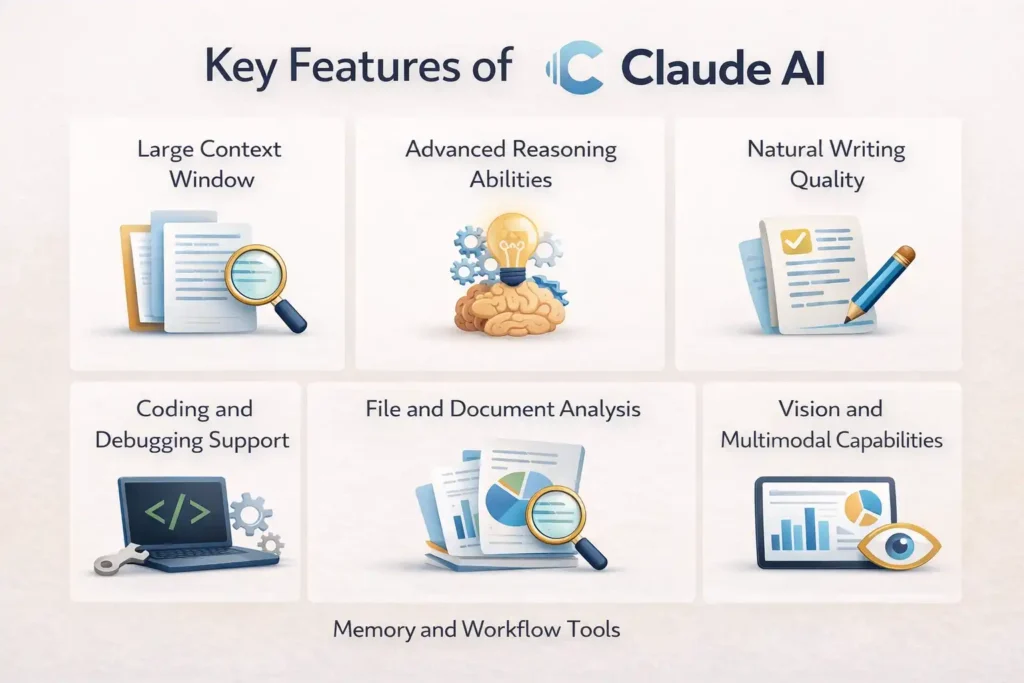
Claude AI stands out because of its combination of advanced reasoning, natural communication, and large-scale document processing capabilities. Unlike many traditional AI chatbots, Claude can understand lengthy conversations and maintain context across complex tasks. Businesses and professionals use Claude to automate workflows, analyze reports, write detailed content, and assist with programming projects. Anthropic continuously improves Claude’s performance by expanding its multimodal abilities and context handling. These features make Claude AI valuable for industries that require accurate information processing, human-like writing, and efficient problem-solving across both creative and technical environments.
Large Context Window
Claude AI supports one of the largest context windows in the AI industry, allowing users to upload lengthy PDFs, contracts, reports, and research papers. This capability enables deeper document analysis and more accurate summaries. Businesses handling large datasets or technical documentation benefit significantly from Claude’s extended memory and contextual understanding.
Advanced Reasoning Abilities
Claude AI performs strongly in logical reasoning, strategic analysis, and multi-step problem-solving tasks. It can break down complex topics into understandable explanations and generate thoughtful responses with improved coherence. This makes Claude useful for researchers, analysts, consultants, and professionals who require high-quality intellectual assistance.
Natural Writing Quality
One of Claude AI’s biggest strengths is its human-like writing style. The AI generates content that feels conversational, clear, and engaging rather than robotic. Marketers, bloggers, and businesses often use Claude for articles, email campaigns, scripts, and long-form content because of its readability and smooth tone.
Coding and Debugging Support
Claude AI assists developers with writing code, debugging errors, explaining programming concepts, and optimizing workflows. It supports multiple programming languages and helps programmers understand complex technical problems quickly. Many software teams use Claude to speed up development processes and improve coding productivity.
File and Document Analysis
Claude AI can analyze uploaded documents, including PDFs, spreadsheets, contracts, presentations, and reports. It extracts key information, summarizes findings, and answers detailed questions about the content. This feature is especially useful for legal professionals, researchers, students, and business analysts working with large files.
💚 You might also like: How AI Wearables and Smart Glasses Changing Technology
Vision and Multimodal Capabilities
Modern Claude models include multimodal capabilities that allow the AI to interpret images and visual information alongside text. Users can upload charts, screenshots, and graphics for analysis. This improves workflow efficiency for teams involved in design reviews, technical analysis, and visual content interpretation.
Memory and Workflow Tools
Claude AI supports productivity-focused workflows by maintaining conversation context and assisting with repetitive tasks. Teams use it for brainstorming, project management, meeting summaries, and process automation. Its contextual memory improves collaboration and allows users to manage large projects more efficiently over extended conversations.
How Claude AI Works
Claude AI operates using advanced large language model technology trained on massive datasets containing text, documents, books, websites, and structured information. The system analyzes patterns in language to generate human-like responses that feel natural and contextually accurate. Anthropic designed Claude to combine powerful reasoning abilities with safer AI behavior through specialized training techniques. Unlike traditional search engines, Claude predicts and generates responses based on contextual understanding rather than simple keyword matching. Its architecture enables the AI to understand long conversations, analyze detailed documents, and assist users with both creative and technical tasks efficiently.
Claude AI Use Cases Across Industries
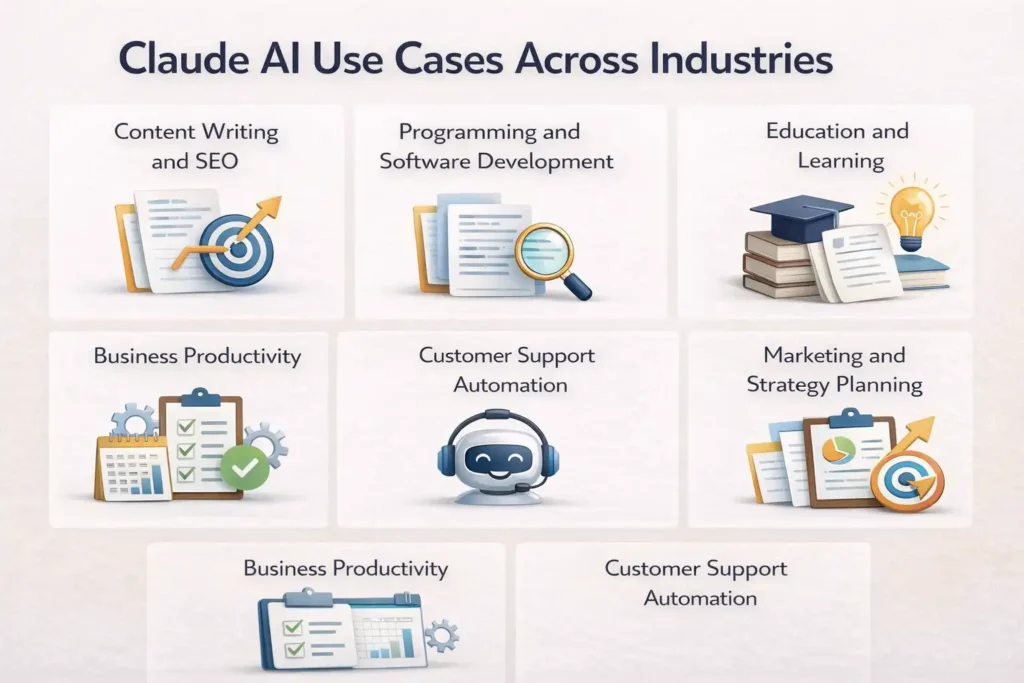
Content Writing and SEO
Content creators use Claude AI to generate blog posts, SEO articles, social media captions, product descriptions, and email campaigns. Its natural writing style improves readability and engagement. Marketers also use Claude for keyword optimization, content planning, competitor research, and long-form article generation that aligns with search engine algorithms.
Programming and Software Development
Developers rely on Claude AI for writing code, debugging applications, explaining programming logic, and improving software workflows. It supports multiple coding languages and helps accelerate development cycles. Many engineering teams use AI assistance to reduce repetitive coding tasks and improve overall development efficiency.
Research and Data Analysis
Researchers use Claude AI to summarize reports, analyze findings, and extract key insights from large datasets or academic documents. Its long-context processing abilities make it highly effective for reviewing technical papers, financial reports, and business intelligence documents without losing contextual understanding.
Education and Learning
Students and educators use Claude AI for tutoring, lesson planning, research assistance, and concept explanations. The AI simplifies difficult topics into understandable language and supports personalized learning experiences. Educational institutions increasingly explore AI-powered learning tools to improve student engagement and productivity.
💚 You might also like: Samigo App: Simple & Fast App for Daily Tasks
Business Productivity
Companies integrate Claude AI into workplace operations for meeting summaries, workflow automation, brainstorming sessions, and internal documentation. AI-driven productivity tools help organizations reduce manual work and improve operational efficiency. Claude’s conversational capabilities also enhance communication and collaboration across teams.
Customer Support Automation
Businesses use Claude AI to power customer service chatbots and automated support systems. The AI can answer common questions, resolve simple issues, and provide personalized responses quickly. This improves customer experience while reducing operational costs and support team workload for growing businesses.
Marketing and Strategy Planning
Marketing teams use Claude AI for campaign planning, audience research, ad copy generation, and strategic brainstorming. Its analytical abilities help businesses identify trends, improve messaging, and create more targeted marketing strategies. AI-assisted planning also speeds up decision-making in competitive industries.
Claude AI vs Other Top AI Models
| Feature | Claude AI | ChatGPT | Gemini | DeepSeek |
| Best For | Long-form writing and research | General productivity and diverse tasks | Google ecosystem users | Budget-friendly AI usage |
| Writing Quality | Excellent | Very Good | Good | Good |
| Coding Performance | Excellent | Excellent | Very Good | Very Good |
| Long Document Analysis | Excellent | Very Good | Excellent | Good |
| Real-Time Information Access | Moderate | Strong | Excellent | Moderate |
| Main Strength | Natural writing and reasoning | Versatility and integrations | Search and multimodal capabilities | Cost efficiency and speed |
Claude AI Pricing and Plans
Free Plan Overview
Claude AI’s free plan provides access to core chatbot features, including writing assistance, summarization, brainstorming, and conversational support. Casual users can explore the platform without paying upfront costs. The free version typically includes usage limitations, reduced message capacity, and restricted access to the most advanced Claude models.
Pro Plan Features
The Claude Pro plan offers faster performance, higher usage limits, and access to advanced AI models such as Claude Opus and Sonnet. Professional users benefit from improved response quality, extended context handling, and priority access during peak usage periods. This plan is popular among content creators, freelancers, and researchers.
Team and Enterprise Plans
Anthropic provides enterprise-level solutions for organizations that require collaboration tools, security controls, workflow integration, and scalable AI access. Team plans support productivity across departments, while enterprise packages include advanced compliance features, administrative controls, and dedicated support for large-scale business operations and AI deployment.
API Pricing for Developers
Developers can access Claude AI through API pricing models based on token usage and model selection. Businesses building AI-powered applications pay according to input and output processing requirements. API access enables integration into chatbots, automation systems, SaaS platforms, and enterprise productivity tools across different industries.
Is Claude AI Worth the Price?
Claude AI delivers strong value for users who need advanced reasoning, high-quality writing, and long-document analysis capabilities. Businesses handling research, content creation, or workflow automation often find the premium plans cost-effective. However, casual users with basic AI needs may find free versions or alternative platforms sufficient for daily tasks.
How to Use Claude AI Effectively
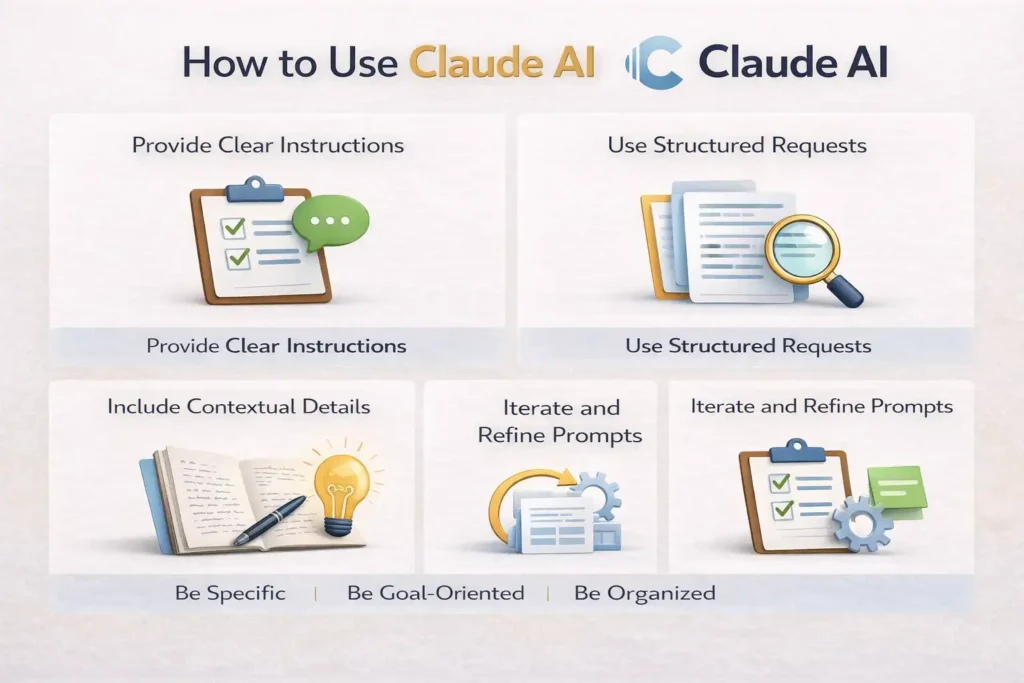
Using Claude AI effectively requires more than simply typing random prompts into a chatbot. Users achieve better results when they provide clear instructions, structured requests, and contextual details. Claude performs best when prompts are specific, goal-oriented, and logically organized. Businesses, students, developers, and marketers increasingly rely on AI assistants to improve productivity and automate repetitive tasks. Learning proper prompting techniques helps users maximize Claude’s reasoning abilities, writing quality, and workflow efficiency. As artificial intelligence continues evolving, understanding how to interact with AI systems strategically will become an essential skill across professional industries and digital environments.
Frequently Asked Questions (FAQs)
Is Claude AI free to use?
Yes, Claude AI offers a free version that allows users to access core features such as writing assistance, question answering, summarization, and general productivity tasks. However, premium plans provide higher usage limits, faster performance, and access to more advanced Claude models.
Is Claude AI better than ChatGPT?
The answer depends on your specific needs. Claude AI often performs exceptionally well in long-form writing, document analysis, and contextual understanding. ChatGPT is widely used for versatility, coding assistance, and broader integrations. Different users may prefer different platforms depending on their workflow requirements.
Can Claude AI write code?
Yes, Claude AI can generate, explain, review, and debug code across multiple programming languages. Developers frequently use it for software development tasks, problem-solving, code optimization, and understanding complex technical concepts more efficiently.
Can Claude AI analyze documents?
Yes, Claude AI can process and analyze large documents, including PDFs, reports, spreadsheets, and research papers. It can summarize information, extract important insights, answer questions about the content, and simplify complex information into understandable explanations.
Is Claude AI safe to use?
Anthropic designed Claude AI with a strong focus on safety and ethical AI development. The platform uses Constitutional AI principles to reduce harmful outputs and improve reliability. However, users should still verify important information before using it for business, medical, financial, or legal decisions.
Which industries use Claude AI?
Claude AI is used across various industries, including marketing, education, software development, customer support, healthcare research, finance, and business operations. Organizations use it to automate workflows, improve productivity, and support decision-making processes.
Which Claude Model Is Best for Different Tasks?
Claude Opus is best for advanced research, coding, and strategic analysis. Sonnet works well for professional writing, business operations, and daily productivity tasks. Haiku is more suitable for lightweight automation and quick customer interactions. Choosing the right model depends on performance requirements, response speed, and operational costs.
Does Claude AI support image understanding?
Modern Claude models include multimodal capabilities that allow the AI to understand and analyze images along with text. Users can upload charts, screenshots, graphics, and visual data for analysis and interpretation.
💚 You might also like: AI Cybersecurity Threats and Defense Strategies
Conclusion
Claude AI has rapidly established itself as one of the most capable AI assistants in today’s technology landscape. Its natural writing style, strong reasoning abilities, and powerful long-context understanding make it valuable for content creators, researchers, businesses, and developers. Unlike many traditional AI tools, Claude focuses heavily on delivering safer and more human-like interactions while maintaining high productivity standards.
As artificial intelligence continues evolving, Claude AI is expected to play an increasingly important role across industries. Whether you need help with writing, coding, research, document analysis, or business workflows, Claude offers a flexible solution that adapts to different needs. Choosing the right AI assistant ultimately depends on your goals, but Claude AI has proven that it can compete strongly among today’s leading AI technologies.
✨ Your daily tech edge starts here. Follow Tech Fueler.