
Introduction
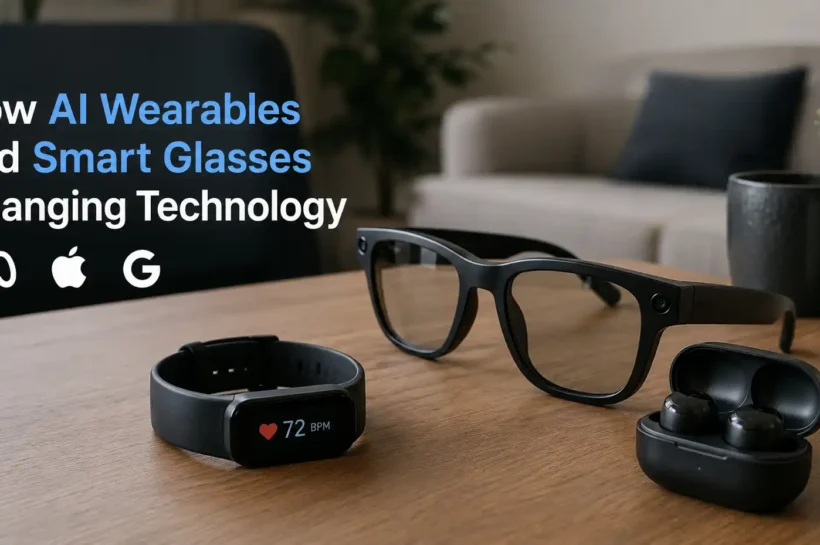
Artificial intelligence is rapidly changing the way people interact with technology, and AI wearables are leading this transformation. Smart glasses, AI-powered earbuds, fitness trackers, and intelligent watches are no longer futuristic concepts. They are becoming part of everyday life. Major companies like Meta, Apple, and Google are investing billions into wearable innovation because they believe smart wearables could become the next major computing platform. According to industry reports from IDC and Statista, the global wearable technology market is expected to surpass $180 billion by the end of this decade. This article explores how AI wearables and smart glasses are reshaping communication, productivity, healthcare, and digital experiences.
What Are AI Wearables and Smart Glasses?
AI wearables are smart electronic devices designed to collect, analyze, and respond to user data in real time using artificial intelligence. Unlike traditional wearables that only track steps or heart rate, modern AI wearables understand user behavior, voice commands, surroundings, and preferences. Smart glasses take this concept further by combining augmented reality, computer vision, voice assistants, and spatial computing into lightweight eyewear. These devices can display notifications, provide navigation, translate languages instantly, and even identify objects around users. The integration of AI and wearable computing is creating a more natural, hands-free digital experience for consumers and businesses worldwide.
The Evolution of Wearable Technology
Wearable technology has evolved dramatically over the last decade. Early devices focused mainly on fitness tracking and simple notifications, but advancements in AI transformed wearables into intelligent companions. The first generation of smart glasses struggled because of poor battery life, bulky designs, and limited functionality. However, rapid improvements in AI chips, sensors, and lightweight displays changed the market completely. Companies are now producing stylish, practical smart glasses with advanced capabilities. Research from Deloitte suggests that consumer demand for AI-powered wearables is increasing due to rising interest in hands-free computing, health monitoring, and immersive digital experiences.
How AI Smart Glasses Work
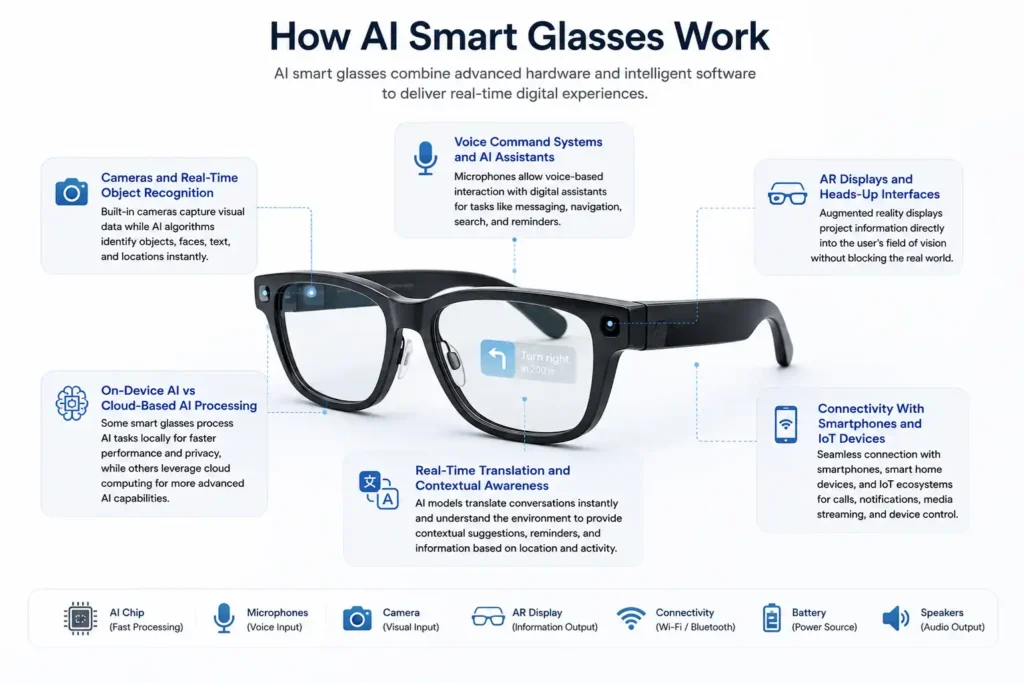
AI smart glasses combine advanced hardware and intelligent software to deliver real-time digital experiences. Built-in cameras capture visual data while AI algorithms analyze surroundings instantly. Microphones allow voice-based interaction with digital assistants, and augmented reality displays project information directly into the user’s field of vision. Some models process AI tasks locally for faster performance and stronger privacy protection. Features like live language translation, object recognition, and contextual reminders demonstrate how AI smart glasses are becoming powerful wearable computing devices.
Cameras and Real-Time Object Recognition
Smart glasses use embedded cameras and computer vision technology to identify objects, faces, text, and locations instantly. This allows users to receive real-time information, navigation assistance, and contextual insights directly through their wearable displays.
Voice Command Systems and AI Assistants
AI assistants integrated into smart glasses respond to voice commands for messaging, navigation, internet searches, and reminders. Natural language processing enables smooth communication between users and wearable devices without requiring physical interaction.
AR Displays and Heads-Up Interfaces
Augmented reality displays project digital information onto transparent lenses, creating interactive overlays in the user’s environment. These interfaces provide navigation directions, notifications, and contextual content while maintaining awareness of the physical world.
On-Device AI vs Cloud-Based AI Processing
Some smart glasses process AI tasks directly on the device for faster performance and improved privacy, while others rely on cloud computing for advanced data analysis and more powerful machine learning capabilities.
Connectivity With Smartphones and IoT Devices
AI smart glasses connect seamlessly with smartphones, smart homes, and IoT ecosystems. This connectivity allows users to control devices, access notifications, stream media, and synchronize data across multiple digital platforms effortlessly.
Real-Time Translation and Contextual Awareness
Advanced AI models allow smart glasses to translate conversations instantly and understand the surrounding environment. Contextual awareness helps devices deliver relevant suggestions, reminders, and information based on location, activity, and user preferences.
Top Features Driving the Smart Glasses Revolution
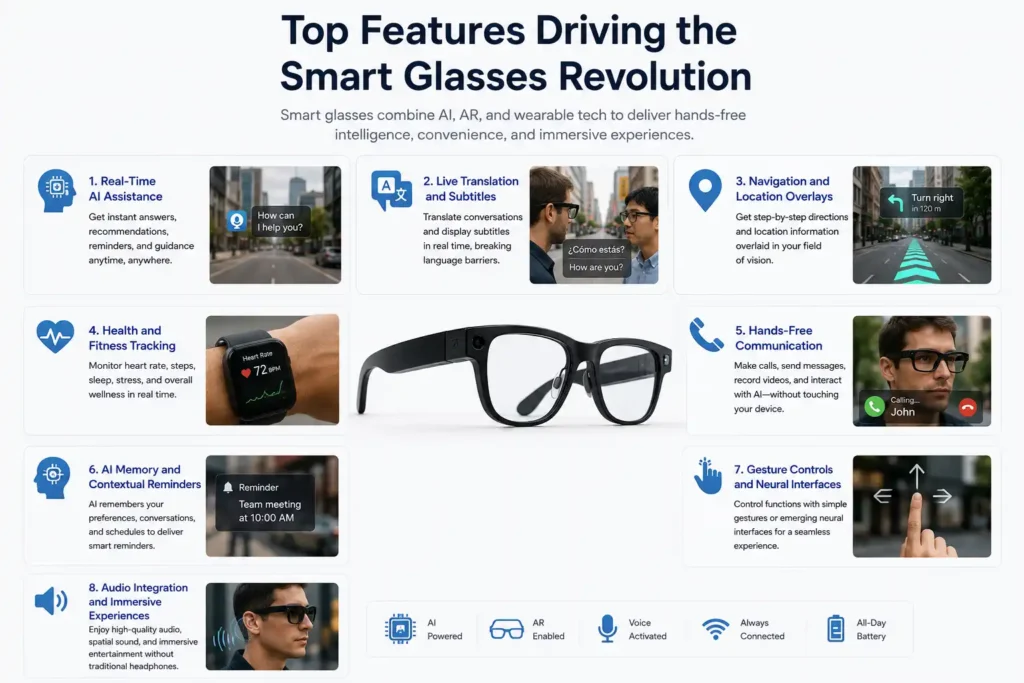
The growing popularity of AI smart glasses is driven by features that improve convenience, communication, and productivity. Modern wearables now provide real-time assistance, immersive audio, health monitoring, and intelligent contextual support. Many devices include live translation capabilities that remove language barriers during conversations or travel. Gesture controls and neural interfaces are also changing how users interact with digital systems. According to market research from Grand View Research, consumers increasingly prefer wearable devices that deliver hands-free experiences while reducing smartphone dependency. These innovations are turning smart glasses into practical tools for work, entertainment, and everyday activities.
Real-Time AI Assistance
AI-powered assistants provide immediate responses, reminders, recommendations, and contextual information. Users can ask questions, schedule tasks, or receive guidance instantly without needing to manually interact with smartphones or computers during activities.
Live Translation and Subtitles
Smart glasses can translate spoken conversations and display subtitles in real time. This feature improves communication for travelers, businesses, and multilingual workplaces by reducing language barriers and enabling smoother interactions globally.
Navigation and Location Overlays
AR navigation overlays project directions directly into the user’s field of vision. This hands-free navigation experience improves convenience while walking, cycling, driving, or exploring unfamiliar environments in crowded urban locations.
Health and Fitness Tracking
AI wearables monitor heart rate, stress levels, sleep patterns, physical activity, and overall wellness. Advanced sensors analyze biometric data continuously, helping users make healthier lifestyle decisions and detect potential health issues earlier.
Hands-Free Communication
Users can make calls, send messages, record videos, and interact with digital assistants without touching a device. Hands-free communication improves convenience, productivity, and safety during work, travel, and multitasking situations.
AI Memory and Contextual Reminders
Context-aware AI systems can remember previous conversations, schedules, and user habits. Smart reminders based on location, time, and activities create a more personalized and intelligent wearable experience for users.
Gesture Controls and Neural Interfaces
Gesture recognition allows users to control smart glasses using simple hand movements. Emerging neural interfaces may eventually enable wearable devices to respond directly to brain signals and subtle physical interactions.
Audio Integration and Immersive Experiences
Built-in speakers and spatial audio technology create immersive sound experiences without traditional headphones. This allows users to enjoy music, calls, navigation prompts, and entertainment while remaining aware of their surroundings.
Industries Being Transformed by AI Wearables
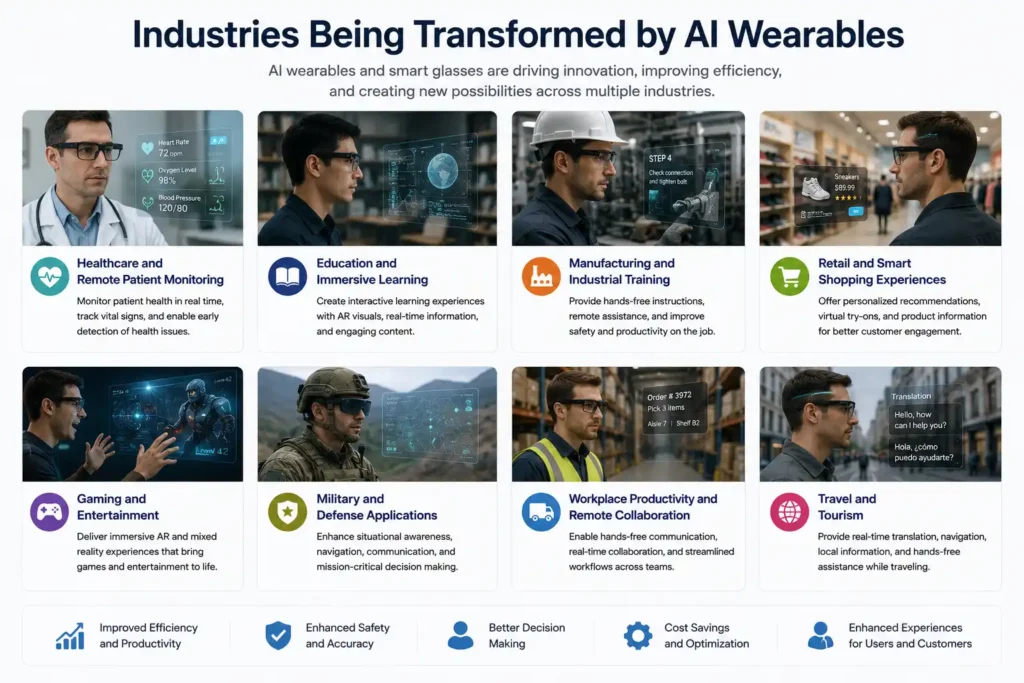
AI wearables are influencing multiple industries by improving efficiency, accessibility, and communication. In healthcare, wearable devices help monitor patients remotely and detect medical conditions earlier. Education is becoming more immersive through augmented reality learning experiences, while manufacturing companies use smart glasses for employee training and workflow management.
Retail businesses are enhancing customer engagement with personalized shopping experiences powered by AI wearables. Gaming companies are also investing heavily in wearable AR and mixed reality technologies. Industry analysts predict that enterprise adoption of smart wearables will accelerate significantly as AI capabilities continue to improve across commercial sectors.
Healthcare and Remote Patient Monitoring
AI wearables help doctors monitor patient health remotely through real-time biometric tracking. These devices improve preventive healthcare by identifying unusual patterns and enabling faster medical responses to potential health complications.
Education and Immersive Learning
Smart glasses create exciting learning environments. Students can visualize complex concepts, access digital resources instantly, and participate in immersive educational experiences that improve engagement and knowledge retention.
Manufacturing and Industrial Training
Manufacturing companies use smart glasses for hands-free instructions, remote assistance, and workflow optimization. Workers can access real-time guidance and safety information directly through wearable displays during industrial operations.
Retail and Smart Shopping Experiences
AI wearables personalize shopping by displaying product information, recommendations, and virtual try-on experiences. Retailers use smart glasses to improve customer engagement and create more interactive in-store experiences.
Gaming and Entertainment
Gaming companies are developing immersive AR and mixed reality experiences using wearable technology. Smart glasses allow users to interact with digital environments more naturally, creating engaging entertainment experiences beyond traditional screens.
Military and Defense Applications
Military organizations use AI wearables for navigation, situational awareness, communication, and tactical training. Smart glasses provide real-time battlefield information, helping improve operational efficiency and decision-making during missions.
Workplace Productivity and Remote Collaboration
Smart wearables support remote collaboration through live video sharing, virtual meetings, and instant communication. Businesses use wearable technology to improve productivity, reduce downtime, and streamline complex workflows across industries.
💚 You might also like: Samigo App: Simple & Fast App for Daily Tasks
Leading Companies Shaping the AI Wearables Market
The AI wearables market is becoming highly competitive as global technology companies race to dominate the future of wearable computing. Meta partnered with Ray-Ban to develop AI-powered smart glasses that combine fashion with digital functionality. Apple introduced spatial computing concepts that expanded interest in immersive wearables, while Google continues investing in augmented reality and AI ecosystems. At the same time, startups are introducing innovative wearable solutions focused on healthcare, productivity, and immersive experiences. Analysts believe competition between major brands will accelerate innovation and reduce costs for consumers.
Meta and Ray-Ban Smart Glasses
Meta’s partnership with Ray-Ban introduced stylish smart glasses featuring AI voice assistance, cameras, and audio integration. The collaboration demonstrated how wearable technology can blend fashion, functionality, and social connectivity successfully.
Apple and Spatial Computing Vision
Apple expanded wearable innovation through spatial computing technologies that combine digital and physical environments. Its ecosystem-focused approach aims to create immersive experiences powered by advanced AI and seamless device integration.
Google and AI-Powered AR Initiatives
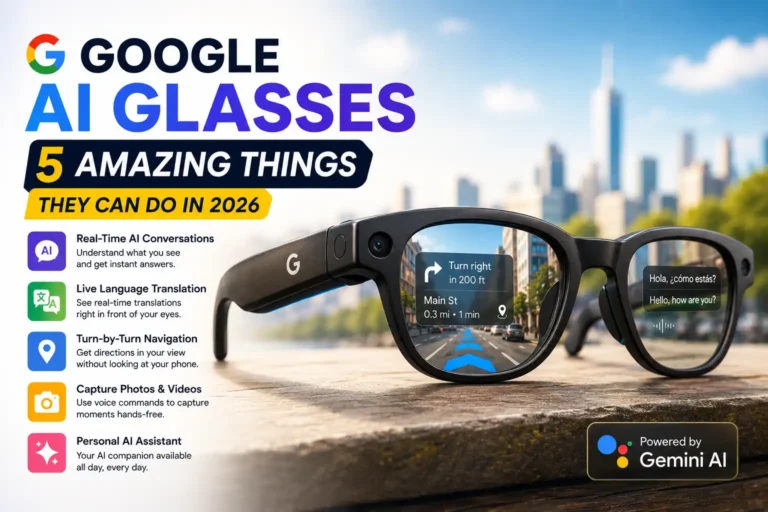
Google continues developing AI and augmented reality solutions focused on smart glasses, contextual computing, and immersive navigation. Its expertise in artificial intelligence strengthens its position within the wearable technology market.
Emerging Startups in AI Wearables
Startups are driving innovation by developing specialized wearables for healthcare, productivity, sports, and immersive entertainment. Many smaller companies focus on lightweight designs, AI personalization, and industry-specific wearable applications.
Competition Between Tech Giants
Technology companies are competing aggressively to dominate the wearable computing industry. Investments in AI chips, augmented reality, and smart ecosystems are accelerating product innovation and improving wearable device capabilities worldwide.
Future Market Trends and Investments
Industry forecasts predict continued growth in AI wearables as companies invest heavily in spatial computing, augmented reality, and AI assistants. Increasing consumer adoption is expected to drive significant long-term market expansion globally.
Benefits of AI Wearables and Smart Glasses
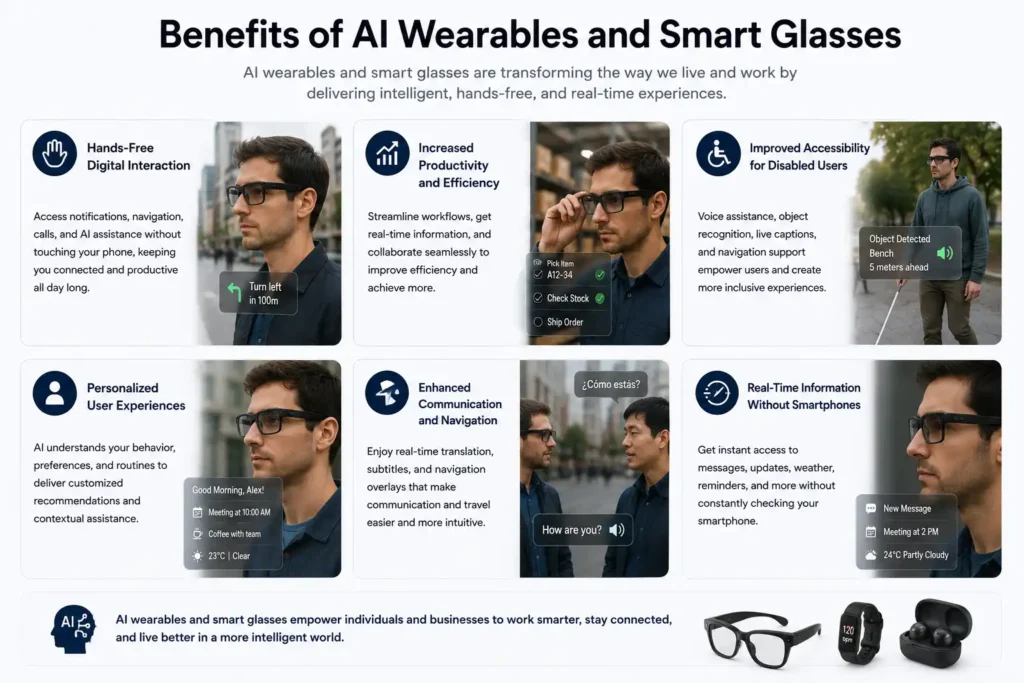
AI wearables and smart glasses are transforming how people interact with technology in daily life. These devices reduce dependence on smartphones by offering hands-free access to information, communication, and digital services. Businesses are also adopting wearable technology to improve productivity, employee training, and operational efficiency. According to research from PwC, wearable technology can increase workplace productivity by improving collaboration and reducing downtime. AI-powered wearables also support accessibility by helping users with disabilities navigate environments and communicate more effectively. As ambient computing becomes more advanced, smart glasses are expected to deliver seamless digital experiences integrated naturally into everyday activities.
Hands-Free Digital Interaction
Smart glasses allow users to access notifications, navigation, calls, and AI assistance without touching a smartphone. Hands-free interaction improves convenience during work, travel, fitness activities, and multitasking while keeping users connected and productive throughout the day.
Increased Productivity and Efficiency
Businesses use AI wearables to streamline workflows, improve communication, and reduce operational delays. Employees can receive instructions, access real-time information, and collaborate remotely through wearable devices, helping organizations increase efficiency and workplace performance significantly.
Improved Accessibility for Disabled Users
AI wearables support visually impaired and disabled users through voice assistance, object recognition, live captions, and navigation support. These features improve independence and create more inclusive digital experiences for individuals facing physical limitations.
Personalized User Experiences
Artificial intelligence analyzes user behavior, preferences, and routines to deliver customized recommendations and contextual assistance. Personalized experiences make wearables more useful by adapting content, reminders, and digital interactions according to individual user needs.
Enhanced Communication and Navigation
Smart glasses simplify communication through voice commands, live translation, and real-time subtitles. Navigation overlays also improve travel experiences by displaying directions directly within the user’s field of vision during movement and exploration.
Real-Time Information Without Smartphones
Wearable AI devices provide instant access to messages, weather updates, reminders, and internet searches without requiring constant smartphone interaction. This creates a more seamless and efficient way to stay informed throughout daily activities.
The Shift Toward Ambient Computing
Ambient computing refers to technology that blends naturally into the environment without demanding constant attention. AI wearables are driving this shift by providing intelligent digital assistance that feels more intuitive, contextual, and integrated into everyday life.
💚 You might also like: AI Cybersecurity Threats and Defense Strategies
Upcoming Technologies in AI Wearables and Smart Glasses
The future of AI wearables is expected to focus on smarter, lighter, and more immersive experiences. Technology companies are developing devices capable of understanding environments, predicting user needs, and interacting naturally through voice or gestures. Advances in microprocessors, battery technology, and augmented reality displays are making wearables smaller and more powerful. Analysts from Gartner predict that AI-powered personal assistants and spatial computing will play a major role in future consumer technology ecosystems. As AI evolves, smart glasses may eventually replace smartphones for many everyday tasks, creating a new era of wearable-first digital interaction and intelligent ambient computing.
FAQs
Are AI smart glasses replacing smartphones?
AI smart glasses are not fully replacing smartphones yet, but many experts believe they could reduce smartphone dependence in the future. Smart glasses already provide communication, navigation, and AI assistance without requiring users to constantly check mobile screens.
Which companies are leading the AI wearables industry?
Major technology companies like Meta, Apple, Google, and Samsung are leading the AI wearables market through investments in smart glasses, spatial computing, augmented reality, and wearable AI technologies.
What are the benefits of AI smart glasses?
AI smart glasses improve productivity, provide hands-free communication, support live translations, enhance navigation, and deliver real-time digital assistance. They also help businesses streamline workflows and create more immersive digital experiences for users.
Are smart glasses safe to use?
Most smart glasses are designed with safety standards in mind, but concerns still exist regarding privacy, eye strain, data security, and long-term wearable usage. Manufacturers continue improving security systems and ergonomic designs to address these issues.
Can AI wearables improve healthcare?
Yes, AI wearables are already transforming healthcare by monitoring heart rate, sleep patterns, stress levels, and other biometric data in real time. Doctors and healthcare providers use wearable technology for remote patient monitoring and early health risk detection.
What is the future of AI wearables?
The future of AI wearables includes smarter AI assistants, lightweight smart glasses, brain-computer interfaces, immersive mixed reality experiences, and contextual AI systems. Experts predict wearables will become more integrated into everyday life over the next decade.
Why are smart glasses becoming popular again?
Smart glasses are becoming popular because modern devices are lighter, more stylish, and powered by advanced AI capabilities. Improved battery performance, augmented reality features, and practical everyday applications have increased consumer interest significantly.
What industries are using AI wearables the most?
Industries such as healthcare, education, retail, manufacturing, gaming, logistics, and defense are actively adopting AI wearables. These sectors use wearable technology to improve productivity, training, communication, customer experiences, and operational efficiency.
Conclusion
AI wearables and smart glasses are reshaping the future of digital interaction by combining artificial intelligence, augmented reality, and wearable computing into practical everyday devices. These technologies are improving productivity, communication, accessibility, and personalized experiences across industries and consumer lifestyles. Although challenges related to privacy, security, and social acceptance remain, ongoing innovation continues pushing wearable technology forward. Major companies are investing heavily in smarter and more immersive wearable ecosystems, signaling strong long-term market potential. As AI continues evolving, smart glasses could become one of the most important technological revolutions since the rise of smartphones and mobile computing.
✨ Your daily tech edge starts here. Follow Tech Fueler.