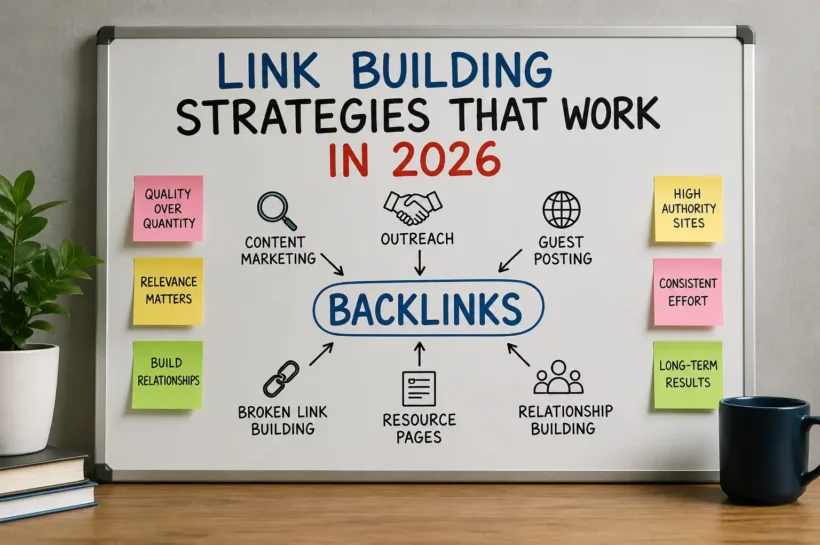

Proven Link Building Strategies That Work in 2026
Link building is the process of acquiring hyperlinks from other websites to your own, helping search engines understand your site’s credibility and relevance. Backlinks remain one of Google’s top ranking factors, as confirmed by multiple industry studies, including research from Backlinko showing a strong correlation between backlinks and rankings. Today, effective link building means earning high-quality, relevant links rather than chasing volume. Modern strategies focus on value, trust, and user intent, ensuring links come naturally through useful content, relationships, and authority-building efforts that align with Google’s evolving algorithms and quality guidelines.
How Link Building Has Evolved
Link building has shifted dramatically from early SEO practices where quantity often outweighed quality. In the past, tactics like directory submissions and link farms worked temporarily, but updates like Google Penguin changed the landscape by penalizing manipulative links. Today, search engines prioritize relevance, authority, and authenticity. Modern link building emphasizes editorial links, brand mentions, and contextual placement. Studies show that websites with fewer but higher-authority links consistently outperform those with large volumes of low-quality links, highlighting the importance of trust and niche relevance in current SEO strategies.
Key Principles of Effective Link Building
Successful link building relies on a few core principles that align with search engine expectations. Relevance is more important than sheer volume, meaning links should come from websites within your niche. Authority and trust signals, such as domain strength and editorial standards, play a crucial role. Natural link acquisition is essential, avoiding manipulative tactics. Anchor text diversity prevents over-optimization penalties, while contextual placement ensures links add real value. Research from Ahrefs indicates that pages with diverse and natural link profiles are significantly more likely to rank in competitive search results.
Top Link Building Strategies That Work Today
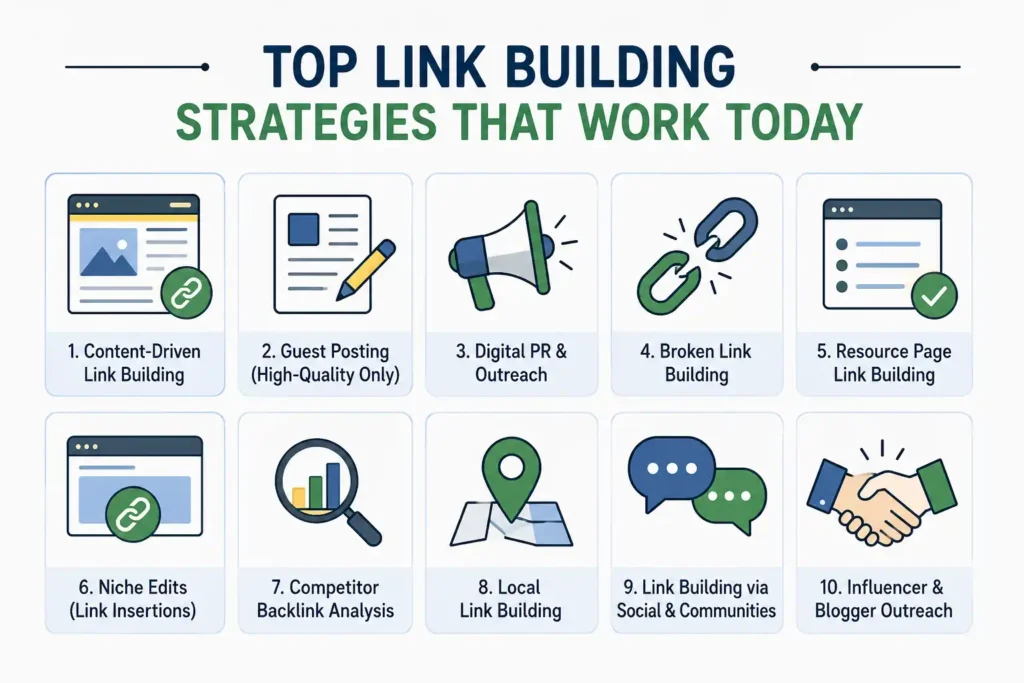
Content-Driven Link Building
Content-driven link building focuses on creating valuable assets that naturally attract backlinks. This includes in-depth guides, original research, and data-backed articles that others want to reference. The updated skyscraper technique emphasizes improving existing top content rather than copying it. Studies show that long-form content exceeding 2,000 words earns more backlinks on average. By focusing on usefulness, clarity, and uniqueness, content becomes a magnet for organic links and shares across the web.
Guest Posting (High-Quality Only)
Guest posting remains effective when done with quality in mind. The key is targeting relevant, authoritative websites and offering genuinely useful content. Personalized outreach increases acceptance rates, while well-researched articles build credibility. According to industry surveys, guest blogging still ranks among the top link-building tactics when focused on niche authority. Avoid spammy networks and prioritize relationships, ensuring each guest post delivers value to readers rather than just serving as a link placement opportunity.
Digital PR & Outreach
Digital PR combines traditional public relations with SEO to earn high-authority backlinks from media sites. Building relationships with journalists and bloggers is essential, often through platforms like HARO. Data shows that PR-driven campaigns can generate links from domains with significantly higher authority than standard outreach. Crafting compelling, newsworthy stories and personalized pitches increases success rates, making digital PR one of the most scalable and impactful modern link-building strategies.
Broken Link Building
Broken link building involves finding dead links on websites and suggesting your content as a replacement. This strategy works because it helps site owners fix issues while gaining a backlink. Tools like Ahrefs or Screaming Frog can identify broken links efficiently. Research indicates that outreach campaigns offering solutions, rather than requests, achieve higher response rates. When scaled properly, this method can consistently generate high-quality, relevant backlinks.
💚 You might also like: Freelancing vs Business: Start Smart in 2026
Resource Page Link Building
Resource pages are curated lists of useful links within a niche, making them ideal for earning backlinks. The strategy involves identifying relevant pages and pitching your content as a valuable addition. Studies show that links from curated resource pages tend to be highly relevant and contextually strong, which positively impacts rankings and referral traffic when approached with a value-first mindset.
Niche Edits (Link Insertions)
Niche edits involve placing your link into existing content on relevant websites. This strategy can be effective when done ethically and with high-quality content. The key is identifying pages that already rank well and ensuring your link adds genuine value. While it can deliver quick results, risks include penalties if done in a manipulative way. Best practices focus on relevance, natural integration, and avoiding paid link schemes that violate Google guidelines.
Competitor Backlink Analysis
Analyzing competitor backlinks helps uncover proven link-building opportunities. By using tools like Ahrefs or SEMrush, you can identify where competitors are getting their links and replicate high-quality ones. Research shows that many top-ranking pages share overlapping backlink sources. This strategy saves time by focusing on links that already work within your niche, allowing you to build a stronger, data-driven link profile.
Local Link Building
Local link building focuses on acquiring links from geographically relevant sources. This includes local directories, business partnerships, and community sponsorships. Google values local relevance, especially for location-based searches. Studies highlight that consistent local citations improve visibility in local search results. Engaging with local communities and organizations not only builds links but also strengthens brand presence and trust within a specific region.
Link Building via Social & Communities
Social platforms and online communities like Reddit and Quora offer indirect link-building opportunities. While most links are nofollow, they drive traffic and visibility, which can lead to organic backlinks. The key is contributing valuable insights rather than spamming links. Data suggests that content gaining traction in communities often attracts natural links from bloggers and journalists, making this a supportive strategy for broader link-building efforts.
Influencer & Blogger Outreach
Influencer outreach involves collaborating with niche experts and bloggers to earn backlinks and brand mentions. Identifying relevant influencers and offering mutual value is essential. Studies show that influencer collaborations can significantly boost referral traffic and link acquisition. Whether through product reviews, interviews, or partnerships, this strategy builds both authority and visibility when executed authentically.
Advanced Link Building Techniques
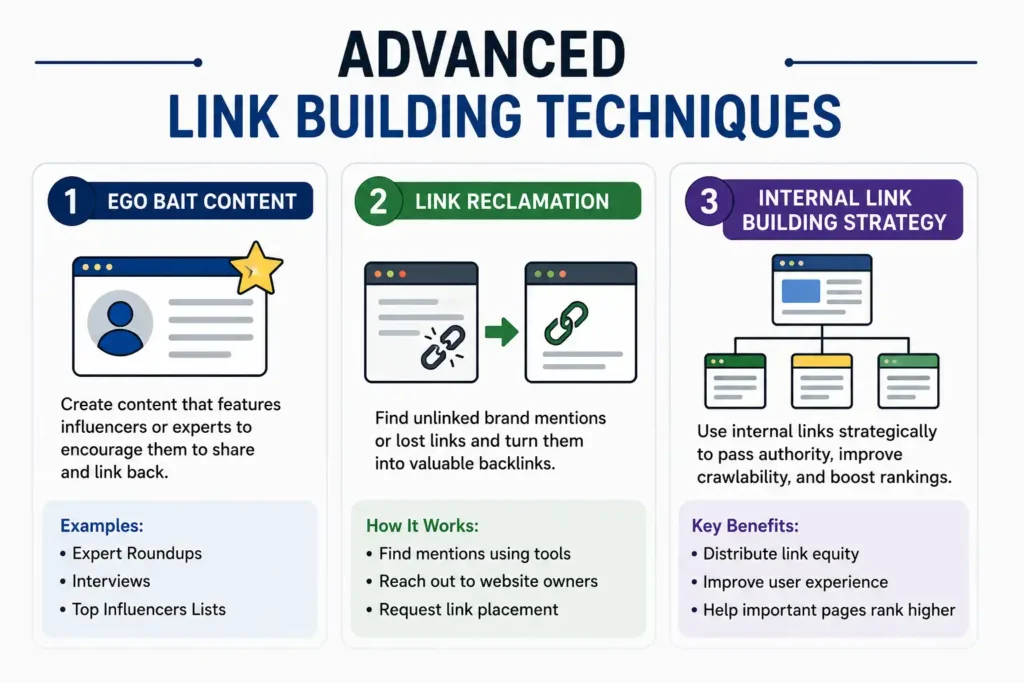
Ego Bait Content
Ego bait content involves featuring influencers or experts in your content to encourage them to share or link back. This includes roundup posts, expert opinions, and curated lists. Research shows that people are more likely to promote content where they are mentioned, increasing its reach and backlink potential. When executed strategically, ego bait can generate natural links and amplify brand exposure.
Link Reclamation
Link reclamation focuses on recovering lost backlinks or turning unlinked brand mentions into active links. Tools can identify mentions of your brand without links, creating easy outreach opportunities. Studies indicate that reclaiming links often has a higher success rate than cold outreach because the site already recognizes your brand. This makes it one of the most efficient ways to strengthen your backlink profile.
Internal Link Building Strategy
Internal linking helps to deliver authority to your entire website and improves crawlability. A well-structured internal linking strategy ensures important pages receive more visibility. Research from SEO experts shows that strategic internal links can significantly boost rankings for target pages. Using descriptive anchor text and maintaining a logical site structure enhances both user experience and search engine understanding of your content hierarchy.
Link Building Tools You Should Use
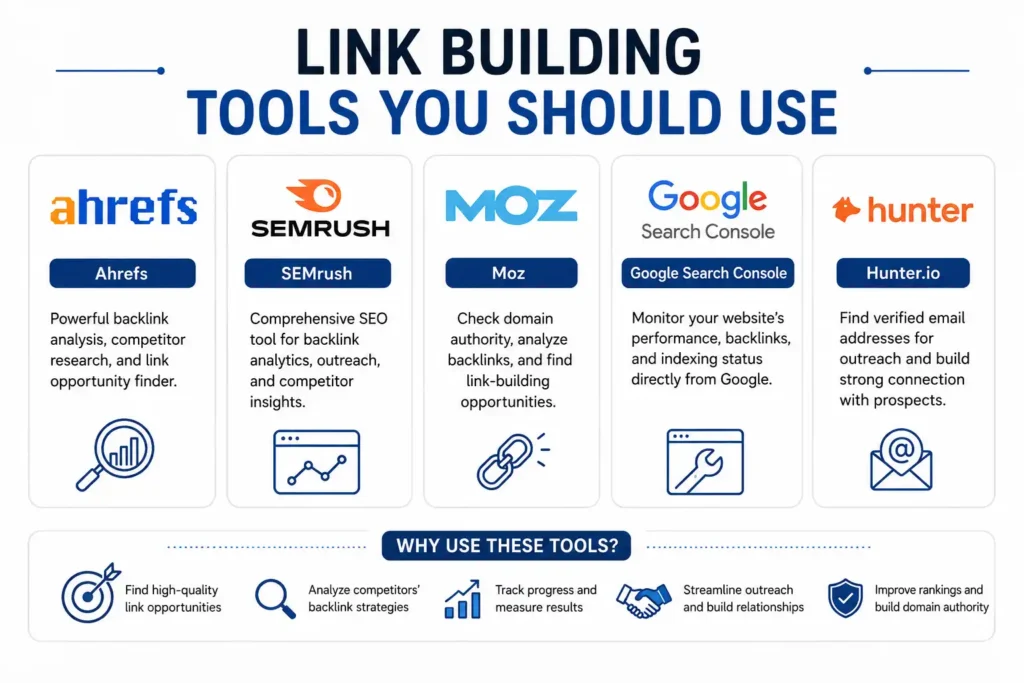
Using the right tools can significantly improve the efficiency and results of your link-building campaigns. Platforms like Ahrefs and SEMrush provide detailed backlink analysis, competitor insights, and outreach opportunities. Moz offers domain authority metrics, while Google Search Console helps monitor your site’s performance and backlinks directly from Google. For outreach, Hunter.io simplifies finding contact emails. Studies show that SEO professionals using data-driven tools are more likely to achieve consistent ranking improvements and build high-quality backlink profiles.
Common Link Building Mistakes to Avoid
Many websites struggle with SEO because of avoidable link-building mistakes. Buying low-quality links may offer short-term gains but often leads to penalties, as Google’s spam updates target unnatural link patterns. Over-optimized anchor text can also trigger algorithmic filters. Ignoring relevance reduces the value of backlinks, while automated link-building tools often generate spammy links. Additionally, focusing only on dofollow links overlooks the importance of a natural backlink profile. Research shows that balanced, organic link profiles perform better long term, making it essential to prioritize quality, diversity, and ethical practices.
How to Measure Link Building Success
Measuring link-building success requires focusing on meaningful metrics rather than vanity numbers. Key indicators include Domain Authority (DA), Domain Rating (DR), organic traffic growth, and keyword rankings. Tools like Ahrefs help track new and lost backlinks, while Google Search Console provides performance insights. ROI can be evaluated by analyzing traffic conversions and ranking improvements. Studies suggest that consistent link acquisition from authoritative domains leads to sustainable SEO growth, making ongoing monitoring and quality assessment essential.
White Hat vs Black Hat Link Building
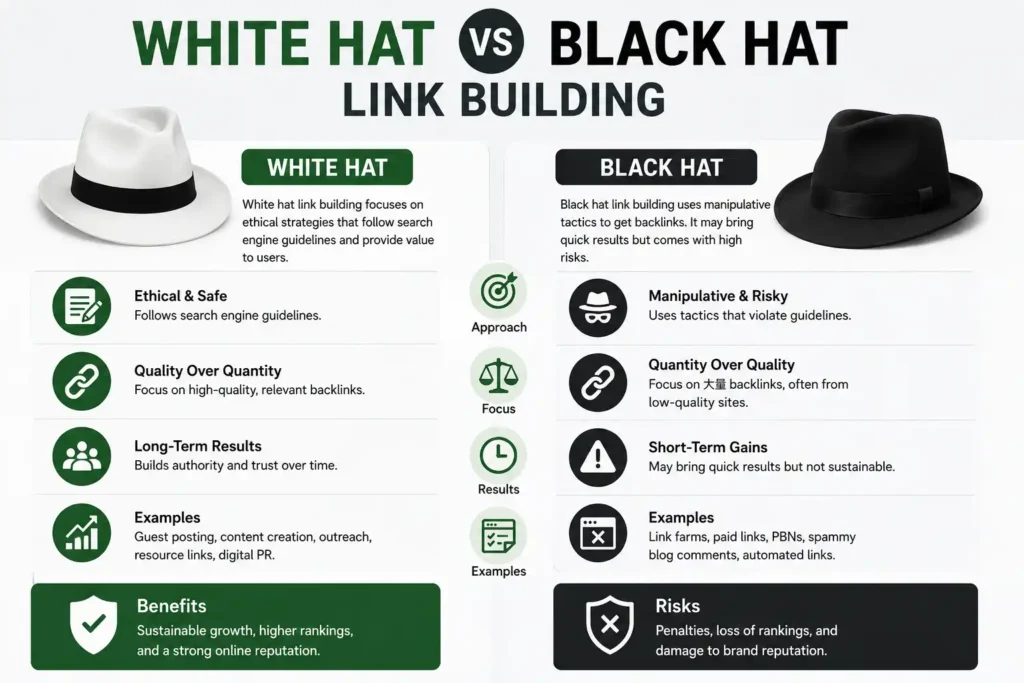
White hat link building focuses on ethical strategies aligned with Google guidelines, such as creating valuable content and earning editorial links. In contrast, black hat techniques involve manipulative practices like link schemes and spam networks. While black hat methods may deliver quick results, they carry significant risks, including penalties and ranking loss. Research shows that websites using white hat strategies achieve more stable, long-term growth. Focusing on trust, relevance, and user value ensures sustainable success and protects your site from algorithm updates.
Upcoming changes in Link Building
The future of link building is increasingly shaped by AI and evolving search engine algorithms. Google is placing more emphasis on E-E-A-T (Experience, Expertise, Authoritativeness, Trustworthiness), making brand authority crucial. AI tools are streamlining outreach and content creation, but quality remains the key differentiator. Studies indicate that search engines are getting better at identifying natural link patterns and user intent. As a result, strategies will continue shifting toward relationship building, high-value content, and genuine brand mentions rather than traditional link acquisition tactics.
FAQs :-
How much time is required to link building to show results?
Link building is a long-term strategy. Typically, you may start seeing results within 3 to 6 months, depending on your niche, competition, and the quality of links acquired. Consistency plays a key role in achieving sustainable growth.
Is guest posting still effective in 2026?
Yes, guest posting is still effective when done on relevant, high-authority websites. The key is to provide valuable content rather than focusing only on getting backlinks, ensuring long-term SEO benefits.
What are toxic backlinks, and should I remove them?
Toxic backlinks are low-quality or spammy links that can harm your website’s SEO. It’s important to monitor your backlink profile and disavow harmful links using tools like Google Search Console if necessary.
How many backlinks do I need to rank on Google?
There is no fixed number. Ranking depends on the quality, relevance, and authority of backlinks compared to your competitors. A few high-quality links can outperform hundreds of low-quality ones.
Which tools are best for link building?
Popular tools include Ahrefs, SEMrush, Moz, and Google Search Console. These tools help with backlink analysis, tracking, and outreach opportunities.
Conclusion
Effective link building is no longer about quantity but about building trust, authority, and relevance. Strategies like content creation, outreach, and relationship building consistently deliver results when executed properly. Avoiding common mistakes and using the right tools can significantly improve outcomes. As search engines evolve, focusing on user value and ethical practices will remain essential. By prioritizing quality and consistency, businesses can build a strong backlink profile that supports long-term SEO growth and sustainable online visibility.
✨ Your daily tech edge starts here. Follow Tech Fueler.