
Introduction
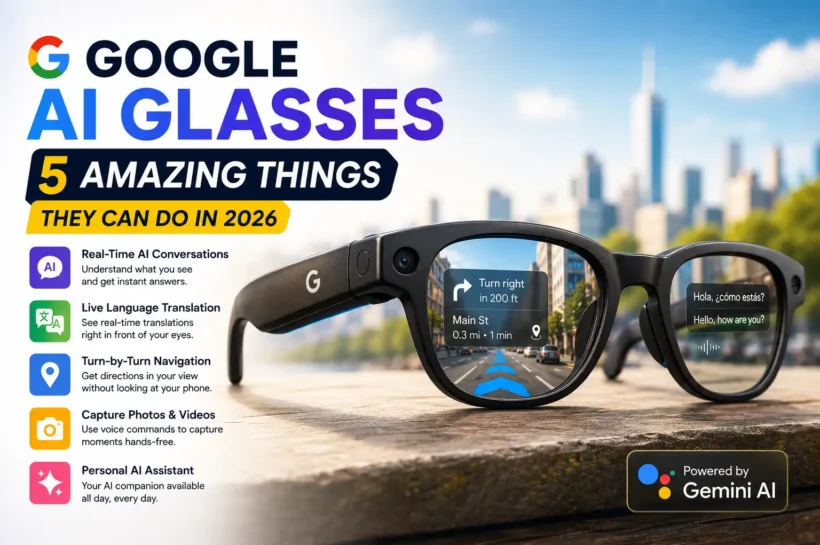
Google AI Glasses are quickly becoming one of the most talked-about innovations in wearable technology. Powered by advanced artificial intelligence and Google’s growing Android XR ecosystem, these smart glasses aim to change how people interact with digital information throughout the day. Instead of constantly checking a smartphone, users can access helpful information directly in their field of view. From live translations and navigation to visual AI assistance, the technology promises a more natural way to stay connected. As Google continues developing AI-powered hardware, many experts believe these glasses could become one of the most important consumer tech products of 2026.
What Are Google AI Glasses?
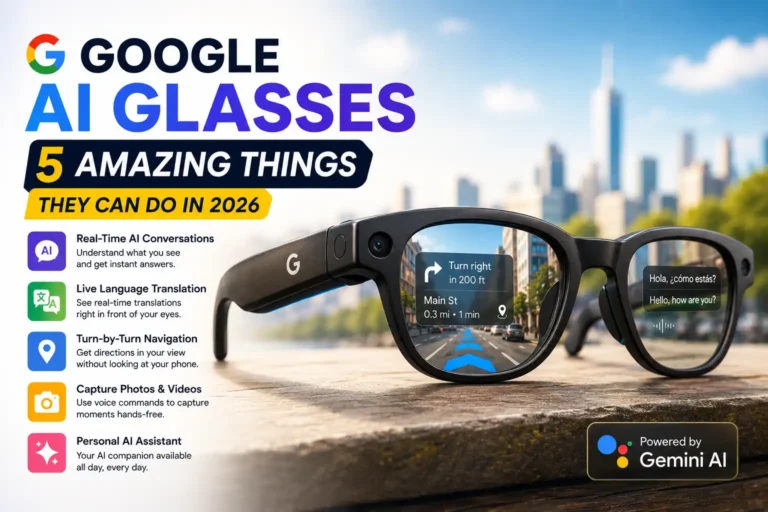
Google AI Glasses are next-generation smart glasses designed to combine artificial intelligence, augmented reality, and hands-free computing into a lightweight wearable device. Built around Google’s Gemini AI technology and Android XR platform, the glasses can understand what users see, hear, and ask in real time. Unlike traditional smart glasses that focus mainly on notifications or media, Google’s vision centers on creating an intelligent assistant that stays available throughout the day. Users can receive contextual information, translate conversations, navigate unfamiliar places, and complete tasks without reaching for a phone. The goal is to make technology feel more seamless and naturally integrated into everyday life.
5 Amazing Things Google AI Glasses Can Do in 2026
Amazing Thing #1
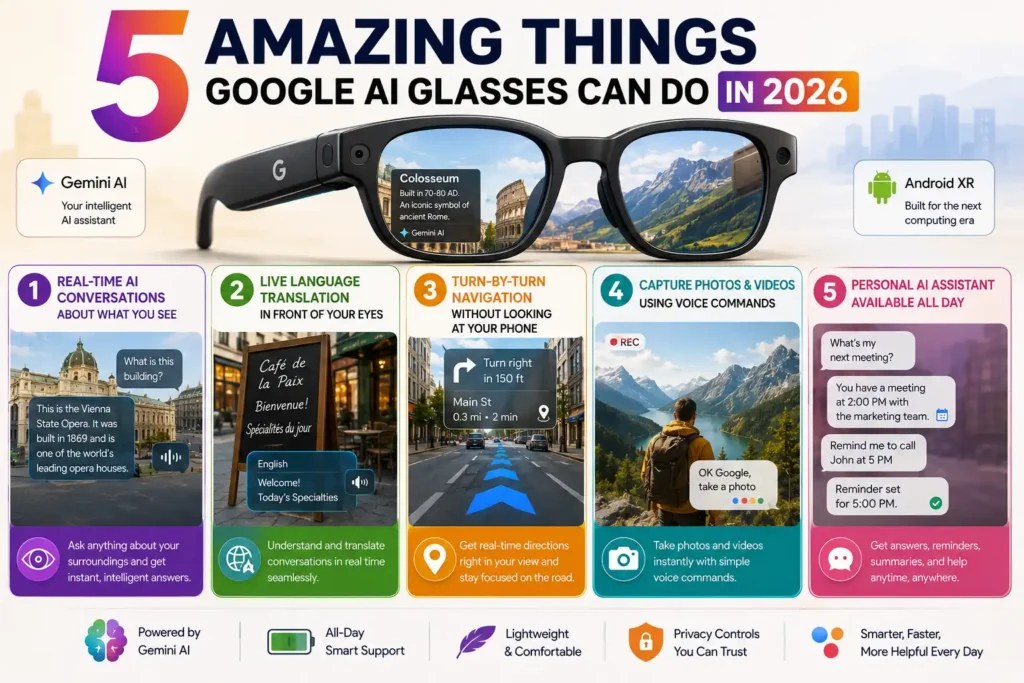
One of the most impressive features of Google AI Glasses is their ability to have real-time conversations about the surrounding environment. Using built-in cameras and Gemini AI, the glasses can analyze objects, landmarks, signs, products, and other visual information instantly. For example, a user could look at a historic building and ask for details about its history or point toward a product and request specifications or reviews. The AI understands visual context and responds naturally through audio or visual prompts. This creates a more interactive experience where information becomes available exactly when needed, making everyday learning significantly easier and faster.
Amazing Thing #2
Google AI Glasses are expected to make communication across different languages much easier through real-time translation capabilities. When someone speaks a foreign language, translated text can appear directly within the user’s view, allowing conversations to flow more naturally. Google has already demonstrated advanced translation technology through products like Google Translate, and AI glasses take this concept even further. Travelers, business professionals, and students could benefit from instant language support without needing to constantly check a phone. By combining speech recognition, AI processing, and visual displays, Google aims to remove language barriers and create smoother communication experiences worldwide.
Amazing Thing #3
Navigation becomes much more convenient when directions appear directly in front of your eyes. Google AI Glasses can potentially display turn-by-turn instructions while walking, cycling, or driving, helping users stay focused on their surroundings. Instead of repeatedly unlocking a smartphone to check maps, visual prompts can guide users in real time. This hands-free experience reduces distractions and makes travel more efficient. Because Google Maps already powers navigation for millions of people worldwide, integrating that technology into smart glasses creates a natural extension of existing services. The result is a more seamless and safer way to explore unfamiliar locations.
💚 You might also like :- Pasonet :- Smart & Flexible Digital Networking Platform
Amazing Thing #4
Google AI Glasses may allow users to capture photos and videos instantly through simple voice commands. Instead of pulling out a smartphone during important moments, users can record experiences naturally while keeping their hands free. Whether documenting travel adventures, family gatherings, or daily activities, the glasses make content creation faster and more convenient. Voice-controlled photography also helps users stay engaged with their surroundings rather than focusing on camera settings. As wearable cameras continue to improve, Google AI Glasses could provide high-quality image capture while integrating AI features that automatically organize, enhance, and manage visual content.
Amazing Thing #5
Perhaps the most powerful feature of Google AI Glasses is the ability to provide a personal AI assistant throughout the day. Powered by Gemini AI, the glasses can answer questions, summarize information, set reminders, manage schedules, and offer contextual assistance whenever needed. Unlike smartphone assistants that require users to stop and interact with a screen, AI glasses enable continuous support in a more natural way. The assistant can understand location, surroundings, and ongoing tasks to provide more relevant recommendations. This constant accessibility transforms artificial intelligence from an occasional tool into a practical companion that helps improve productivity and daily decision-making.
💚 You might also like :- WhatsApp Automation: Complete Guide for Businesses
How Google AI Glasses Vs Other Smart Glasses
Google AI Glasses stand out from many existing smart glasses because they focus heavily on artificial intelligence rather than simply recording videos or displaying notifications. While products such as Meta and Ray-Ban smart glasses emphasize camera functionality and voice assistance, Google’s approach combines visual understanding, real-time conversations, live translation, and contextual awareness through Gemini AI. The Android XR platform also gives Google an advantage by connecting smart glasses with a broader ecosystem of apps and services. Although official specifications are still limited, Google AI Glasses appear designed to function as an intelligent companion rather than just another wearable gadget.
How Google AI Glasses vs Other Smart Glasses
| Feature | Google AI Glasses (Expected) | Other Smart Glasses (e.g., Meta Ray-Ban) |
| Core Focus | Advanced AI + real-time understanding | Media capture + basic AI assistant |
| AI Capability | Gemini AI with visual context awareness | Limited AI voice commands |
| Display Type | Light AR / heads-up information overlay | Mostly no display, audio-based feedback |
| Real-Time Translation | Expected built-in live translation | Not fully advanced or limited |
| Camera Usage | AI-assisted photo/video with context | Standard photo and video capture |
| Ecosystem | Deep Android XR + Google services integration | Mainly tied to Meta ecosystem |
If you want, I can also turn this into a more “visual blog-style” comparison section with icons and highlighted boxes for better SEO engagement.
Pros & Cons
Pros
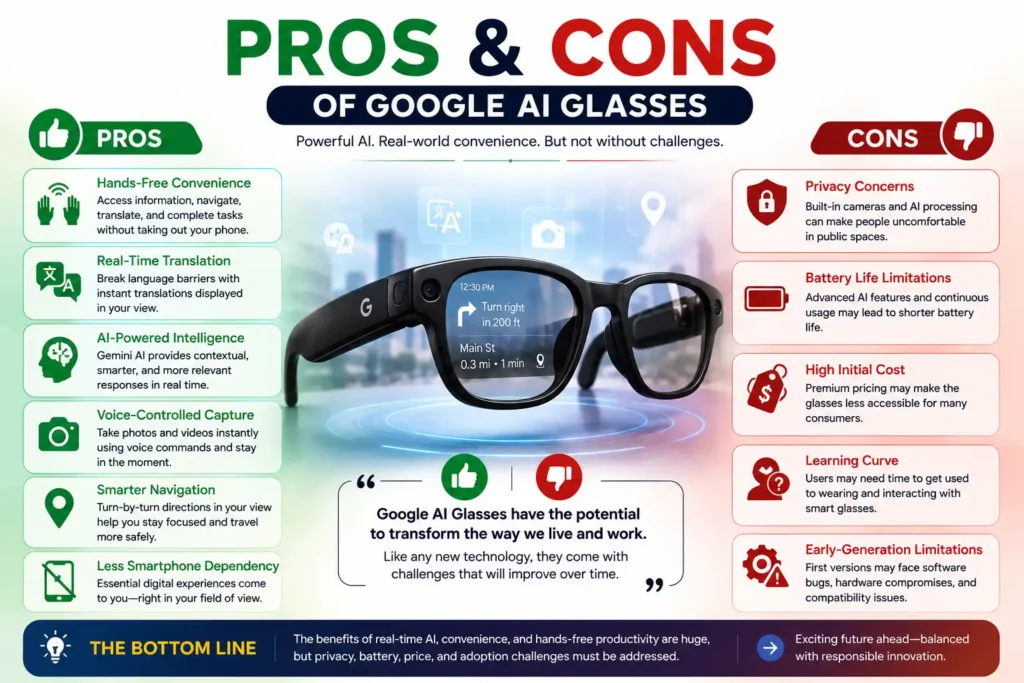
Google AI Glasses offer several advantages that could transform how people interact with technology. Hands-free access to information allows users to stay focused on their surroundings while receiving assistance when needed. Features such as real-time translation, AI-powered visual recognition, voice-controlled photography, and navigation improve convenience throughout the day. Integration with Gemini AI provides more intelligent and context-aware responses compared to traditional voice assistants. The glasses may also reduce smartphone dependency by bringing essential digital experiences directly into the user’s field of view, creating a more natural and efficient way to access information and complete tasks.
Cons
Despite their potential, Google AI Glasses may face several challenges during adoption. Privacy concerns remain one of the biggest issues because built-in cameras and AI processing can make people uncomfortable in public spaces. Battery life could also limit extended daily use, especially when running advanced AI features continuously. Pricing may initially place the technology beyond the reach of some consumers. Additionally, users may need time to adapt to wearing smart glasses regularly. Like many first-generation devices, early versions could experience software limitations, hardware compromises, and compatibility challenges that improve over future product generations.
💚 You might also like :- 5 Best Tips to Protect Yourself From Online Scams
The More Features We Expect in Google AI Glasses and Android XR
As Google continues developing Android XR and Gemini-powered wearables, experts expect even more advanced capabilities in future versions of Google AI Glasses. Potential features include real-time object recognition, enhanced augmented reality overlays, fitness tracking, gesture controls, virtual workspace support, and deeper integration with smart home devices. AI-powered memory assistance could help users remember appointments, conversations, and important information throughout the day. Future updates may also introduce better battery efficiency, improved displays, and expanded third-party app support. If these innovations become reality, Google AI Glasses could evolve into one of the most powerful wearable computing platforms available.
FAQs
What are Google AI Glasses?
Google AI Glasses are next-generation smart glasses designed to combine artificial intelligence, augmented reality, and wearable computing. They aim to provide real-time assistance using Gemini AI, allowing users to see information, interact with the world, and complete tasks without constantly using a phone. Instead of being just a gadget, they are built as an AI-powered assistant that stays with you throughout the day.
When will Google AI Glasses launch?
Google has not officially confirmed a global release date yet. However, based on industry reports and ongoing Android XR development, many analysts expect early versions or developer-focused releases to appear first, followed by wider consumer availability in the near future. The timeline may vary depending on hardware readiness and software integration progress.
Do Google AI Glasses have a display?
Most expected versions are rumored to include a minimal heads-up display or AR overlay rather than a full immersive screen. This means users may see simple information like directions, translations, or notifications directly in their field of view without blocking real-world vision.
Can Google AI Glasses translate languages in real time?
Yes, real-time translation is one of the most expected features. Using Google’s advanced language models and speech recognition systems, the glasses can potentially display translated text or provide audio translations instantly during conversations, making communication across languages much easier.
Can Google AI Glasses take photos and videos?
Yes, they are expected to support voice-controlled photo and video capture. Users can record moments hands-free, which makes it useful for travel, content creation, and daily life documentation without needing to take out a smartphone.
Are Google AI Glasses better than Meta Ray-Ban glasses?
Compared to Meta Ray-Ban smart glasses, Google AI Glasses are expected to focus more on AI intelligence and real-time contextual understanding rather than just media capture and basic voice assistance. However, the final comparison depends on official specs, pricing, and real-world performance once both ecosystems mature.
How much will Google AI Glasses cost?
There is no confirmed price yet. Based on current smart glasses trends, early versions could fall into a premium category, likely similar to high-end wearable tech. Pricing will depend on display technology, AI processing power, and battery performance.
Will Google AI Glasses work with Android and iPhone?
They are expected to integrate best with Android devices through the Android XR ecosystem. Limited compatibility with iPhones may exist, but full feature access will likely be optimized for Android users, similar to how other Google hardware products operate.
Are Google AI Glasses safe for privacy?
Privacy is one of the biggest concerns with smart glasses. Google is expected to include indicators like recording lights, user controls, and data protection policies. However, users and regulators will likely continue to closely monitor how visual and audio data are processed and stored.
Can Google AI Glasses replace smartphones in the future?
Not completely, at least not in the very near. While they may reduce phone usage by handling navigation, translation, and quick interactions, smartphones will still be needed for heavy tasks like gaming, editing, and long-form content creation. Over time, they may become a strong secondary device.
💚 You might also like :- Oncepik: Smart & Simple Tool for Team Productivity
Conclusion
Google AI Glasses represent a major step toward a more natural and AI-driven digital experience. Instead of interacting through screens, users will be able to access information directly in their environment using voice, vision, and contextual awareness. While the technology is still evolving, its potential is significant, especially with the support of Google’s AI systems and Android XR ecosystem. If executed well, these glasses could reshape how people travel, communicate, learn, and work in everyday life. The future of wearable computing is moving closer to a world where information is always available, but never intrusive.
✨ Smart minds follow smart pages, hit follow on Tech Fueler.